
Latest Updates
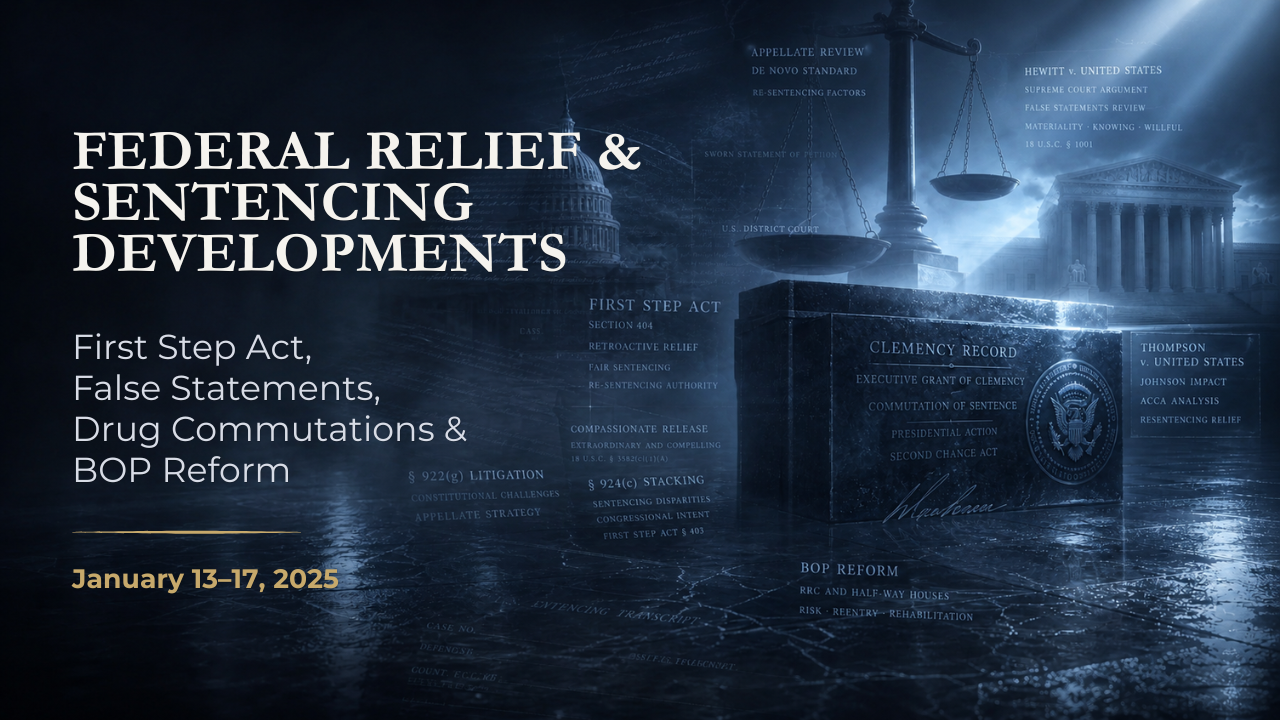
Federal Relief & Sentencing Developments — January 13–17, 2025
Supreme Court arguments involving First Step Act resentencing and false statement prosecutions, major clemency developments, BOP reform discussion, § 922(g) litigation, and compassionate release considerations.
This federal sentencing developments bulletin reviews recent Supreme Court activity, executive clemency updates, First Step Act issues, federal sentencing policy, and post-conviction relief considerations.
Federal Sentencing Developments Executive Summary
Recent federal sentencing developments include Supreme Court arguments involving whether First Step Act sentencing reforms apply after a pre-Act sentence is vacated and a defendant is resentenced after enactment.
This update also reviews Thompson v. United States, a potential white-collar criminal law case involving whether misleading but not false statements can support federal false statement liability, along with President Biden’s large-scale drug-sentence commutations and First Step Act reform discussion during the Attorney General confirmation process.
Supreme Court Watch
First Step Act Resentencing — Hewitt v. United States
The Supreme Court heard argument in Hewitt v. United States, addressing whether First Step Act sentencing reduction provisions apply when a defendant was originally sentenced before the Act but later resentenced after the original sentence was vacated.
Federal Relief Consideration: The decision may affect defendants whose older sentences were vacated and who face resentencing under post-First Step Act law, especially where mandatory minimums or stacked sentencing provisions are involved.
False Statement Prosecutions — Thompson v. United States
The Supreme Court also heard argument in Thompson v. United States, involving whether federal false statement law applies to statements that may be misleading but are not literally false.
Federal Relief Consideration: This case may affect white-collar prosecutions and other federal false statement cases where the government relied on ambiguity, misleading impressions, or incomplete statements rather than clear falsity.
Federal Appellate Developments
No favorable federal circuit opinions were reported during this period. However, Supreme Court arguments and executive clemency developments made this an important week for federal sentencing and relief monitoring.
Clemency Developments
President Biden Commutes Nearly 2,500 Drug Sentences
President Biden announced commutations for nearly 2,500 people convicted of nonviolent drug offenses who were serving lengthy sentences compared to what they might receive under current law, policy, and practice.
The clemency action focused on outdated drug sentencing rules, crack-powder disparities, and prior sentencing enhancements that produced disproportionately long prison terms.
Federal Relief Consideration: Clemency, commutation, and pardon relief are separate from court-based litigation. They may be relevant where judicial remedies are unavailable, exhausted, or limited by procedural barriers.
First Step Act & BOP Reform Discussion
Attorney General nominee Pam Bondi discussed the First Step Act, Bureau of Prisons reform, halfway houses, recidivism reduction, and federal corrections improvements during Senate confirmation proceedings.
Federal Relief Consideration: BOP reform, First Step Act implementation, halfway house placement, earned time credits, and reentry planning remain important issues for federal prisoners and families monitoring release pathways.
§ 922(g) Firearm Litigation & Compassionate Release
Federal litigation continued involving Second Amendment challenges to § 922(g) firearm convictions, especially where prior convictions were nonviolent or non-drug-related.
Several circuits also continued allowing courts to consider nonretroactive § 403(a) changes to old stacked § 924(c) sentences as part of compassionate release analysis when combined with other individualized factors.
Federal Relief Consideration: Firearm and compassionate release arguments depend heavily on the record, including prior convictions, offense conduct, sentence length, rehabilitation, medical concerns, family circumstances, and current circuit law.
Related resource: Compassionate Release
Why These Federal Sentencing Developments Matter
These developments show how federal relief issues may arise from First Step Act resentencing, false statement prosecutions, clemency, BOP reform, § 922(g) litigation, and compassionate release law.
Federal relief analysis is highly case-specific. Sentencing records, plea agreements, prior conviction documents, clemency materials, BOP records, and appellate history may all affect whether a development applies.