
Latest Updates
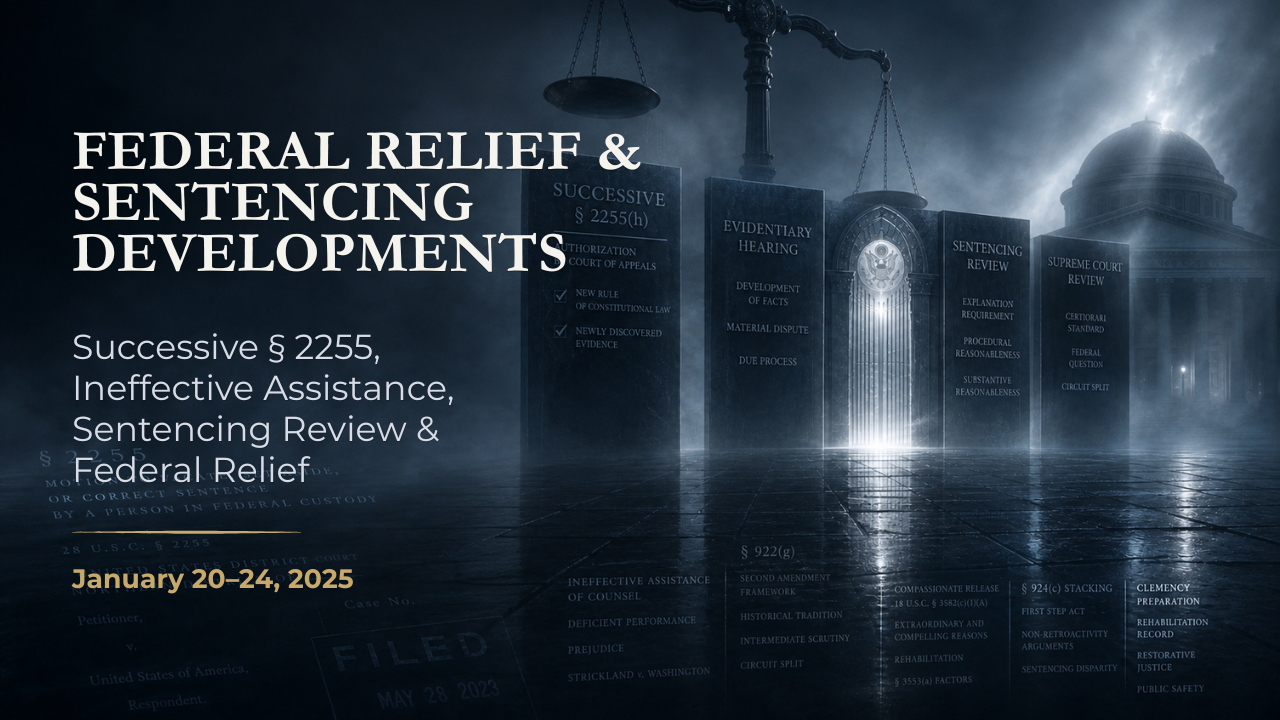
Federal Relief & Sentencing Developments — January 20–24, 2025
Supreme Court review of successive § 2255 procedure, ineffective assistance claims, evidentiary hearing requirements, sentencing explanation errors, § 922(g) litigation, clemency considerations, and compassionate release developments.
This federal sentencing developments bulletin reviews recent Supreme Court activity and appellate decisions affecting federal post-conviction relief, sentencing review, ineffective assistance claims, and federal relief strategy.
Federal Sentencing Developments Executive Summary
Recent federal sentencing developments include Supreme Court review in Bowe v. United States, involving successive § 2255 procedure and certiorari jurisdiction.
This update also reviews Fourth Circuit decisions involving ineffective assistance claims requiring an evidentiary hearing and sentencing explanation errors requiring resentencing.
Supreme Court Watch
Successive § 2255 Procedure — Bowe v. United States
The Supreme Court granted review in Bowe v. United States, a case involving whether rules governing second or successive habeas applications also apply to successive § 2255 motions.
The case also raises whether the Supreme Court has certiorari jurisdiction to review a court of appeals decision granting or denying authorization to file a successive § 2255 motion.
Federal Relief Consideration: This case may affect federal post-conviction procedure, especially for individuals seeking permission to file second or successive § 2255 motions.
Favorable Federal Appellate Decisions
Ineffective Assistance Claims Require Evidentiary Hearing — Fourth Circuit
In United States v. McNeil, the Fourth Circuit vacated the denial of a § 2255 motion and remanded for an evidentiary hearing.
The defendant alleged ineffective assistance of counsel based on counsel’s failure to pursue suppression issues and failure to seek a plea agreement despite repeated requests.
The appellate court concluded that the ineffective assistance claims could not be resolved on the limited record before the court.
Federal Relief Consideration: § 2255 claims may require evidentiary hearings where the existing record does not conclusively resolve whether counsel performed deficiently or whether prejudice occurred.
Sentencing Explanation Error — Fourth Circuit
In United States v. Shields, the Fourth Circuit vacated a sentence after concluding that the district court failed to address a non-frivolous argument for a downward variance.
The appellate court found the sentence procedurally unreasonable because the district court did not adequately explain the sentence imposed.
Federal Relief Consideration: Sentencing transcripts may require review where the court failed to address mitigation arguments, downward variance requests, or individualized sentencing factors.
Related resource: Understanding Federal Sentencing
§ 922(g) Firearm Litigation & Compassionate Release
Federal courts continued addressing Second Amendment challenges involving § 922(g) firearm convictions, especially where the prior conviction was nonviolent or non-drug-related.
Several circuits also continued allowing courts to consider nonretroactive § 403(a) changes to old stacked § 924(c) sentences as part of compassionate release analysis when combined with other individualized factors.
Federal Relief Consideration: Firearm and compassionate release arguments remain highly case-specific. Prior convictions, offense conduct, sentencing history, rehabilitation, medical issues, family circumstances, and current circuit law may all matter.
Related resource: Compassionate Release
Clemency Considerations
This reporting period also included discussion of clemency preparation for individuals seeking executive relief.
Federal Relief Consideration: Clemency, commutation, and pardon requests are separate from court-based relief and may be relevant where judicial remedies are unavailable or exhausted.
Why These Federal Sentencing Developments Matter
These developments show how federal relief issues may arise from successive § 2255 procedure, ineffective assistance claims, evidentiary hearing denials, sentencing explanation errors, § 922(g) litigation, and compassionate release law.
Federal relief analysis is highly case-specific. Plea records, suppression issues, sentencing transcripts, § 2255 filings, prior conviction documents, and appellate history may all affect whether a development applies.