
Latest Updates
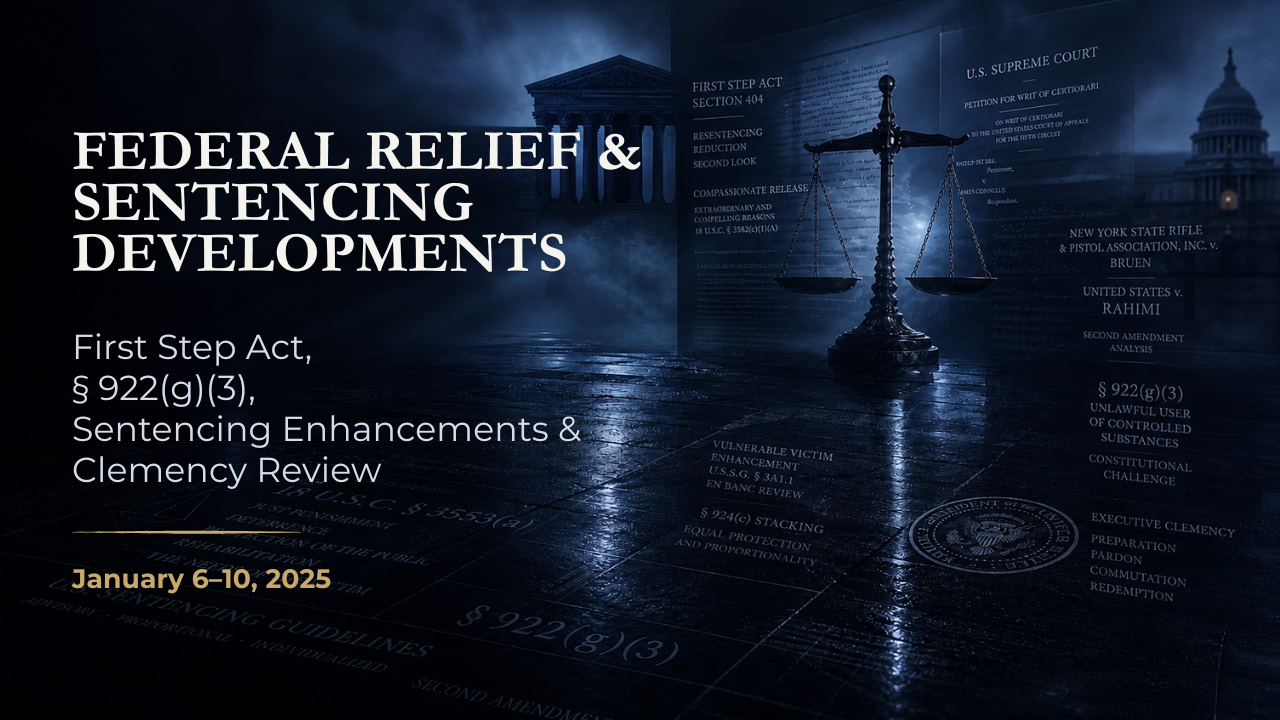
Federal Relief & Sentencing Developments — January 6–10, 2025
Supreme Court activity involving First Step Act resentencing, federal sentencing enhancement errors, § 922(g)(3) Second Amendment litigation, compassionate release considerations, and clemency developments.
This federal sentencing developments bulletin reviews recent Supreme Court activity and appellate decisions affecting federal firearm convictions, sentencing enhancements, post-conviction review, and federal relief strategy.
Federal Sentencing Developments Executive Summary
Recent federal sentencing developments include Supreme Court monitoring of Hewitt v. United States, a case involving whether First Step Act sentencing reductions apply after a pre-Act sentence is vacated and resentencing occurs after the Act’s enactment.
This update also reviews Fourth Circuit sentencing enhancement issues and a Fifth Circuit decision involving § 922(g)(3), marijuana use, and Second Amendment limits after Rahimi and Connelly.
Supreme Court Watch
First Step Act Resentencing — Hewitt v. United States
The Supreme Court was scheduled to hear argument in Hewitt v. United States, addressing whether First Step Act sentencing reduction provisions apply when an original pre-Act sentence is vacated and a new sentence is imposed after the Act.
Federal Relief Consideration: This issue may affect defendants with older sentences that were later vacated, especially where resentencing involves harsh mandatory minimums, stacked firearm counts, or sentencing reforms Congress later changed.
Favorable Federal Appellate Decisions
Vulnerable Victim Enhancement & Sentencing Findings — Fourth Circuit
In United States v. Luong, the Fourth Circuit vacated a sentence after finding problems with the district court’s application of a vulnerable victim enhancement under U.S.S.G. § 3A1.1(b)(1).
The appellate court remanded for resentencing after the defendant challenged both the evidentiary basis for the enhancement and the lack of supporting factual findings.
Federal Relief Consideration: Sentencing enhancements may require review where the district court failed to make adequate factual findings or where the record does not support the enhancement applied.
§ 922(g)(3), Marijuana Use & Second Amendment Review — Fifth Circuit
In United States v. Daniels, the Fifth Circuit again reversed a § 922(g)(3) conviction after reconsideration in light of Rahimi.
The court concluded that disarming a person solely based on prior, occasional, or habitual marijuana use was not consistent with the nation’s historical tradition of firearm regulation where the jury did not necessarily find present or recent unlawful drug use.
Federal Relief Consideration: § 922(g)(3) cases may require fact-specific review involving timing of drug use, firearm possession, intoxication, dangerousness, jury findings, and current circuit law.
§ 922(g) Firearm Litigation & Compassionate Release
Federal courts continued addressing Second Amendment challenges involving § 922(g) firearm convictions, especially after Bruen, Rahimi, Range, and related circuit decisions.
Several circuits also continued allowing courts to consider nonretroactive § 403(a) changes to older stacked § 924(c) sentences as part of compassionate release analysis when combined with other individualized factors.
Federal Relief Consideration: Firearm and compassionate release arguments remain highly case-specific. Prior convictions, offense conduct, sentencing history, rehabilitation, medical circumstances, family circumstances, and current circuit law may all matter.
Related resource: Compassionate Release
Clemency Considerations
This reporting period also included discussion of clemency preparation as the presidential transition approached.
Federal Relief Consideration: Clemency, commutation, and pardon requests are separate from court-based relief. They may be relevant where judicial remedies are unavailable, exhausted, or limited by procedural barriers.
Why These Federal Sentencing Developments Matter
These developments show how federal relief issues may arise from First Step Act resentencing, sentencing enhancement findings, § 922(g)(3) firearm litigation, compassionate release, and clemency review.
Federal relief analysis is highly case-specific. Sentencing transcripts, guideline worksheets, prior conviction records, firearm records, jury findings, plea agreements, and appellate history may all affect whether a development applies.