
Latest Updates
December 2024 Federal Sentencing Guideline Developments
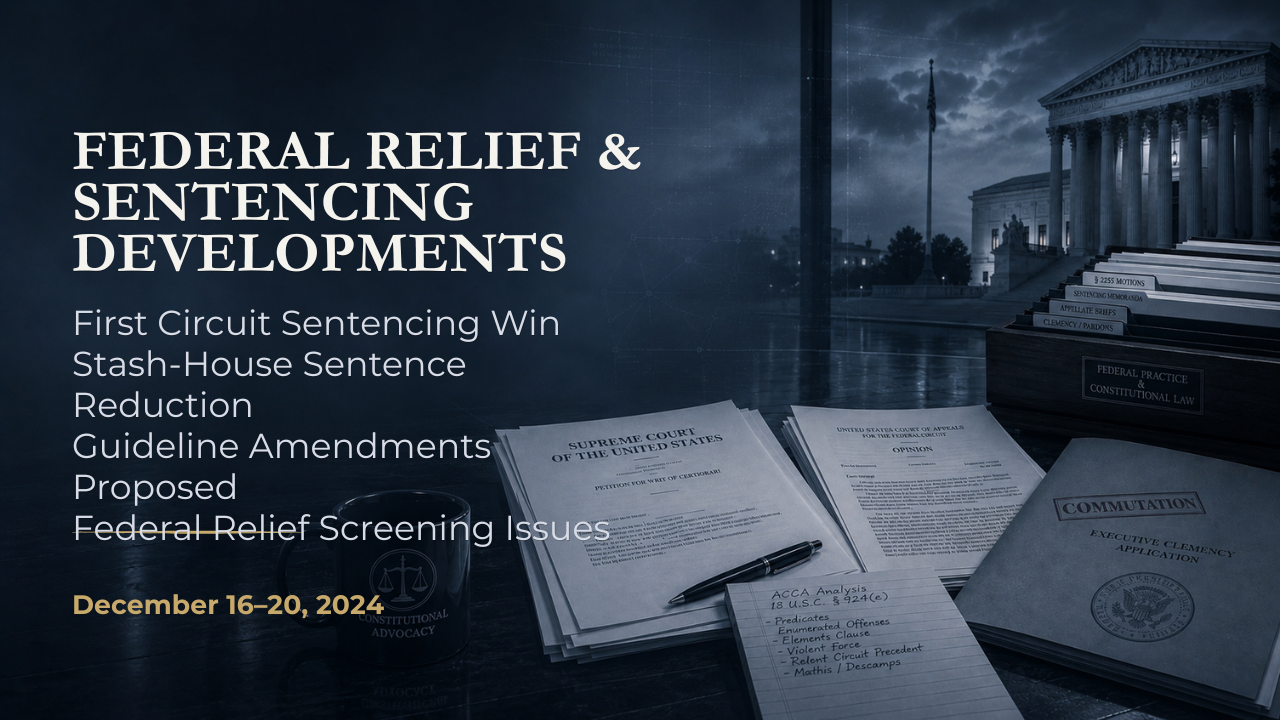
Supreme Court recess activity, a First Circuit resentencing win, compassionate-release relief in a reverse stash-house sting case, and U.S. Sentencing Commission proposed guideline amendments for the week of December 16–20, 2024.
Federal Sentencing Developments Overview
December 2024 Federal Sentencing Guideline Developments included a favorable First Circuit sentencing decision, a significant compassionate-release ruling in a reverse stash-house sting case, and proposed U.S. Sentencing Commission amendments that may affect future guideline litigation.
This weekly federal relief update highlights developments from December 16–20, 2024, including sentencing enhancements, compassionate release, unusually long sentences, career offender guideline proposals, firearms guideline issues, and post-conviction screening considerations.
This federal relief update is provided for educational and informational purposes only. It is not legal advice and does not create legal representation.
Supreme Court Watch
Christmas Recess and No New Grants
The Supreme Court did not hold a regular conference during the week ending December 20, 2024, because the Justices were in Christmas recess. No new case grants were reported during the week.
Federal Relief Consideration: Even during weeks without new Supreme Court grants, lower-court decisions and Sentencing Commission activity can still create important federal relief screening issues.
Favorable Federal Appellate Developments
First Circuit: Role Enhancement Vacated in United States v. Goncalves
In United States v. Goncalves, No. 23-1037, the First Circuit vacated a two-level role enhancement under U.S.S.G. § 3B1.1(c) and remanded for resentencing.
Goncalves pleaded guilty to multiple drug and firearm-related charges and received a 230-month sentence. On appeal, he challenged the district court’s finding that he acted as an organizer, leader, supervisor, or manager.
The First Circuit recognized that even one instance of directing another person may sometimes support a managerial or supervisory enhancement. However, the court found the record insufficient because it did not show by a preponderance of the evidence that the other person actually obeyed Goncalves’s alleged directive.
Federal Relief Consideration: Role enhancements under § 3B1.1 can significantly increase a guideline range. If a sentence was increased because the defendant allegedly supervised or directed another person, the record should support more than the mere existence of an instruction. It should show the factual basis required for the enhancement.
Other Federal Relief News
Sentence Reduction Granted in Reverse Stash-House Sting Case
In United States v. Evans, No. 93-00123-CR, the Southern District of Florida granted a sentence reduction in a decades-old reverse stash-house sting case.
Evans had served more than 31 years of a sentence totaling 595 months. He moved for a reduction under 18 U.S.C. § 3582(c)(1)(A), relying on extraordinary and compelling reasons recognized by the Sentencing Commission’s compassionate-release policy statement.
The court addressed two major grounds: the unusually long sentence provision under U.S.S.G. § 1B1.13(b)(6), and the catch-all provision under § 1B1.13(b)(5). The court considered the length of the sentence, changes in law, the disparity between the original sentence and a likely sentence today, and the unusual facts of the reverse stash-house sting.
Federal Relief Consideration: Reverse stash-house sting cases may deserve careful screening, especially where the sentence was unusually long, the defendant played a minor role, the drugs did not actually exist, or the sentence would likely be dramatically lower today.
U.S. Sentencing Commission Update
Commission Votes to Publish Proposed Guideline Amendments
On December 19, 2024, the United States Sentencing Commission voted unanimously to publish proposed amendments to the federal sentencing guidelines for the amendment cycle ending May 1, 2025.
The proposed amendments followed public input and comments on the Commission’s priorities for the amendment cycle.
Proposed Amendment Topics
The proposed amendments included issues that may affect future sentencing litigation and guideline interpretation, including:
- An alternative to the categorical approach used in the career offender guideline
- Simplification of the “three-step” approach courts use when applying the guidelines
- Guideline treatment of devices designed to convert firearms into fully automatic weapons
- A mens rea requirement for the stolen-firearm enhancement
- Resolution of certain circuit conflicts involving guideline application
The Commission sought public comment on the proposals through February 3, 2025, with a reply period closing February 18, 2025.
Federal Relief Consideration: Proposed guideline amendments are not the same as retroactive relief. However, they may signal future changes in sentencing practice and may help identify issues worth preserving, especially in cases involving career offender status, firearm enhancements, stolen firearms, machinegun conversion devices, and guideline-application disputes.
Clemency and Sentence-Reduction Context
During December 2024, President Biden also announced clemency for nearly 1,500 people who had been placed on home confinement during the COVID-19 pandemic and pardons for 39 individuals convicted of nonviolent crimes.
Clemency is different from court-based relief. A clemency request does not replace a direct appeal, § 2255 motion, § 2241 petition, compassionate-release motion, or sentence-reduction request. However, clemency may be relevant where a person has strong rehabilitation, reentry, humanitarian, family, disparity, or public-safety factors.
Federal Relief Consideration: Families should distinguish between legal remedies available in court and discretionary executive clemency. Both require careful preparation, but they are different pathways with different standards.
Fast Screening Considerations
A case-specific review may be especially important where any of the following issues appear in the record:
- A role enhancement under U.S.S.G. § 3B1.1 based on alleged leadership or supervision
- A sentence increased because the defendant allegedly directed another person
- A reverse stash-house sting prosecution
- An unusually long sentence compared to likely sentencing exposure today
- A compassionate-release motion based on U.S.S.G. § 1B1.13(b)(6)
- A career offender enhancement affected by the categorical approach
- Firearm guideline issues involving machinegun conversion devices
- Stolen-firearm enhancements where mens rea may matter
- Potential sentencing guideline circuit conflicts
- Clemency interest based on rehabilitation, home confinement success, disparity, or hardship
What This Means for Federal Prisoners and Families
The December 16–20, 2024 developments show why guideline details matter. A two-level role enhancement, a career offender label, a firearm enhancement, or an unusually long sentence can change the outcome of a federal case dramatically.
They also show that federal relief is often case-specific. A favorable ruling does not automatically apply to every person, but it may help identify issues that deserve review in the indictment, plea agreement, presentence report, sentencing transcript, judgment, appellate history, and prior post-conviction filings.
Why a Written Case Evaluation May Help
A written case evaluation can help identify whether a federal case involves guideline enhancements, role adjustments, reverse stash-house sting issues, compassionate-release arguments, career offender concerns, firearm guideline questions, clemency considerations, or post-conviction remedies that may deserve closer review.
Because many federal relief arguments depend on the facts, the circuit, the procedural history, and the available record, families should avoid relying on general rumor or incomplete information. A structured review can help determine what issues may actually be available.