
Latest Updates
August 2024 Federal Sentencing Retroactivity Developments
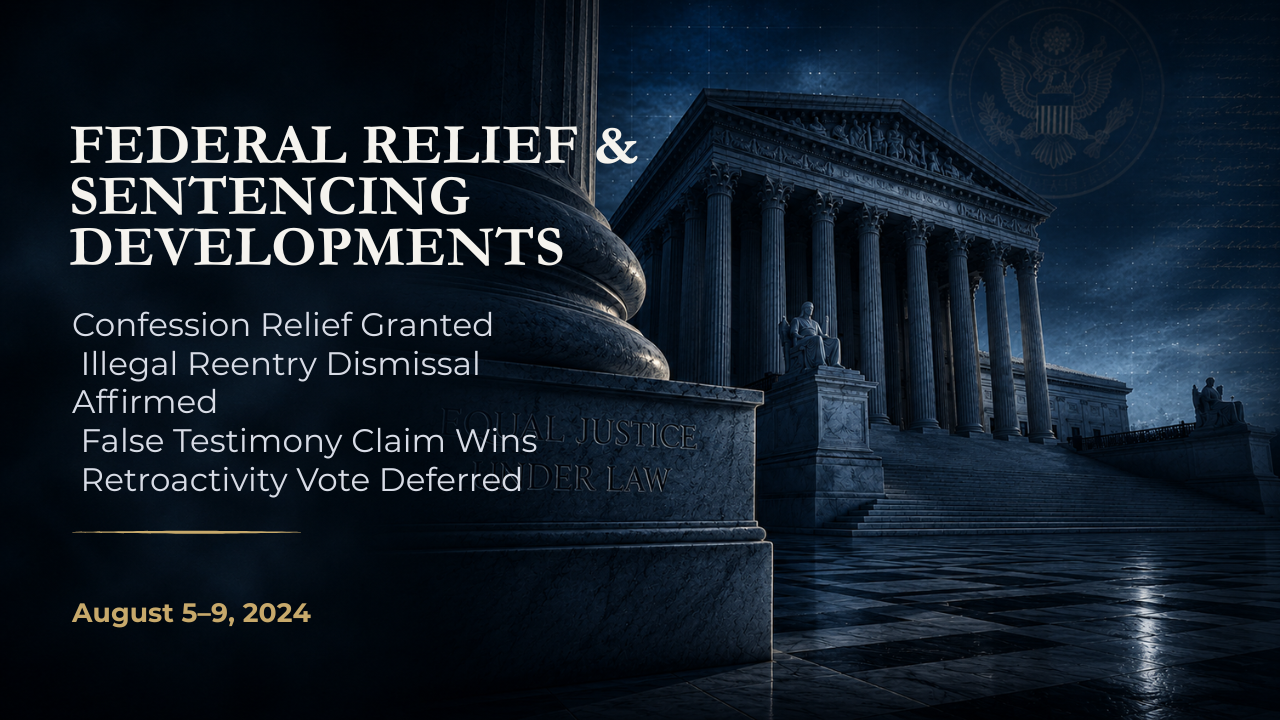
Favorable appellate decisions involving confessions, illegal reentry, false testimony, escape instructions, denaturalization, and Sentencing Commission retroactivity issues for the week of August 5–9, 2024.
Federal Sentencing Developments Overview
August 2024 Federal Sentencing Retroactivity Developments included several favorable appellate rulings involving ineffective assistance, removal-order challenges, Napue violations, jury-instruction error, denaturalization, and U.S. Sentencing Commission retroactivity questions.
This weekly update highlights developments from August 5–9, 2024, including Fifth Amendment confession issues, Sixth Amendment ineffective assistance, illegal reentry under 8 U.S.C. § 1326, false jailhouse-informant testimony, residential reentry center escape instructions, denaturalization proceedings, 2024 guideline amendments, and BOP relief statistics.
This federal relief update is provided for educational and informational purposes only. It is not legal advice and does not create legal representation.
Supreme Court Watch
Summer Recess
The Supreme Court remained in summer recess during the week ending August 9, 2024. The new term was scheduled to begin in October 2024.
Federal Relief Consideration: Even when the Supreme Court is in recess, federal circuit courts may continue applying Supreme Court precedent to criminal appeals, habeas cases, immigration-related prosecutions, and sentencing issues.
Favorable Federal Appellate Developments
Ninth Circuit: Confession and Ineffective Assistance Relief in United States v. Osorio-Arellanes
In United States v. Osorio-Arellanes, No. 20-10003, the Ninth Circuit reversed the district court’s order reconsidering suppression of a confession, vacated the convictions and sentences, and remanded for further proceedings.
Osorio argued that his confession was taken and admitted in violation of his Fifth Amendment right against self-incrimination and his Sixth Amendment right to effective assistance of counsel.
Applying Strickland v. Washington, the panel held that counsel’s performance was deficient and that the advice was prejudicial because there was a reasonable probability that, without the deficient advice, Osorio would not have been convicted of any of the charges.
Federal Relief Consideration: Cases involving damaging confessions may deserve review where counsel gave incorrect advice, failed to protect Fifth Amendment rights, or failed to properly litigate suppression issues.
Ninth Circuit: Illegal Reentry Indictment Dismissal Affirmed in United States v. Valdivias-Soto
In United States v. Valdivias-Soto, No. 20-10415, the Ninth Circuit affirmed dismissal of an illegal reentry indictment under 8 U.S.C. § 1326.
The district court dismissed the indictment after finding that the underlying removal order was invalid. The Ninth Circuit held that Valdivias satisfied § 1326(d)(1)’s administrative-exhaustion requirement despite not appealing to the Board of Immigration Appeals.
The panel explained that erroneous advice and translation errors at the removal hearing made administrative review unavailable, including confusion about the right to counsel and access to pro bono legal assistance.
Federal Relief Consideration: Illegal reentry cases may deserve review where the underlying removal hearing involved translation errors, incorrect advice about counsel, invalid waiver of rights, or unavailable administrative remedies.
Ninth Circuit: Napue Habeas Relief in Clements v. Madden
In Clements v. Madden, No. 22-55333, the Ninth Circuit reversed the denial of habeas relief on a Napue v. Illinois claim and remanded with instructions to grant relief as to aggravated kidnapping charges.
The panel held that the prosecution violated Napue by allowing a jailhouse informant to testify that he received no parole consideration and came forward for altruistic reasons, when prosecutors knew or should have known that the testimony was false.
The Ninth Circuit found materiality because there was a reasonable likelihood that the false testimony could have affected the jury’s judgment on the aggravated kidnapping counts.
Federal Relief Consideration: Habeas cases may deserve review where a jailhouse informant, cooperating witness, or government witness falsely denied receiving benefits, consideration, promises, or favorable treatment.
Eleventh Circuit: New Trial Ordered for Escape Instruction Error in United States v. Bush
In United States v. Bush, No. 22-13867, the Eleventh Circuit vacated an escape conviction and remanded for a new trial.
Bush was convicted of escaping from a residential reentry center under 18 U.S.C. §§ 751(a) and 4082(a). On appeal, he argued that the jury instruction failed to properly explain the required mens rea.
The Eleventh Circuit agreed that the district court erred by omitting the requirement that the government prove Bush acted willfully, including that he knew his conduct was unlawful.
Federal Relief Consideration: Escape or residential reentry center cases may deserve review where the jury instructions did not require proof that the defendant acted willfully or knew the conduct was unlawful.
Eleventh Circuit: Denaturalization Judgment Vacated in United States v. Munoz
In United States v. Munoz, No. 22-11574, the Eleventh Circuit vacated a denaturalization judgment and remanded for further proceedings.
Munoz became a United States citizen and later pleaded guilty to a drug-conspiracy offense. The government sought denaturalization, arguing that his plea admissions showed he had participated in drug trafficking before naturalization and therefore had illegally procured citizenship.
The Eleventh Circuit held that collateral estoppel was unavailable because the start date of the drug offense was not necessary to the prior conviction. The court also held that the district court abused its discretion in applying judicial estoppel because the required findings lacked support in the record.
Federal Relief Consideration: Naturalized citizens facing denaturalization may need careful review where the government relies on plea admissions, drug-conspiracy date ranges, collateral estoppel, or judicial estoppel.
Sentencing Commission Watch
No Formal Retroactivity Vote on Certain 2024 Guideline Amendments
The U.S. Sentencing Commission held a public meeting on August 8, 2024. The agenda included a possible vote on final 2024–2025 policy priorities and a possible vote on retroactivity of certain 2024 amendments.
The Commission adopted policy priorities, but the source update reported that the retroactivity issue did not proceed to a formal vote because the matter failed for lack of a motion.
Proposed retroactivity issues discussed during this period included guideline changes involving acquitted conduct, certain firearm-related enhancements, guideline calculations involving § 922(g), § 841, and § 924(c), and drug guideline changes connected to statutory maximums and base offense levels.
Federal Relief Consideration: A guideline amendment does not automatically apply retroactively to already-sentenced individuals. Retroactive relief generally requires the Sentencing Commission to include the amendment in U.S.S.G. § 1B1.10 and for the person to qualify under the amended guideline and § 3553(a) review.
BOP Relief Statistics Snapshot
The source update identified Bureau of Prisons statistics available at that time, including:
- Fair Sentencing and retroactive sentence reductions: 4,146 orders granted
- Elderly Offender Home Confinement: 1,246 approved
- First Step Act releases: 35,917 granted
- Compassionate release and sentence reductions: 4,739 granted
- Residential Reentry Center population: 8,431
- Home confinement population: 4,864
Federal Relief Consideration: BOP statistics can help show how certain relief mechanisms are being used, but they do not determine whether a specific person qualifies for relief.
Fast Screening Considerations
A case-specific review may be especially important where any of the following issues appear in the record:
- Confession admitted after questionable legal advice from counsel
- Suppression issue involving Fifth Amendment or Sixth Amendment concerns
- Illegal reentry case based on a prior removal order
- Removal hearing involving mistranslation or incorrect advice about right to counsel
- Jailhouse informant or cooperating witness falsely denied receiving benefits
- Napue claim involving false testimony known to prosecutors
- Escape or residential reentry center conviction involving willfulness instructions
- Denaturalization case based on plea admissions or drug-conspiracy dates
- Sentencing guideline issue involving 2024 amendments or retroactivity questions
- BOP, First Step Act, compassionate release, or home confinement questions
What This Means for Federal Prisoners and Families
The August 5–9, 2024 developments show that federal relief may arise from trial errors, immigration-related procedural defects, habeas violations, sentencing guideline changes, and post-conviction review.
These issues often require reviewing the plea record, removal hearing transcript, jury instructions, witness-benefit disclosures, suppression record, sentencing transcript, presentence report, and post-conviction history.
Why a Written Case Evaluation May Help
A written case evaluation can help identify whether a federal case involves confession issues, ineffective assistance, illegal reentry defects, false testimony, escape instruction errors, denaturalization risks, guideline retroactivity questions, BOP relief issues, compassionate-release factors, or other post-conviction remedies.
Because many federal relief arguments are highly fact-specific and circuit-specific, families should avoid relying on general rumor or broad headlines. A structured review can help determine what issues may actually be available.