
Latest Updates
August 2024 Federal Sentencing Guideline Developments
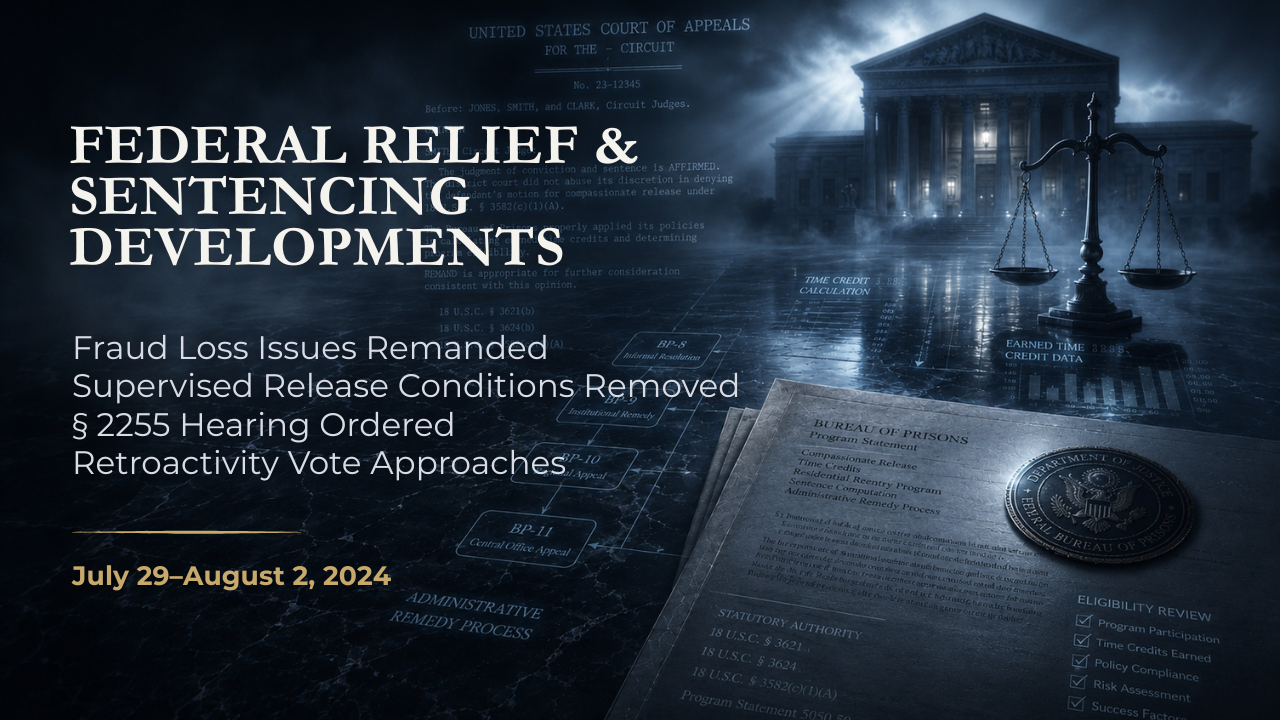
Supreme Court October Term preview, favorable appellate decisions involving loss calculations, restitution, forfeiture, supervised-release conditions, § 2255 evidentiary hearings, and Sentencing Commission retroactivity issues for the week of July 29–August 2, 2024.
Federal Sentencing Developments Overview
August 2024 Federal Sentencing Guideline Developments included Supreme Court calendar updates, favorable appellate decisions involving fraud sentencing and supervised-release conditions, and important Sentencing Commission retroactivity issues involving 2024 guideline amendments.
This weekly update highlights developments from July 29–August 2, 2024, including loss enhancements under U.S.S.G. § 2B1.1, restitution and forfeiture orders, oral pronouncement of supervised-release conditions, § 2255 hearings, the Sixth Amendment autonomy right recognized in McCoy v. Louisiana, and guideline retroactivity questions.
This federal relief update is provided for educational and informational purposes only. It is not legal advice and does not create legal representation.
Supreme Court Watch
October and November Argument Calendars Released
The Supreme Court remained in summer recess during the week ending August 2, 2024, but released argument calendars for the early part of the October 2024 Term.
The October calendar included Garland v. VanDerStok, involving federal regulation of so-called ghost guns, and Glossip v. Oklahoma, an unusual death-penalty case in which state officials supported review of the conviction and sentence.
The November calendar included Delligatti v. United States, a criminal case involving whether an offense requiring proof of bodily injury or death, but capable of being committed by omission, has as an element the use, attempted use, or threatened use of physical force.
Federal Relief Consideration: Supreme Court argument calendars identify issues to watch, but they do not create relief until the Court issues a decision and that decision is applied to a specific case record.
Favorable Federal Appellate Developments
Second Circuit: Fraud Loss, Restitution, and Forfeiture Issues in United States v. Rainford
In United States v. Rainford, Nos. 20-359, 20-2695, 20-2993, and 21-1753, the Second Circuit addressed convictions and sentences arising from a fraudulent slip-and-fall scheme.
The defendants challenged their convictions, guideline calculations, restitution orders, forfeiture orders, and sentences. The court remanded for additional factfinding regarding the number of fraudulent accidents attributable to certain defendants for purposes of calculating the loss enhancement under U.S.S.G. § 2B1.1.
The Second Circuit also vacated and remanded a forfeiture order that was based only on government allegations rather than factual material, modified restitution as to certain defendants, and remanded for further sentencing consideration.
Federal Relief Consideration: Fraud cases may deserve review where loss amount, restitution, forfeiture, intended loss, victim count, or the scope of jointly undertaken activity was not supported by reliable evidence.
Second Circuit: Written Supervised-Release Conditions Removed in United States v. Rosado
In United States v. Rosado, No. 22-1013-cr, the Second Circuit vacated and remanded after finding that the written judgment included supervised-release conditions that were not orally pronounced at sentencing.
Rosado challenged seven added conditions of supervised release. The Second Circuit agreed that the oral pronouncement did not match the later written judgment and explained that the oral sentence controls.
The court remanded for the district court to strike the challenged conditions from the written judgment.
Federal Relief Consideration: Supervised-release judgments may deserve review where special, discretionary, or burdensome conditions appear in the written judgment but were not pronounced or properly incorporated at sentencing.
Fourth Circuit: § 2255 Hearing Ordered in United States v. Hashimi
In United States v. Hashimi, No. 22-7190, the Fourth Circuit vacated the denial of a § 2255 motion and remanded for further factual development.
Hashimi argued that his trial counsel conceded guilt on two charges against his wishes, violating the Sixth Amendment autonomy right recognized in McCoy v. Louisiana. The district court denied relief without an evidentiary hearing.
The Fourth Circuit held that the existing record did not conclusively show that Hashimi was not entitled to relief. Because § 2255(b) requires a hearing unless the record conclusively shows no entitlement to relief, remand was required.
Federal Relief Consideration: § 2255 cases may deserve review where counsel conceded guilt, admitted elements, or pursued a defense strategy against the defendant’s express objective of maintaining innocence.
Sentencing Commission Watch
Retroactivity Vote Scheduled for 2024 Guideline Amendments
The U.S. Sentencing Commission’s August 8, 2024 meeting was expected to address whether certain 2024 guideline amendments should apply retroactively.
The amendments discussed in the source update included the acquitted-conduct amendment, a change to the obliterated-serial-number enhancement under U.S.S.G. § 2K2.1, grouping commentary involving § 922(g), § 841, and § 924(c), and changes to drug guideline base offense levels tied to statutory maximum penalties.
Federal Relief Consideration: A guideline amendment does not automatically reduce an already-imposed sentence. Retroactivity generally depends on whether the Sentencing Commission adds the amendment to U.S.S.G. § 1B1.10 and whether the person qualifies under § 3582(c)(2).
BOP Relief Statistics Snapshot
The source update identified Bureau of Prisons statistics available at that time, including:
- Fair Sentencing and retroactive sentence reductions: 4,146 orders granted
- Elderly Offender Home Confinement: 1,246 approved
- First Step Act releases: 35,917 granted
- Compassionate release and sentence reductions: 4,739 granted
- Residential Reentry Center population: 8,370
- Home confinement population: 4,846
Federal Relief Consideration: BOP statistics can help show how certain relief mechanisms are being used, but they do not determine whether a specific person qualifies for relief.
Fast Screening Considerations
A case-specific review may be especially important where any of the following issues appear in the record:
- Fraud sentence driven by disputed loss amount under U.S.S.G. § 2B1.1
- Loss enhancement based on conduct not attributable to the defendant
- Restitution or forfeiture order based only on allegations rather than factual findings
- Written judgment added supervised-release conditions not orally pronounced
- Burdensome supervised-release conditions added after sentencing
- § 2255 claim involving counsel conceding guilt without consent
- McCoy claim involving the defendant’s autonomy right
- Potential guideline retroactivity issue involving 2024 amendments
- Firearm enhancement, drug guideline, or acquitted-conduct issue affected by guideline changes
- Compassionate release, First Step Act, home confinement, or BOP custody-related questions
What This Means for Federal Prisoners and Families
The July 29–August 2, 2024 developments show that federal relief may arise from sentencing calculations, supervised-release errors, trial-right violations, or guideline amendment activity.
These issues often require reviewing the presentence report, sentencing transcript, written judgment, restitution order, forfeiture order, trial strategy, § 2255 record, and guideline amendment history.
Why a Written Case Evaluation May Help
A written case evaluation can help identify whether a federal case involves fraud loss-calculation errors, restitution or forfeiture issues, supervised-release condition problems, § 2255 hearing issues, trial-autonomy claims, guideline retroactivity questions, BOP relief issues, compassionate-release factors, or other post-conviction remedies.
Because many federal relief arguments are highly fact-specific and circuit-specific, families should avoid relying on general rumor or broad headlines. A structured review can help determine what issues may actually be available.
Related APEX Federal Relief Resources
Latest Updates
August 2024 Federal Sentencing Guideline Developments
Supreme Court October Term preview, favorable appellate decisions involving loss calculations, restitution, forfeiture, supervised-release conditions, § 2255 evidentiary hearings, and Sentencing Commission retroactivity issues for the week of July 29–August 2, 2024.
Federal Sentencing Developments Overview
August 2024 Federal Sentencing Guideline Developments included Supreme Court calendar updates, favorable appellate decisions involving fraud sentencing and supervised-release conditions, and important Sentencing Commission retroactivity issues involving 2024 guideline amendments.
This weekly update highlights developments from July 29–August 2, 2024, including loss enhancements under U.S.S.G. § 2B1.1, restitution and forfeiture orders, oral pronouncement of supervised-release conditions, § 2255 hearings, the Sixth Amendment autonomy right recognized in McCoy v. Louisiana, and guideline retroactivity questions.
This federal relief update is provided for educational and informational purposes only. It is not legal advice and does not create legal representation.
Supreme Court Watch
October and November Argument Calendars Released
The Supreme Court remained in summer recess during the week ending August 2, 2024, but released argument calendars for the early part of the October 2024 Term.
The October calendar included Garland v. VanDerStok, involving federal regulation of so-called ghost guns, and Glossip v. Oklahoma, an unusual death-penalty case in which state officials supported review of the conviction and sentence.
The November calendar included Delligatti v. United States, a criminal case involving whether an offense requiring proof of bodily injury or death, but capable of being committed by omission, has as an element the use, attempted use, or threatened use of physical force.
Federal Relief Consideration: Supreme Court argument calendars identify issues to watch, but they do not create relief until the Court issues a decision and that decision is applied to a specific case record.
Favorable Federal Appellate Developments
Second Circuit: Fraud Loss, Restitution, and Forfeiture Issues in United States v. Rainford
In United States v. Rainford, Nos. 20-359, 20-2695, 20-2993, and 21-1753, the Second Circuit addressed convictions and sentences arising from a fraudulent slip-and-fall scheme.
The defendants challenged their convictions, guideline calculations, restitution orders, forfeiture orders, and sentences. The court remanded for additional factfinding regarding the number of fraudulent accidents attributable to certain defendants for purposes of calculating the loss enhancement under U.S.S.G. § 2B1.1.
The Second Circuit also vacated and remanded a forfeiture order that was based only on government allegations rather than factual material, modified restitution as to certain defendants, and remanded for further sentencing consideration.
Federal Relief Consideration: Fraud cases may deserve review where loss amount, restitution, forfeiture, intended loss, victim count, or the scope of jointly undertaken activity was not supported by reliable evidence.
Second Circuit: Written Supervised-Release Conditions Removed in United States v. Rosado
In United States v. Rosado, No. 22-1013-cr, the Second Circuit vacated and remanded after finding that the written judgment included supervised-release conditions that were not orally pronounced at sentencing.
Rosado challenged seven added conditions of supervised release. The Second Circuit agreed that the oral pronouncement did not match the later written judgment and explained that the oral sentence controls.
The court remanded for the district court to strike the challenged conditions from the written judgment.
Federal Relief Consideration: Supervised-release judgments may deserve review where special, discretionary, or burdensome conditions appear in the written judgment but were not pronounced or properly incorporated at sentencing.
Fourth Circuit: § 2255 Hearing Ordered in United States v. Hashimi
In United States v. Hashimi, No. 22-7190, the Fourth Circuit vacated the denial of a § 2255 motion and remanded for further factual development.
Hashimi argued that his trial counsel conceded guilt on two charges against his wishes, violating the Sixth Amendment autonomy right recognized in McCoy v. Louisiana. The district court denied relief without an evidentiary hearing.
The Fourth Circuit held that the existing record did not conclusively show that Hashimi was not entitled to relief. Because § 2255(b) requires a hearing unless the record conclusively shows no entitlement to relief, remand was required.
Federal Relief Consideration: § 2255 cases may deserve review where counsel conceded guilt, admitted elements, or pursued a defense strategy against the defendant’s express objective of maintaining innocence.
Sentencing Commission Watch
Retroactivity Vote Scheduled for 2024 Guideline Amendments
The U.S. Sentencing Commission’s August 8, 2024 meeting was expected to address whether certain 2024 guideline amendments should apply retroactively.
The amendments discussed in the source update included the acquitted-conduct amendment, a change to the obliterated-serial-number enhancement under U.S.S.G. § 2K2.1, grouping commentary involving § 922(g), § 841, and § 924(c), and changes to drug guideline base offense levels tied to statutory maximum penalties.
Federal Relief Consideration: A guideline amendment does not automatically reduce an already-imposed sentence. Retroactivity generally depends on whether the Sentencing Commission adds the amendment to U.S.S.G. § 1B1.10 and whether the person qualifies under § 3582(c)(2).
BOP Relief Statistics Snapshot
The source update identified Bureau of Prisons statistics available at that time, including:
- Fair Sentencing and retroactive sentence reductions: 4,146 orders granted
- Elderly Offender Home Confinement: 1,246 approved
- First Step Act releases: 35,917 granted
- Compassionate release and sentence reductions: 4,739 granted
- Residential Reentry Center population: 8,370
- Home confinement population: 4,846
Federal Relief Consideration: BOP statistics can help show how certain relief mechanisms are being used, but they do not determine whether a specific person qualifies for relief.
Fast Screening Considerations
A case-specific review may be especially important where any of the following issues appear in the record:
- Fraud sentence driven by disputed loss amount under U.S.S.G. § 2B1.1
- Loss enhancement based on conduct not attributable to the defendant
- Restitution or forfeiture order based only on allegations rather than factual findings
- Written judgment added supervised-release conditions not orally pronounced
- Burdensome supervised-release conditions added after sentencing
- § 2255 claim involving counsel conceding guilt without consent
- McCoy claim involving the defendant’s autonomy right
- Potential guideline retroactivity issue involving 2024 amendments
- Firearm enhancement, drug guideline, or acquitted-conduct issue affected by guideline changes
- Compassionate release, First Step Act, home confinement, or BOP custody-related questions
What This Means for Federal Prisoners and Families
The July 29–August 2, 2024 developments show that federal relief may arise from sentencing calculations, supervised-release errors, trial-right violations, or guideline amendment activity.
These issues often require reviewing the presentence report, sentencing transcript, written judgment, restitution order, forfeiture order, trial strategy, § 2255 record, and guideline amendment history.
Why a Written Case Evaluation May Help
A written case evaluation can help identify whether a federal case involves fraud loss-calculation errors, restitution or forfeiture issues, supervised-release condition problems, § 2255 hearing issues, trial-autonomy claims, guideline retroactivity questions, BOP relief issues, compassionate-release factors, or other post-conviction remedies.
Because many federal relief arguments are highly fact-specific and circuit-specific, families should avoid relying on general rumor or broad headlines. A structured review can help determine what issues may actually be available.