
Latest Updates
October 2024 Supervised Release Sentencing Developments
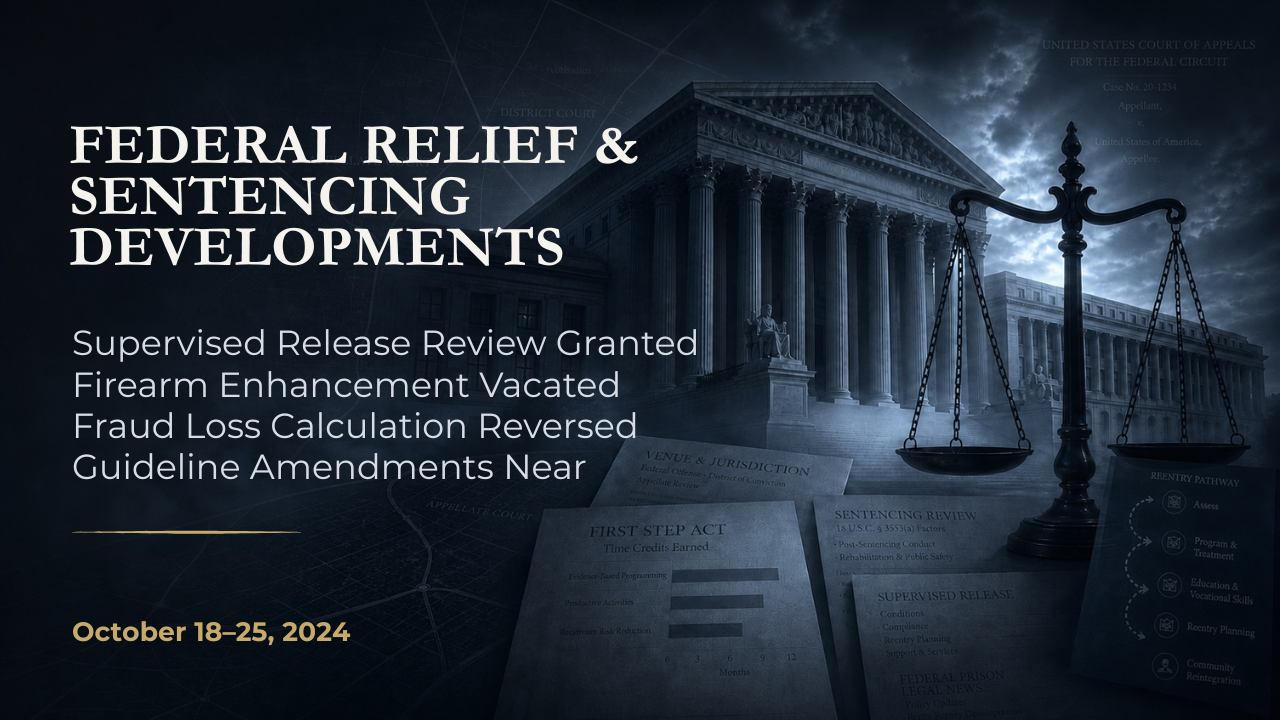
Supreme Court review of supervised-release revocation factors, favorable sentencing decisions involving firearm enhancements and loss calculations, BOP statistics, and upcoming federal guideline amendments for the week of October 18–25, 2024.
Federal Sentencing Developments Overview
October 2024 Supervised Release Sentencing Developments included a Supreme Court cert grant involving supervised-release revocation sentencing factors, a Fifth Circuit firearm-enhancement resentencing win, and a Ninth Circuit resentencing decision involving loss calculation and obstruction-enhancement errors.
This weekly update highlights developments from October 18–25, 2024, including supervised release, 18 U.S.C. § 3583(e), § 3553(a) factors, firearm guideline enhancements, stolen-property issues, fraud loss calculations, BOP statistics, and the 2024 federal sentencing guideline amendments.
This federal relief update is provided for educational and informational purposes only. It is not legal advice and does not create legal representation.
Supreme Court Watch
Esteras v. United States: Supervised-Release Revocation Factors
During the week ending October 25, 2024, the Supreme Court granted review in Esteras v. United States, No. 23-7483, a case involving what sentencing factors a district court may consider when revoking supervised release.
The supervised-release revocation statute, 18 U.S.C. § 3583(e), cross-references some, but not all, of the sentencing factors listed in 18 U.S.C. § 3553(a). One omitted provision is § 3553(a)(2)(A), which refers to the need for a sentence to reflect the seriousness of the offense, promote respect for the law, and provide just punishment.
At the time of this October 2024 update, the Supreme Court had not yet issued its decision. The grant was important because the courts of appeals had disagreed over whether district courts may rely on § 3553(a)(2)(A) when imposing a revocation sentence.
Federal Relief Consideration: Supervised-release revocation cases may deserve review where the court relied heavily on punishment, seriousness of the offense, respect for the law, or just punishment when imposing revocation imprisonment.
Favorable Federal Appellate Developments
Fifth Circuit: Firearm Enhancement Vacated in United States v. Henry
In United States v. Henry, No. 23-30589, the Fifth Circuit vacated a sentence involving the firearm enhancement under U.S.S.G. § 2K2.1(b)(6)(B).
Henry pleaded guilty to being a felon in possession of a firearm under 18 U.S.C. § 922(g)(1). The key issue on appeal was whether the enhancement applied because Henry possessed a firearm “in connection with” possession of stolen property.
The Fifth Circuit adhered to precedent that mere simultaneous possession of a firearm and stolen property was not enough to support the enhancement in that context. The court vacated Henry’s sentence and remanded for resentencing.
Federal Relief Consideration: Firearm enhancements require a sufficient connection between the firearm and another felony offense. If the only connection is that the firearm and other property were possessed at the same time, the enhancement may deserve review depending on the circuit and facts.
Ninth Circuit: Avenatti Sentence Vacated for Loss and Enhancement Errors
In United States v. Avenatti, No. 22-50301, the Ninth Circuit vacated a 168-month sentence and remanded for resentencing.
Avenatti had pleaded guilty to wire fraud and obstruction of the administration of internal revenue laws. On appeal, the Ninth Circuit found multiple sentencing problems, including issues with the district court’s fraud-loss calculation and obstruction enhancement.
The panel concluded that the district court should have accounted for the value of Avenatti’s legal services and costs, as well as certain payments made to victims, when calculating loss. The court also found problems with the obstruction-of-justice analysis.
Federal Relief Consideration: Fraud cases may deserve review where the loss calculation did not account for value provided, repayments, offsets, credits, or actual pecuniary harm. Loss calculations can dramatically affect the advisory Guidelines range.
BOP Relief Statistics Snapshot
The source update identified Bureau of Prisons statistics available at that time, including:
- Fair Sentencing and retroactive sentence reductions: 4,148 orders granted
- Elderly Offender Home Confinement: 1,246 approved
- First Step Act releases: 39,455 granted
- Compassionate release and sentence reductions: 4,763 granted
- Residential Reentry Center population: 8,355
- Home confinement population: 4,985
Federal Relief Consideration: BOP statistics can help show how certain relief mechanisms are being used, but they do not determine whether any specific person qualifies for relief.
Sentencing Guideline Amendment Watch
The 2024 U.S. Sentencing Guideline amendments were scheduled to become effective November 1, 2024. Topics included acquitted conduct, loss calculation, circuit conflicts, youthful individuals, and miscellaneous guideline changes.
Federal Relief Consideration: Guideline amendments do not automatically reduce every sentence. A case-specific review is needed to determine whether an amendment affects the guideline calculation, whether retroactivity applies, and whether a procedural vehicle exists.
Fast Screening Considerations
A case-specific review may be especially important where any of the following issues appear in the record:
- Supervised-release revocation sentence based on punishment or seriousness of the offense
- Revocation sentence involving disputed § 3553(a) factor analysis
- Firearm enhancement under U.S.S.G. § 2K2.1(b)(6)(B)
- Sentence increased because the firearm was allegedly possessed “in connection with” another felony
- Firearm and stolen-property facts where the only connection was simultaneous possession
- Fraud loss calculation that failed to account for value provided, credits, or repayments
- Obstruction enhancement without required findings
- Sentence affected by acquitted conduct or loss-calculation guideline issues
- Youthful-individual facts or criminal-history scoring concerns
- § 922(g) or § 924(c) firearm issues requiring case-specific review after recent Supreme Court and circuit decisions
What This Means for Federal Prisoners and Families
The October 18–25, 2024 developments show that federal sentencing issues often turn on technical details. A revocation sentence may depend on which § 3553(a) factors the court considered. A firearm enhancement may depend on whether the firearm actually facilitated another felony. A fraud sentence may depend on how loss was calculated.
These issues are not always visible from the judgment alone. They often require review of the presentence report, sentencing transcript, statement of reasons, plea agreement, objections, and appellate history.
Why a Written Case Evaluation May Help
A written case evaluation can help identify whether a federal case involves supervised-release revocation issues, firearm enhancement problems, fraud loss-calculation errors, obstruction-enhancement concerns, guideline amendments, BOP relief questions, or other post-conviction remedies.
Because many federal relief arguments are highly fact-specific and circuit-specific, families should avoid relying on general rumor or broad headlines. A structured review can help determine what issues may actually be available.