
Latest Updates
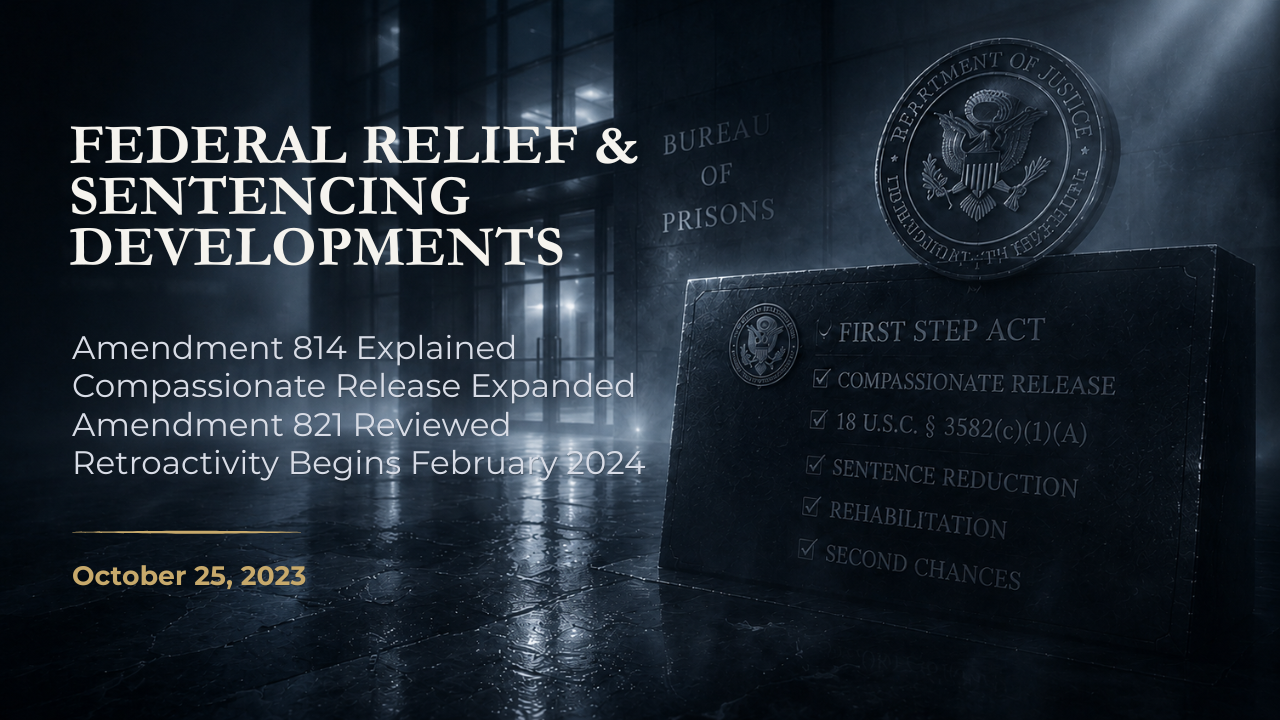
October 2023 Federal Sentencing Amendment 814 821 Update
Special federal sentencing update covering U.S. Sentencing Guidelines Amendment 814, compassionate release, Amendment 821, criminal history, status points, zero-point offenders, retroactive sentence-reduction screening, and federal relief considerations ahead of the November 1, 2023 and February 1, 2024 effective dates.
Federal Sentencing Guidelines Update Overview
October 2023 Federal Sentencing Amendment 814 821 Update focuses on two major U.S. Sentencing Guidelines amendments expected to affect many federal sentencing and sentence-reduction reviews: Amendment 814 for compassionate release and Amendment 821 for criminal history.
This special update explains the core screening issues involving U.S.S.G. § 1B1.13, 18 U.S.C. § 3582(c)(1)(A), compassionate release, unusually long sentences, nonretroactive changes in law, status points, zero-point offenders, prior marijuana possession sentences, Amendment 821 retroactivity, and federal sentence-reduction strategy.
This federal relief update is provided for educational and informational purposes only. It is not legal advice and does not create legal representation.
Amendment 814: Compassionate Release Under § 3582(c)(1)(A)
Amendment 814 revised U.S.S.G. § 1B1.13, the Sentencing Commission’s compassionate-release policy statement, to reflect the First Step Act’s change allowing defendants to file their own compassionate-release motions after satisfying statutory exhaustion requirements.
The amendment expanded and clarified the categories of “extraordinary and compelling reasons” that may support a sentence reduction under 18 U.S.C. § 3582(c)(1)(A).
Federal Relief Consideration: Compassionate-release screening may be important for people with serious medical needs, inadequate care concerns, family-caregiver issues, abuse-related circumstances, unusually long sentences, rehabilitation evidence, or other extraordinary and compelling circumstances.
Medical Circumstances and Inadequate Medical Care
Amendment 814 added and clarified medical circumstances that may support compassionate-release review, including situations where a person requires long-term or specialized care that is not being provided and where the lack of care creates a serious risk of deterioration or death.
Federal Relief Consideration: Medical compassionate-release review may require BOP medical records, outside specialist records, diagnosis history, treatment requests, medication records, mobility records, administrative remedy records, and evidence showing whether adequate care is actually available.
Public Health Emergency and Pandemic-Related Risk
Amendment 814 also reflected lessons from COVID-19 by addressing situations involving infectious disease outbreaks or public health emergencies in correctional facilities.
This type of review may involve both facility-level conditions and person-specific risk factors that cannot be adequately mitigated in custody.
Federal Relief Consideration: These cases may require medical vulnerability evidence, facility outbreak information, vaccination or treatment history, BOP mitigation records, and documentation showing why the risk remains serious despite available precautions.
Family Circumstances
Amendment 814 expanded the family-circumstances category beyond earlier narrow caregiver situations. The amendment recognized that some defendants may be the only available caregiver for a minor child, debilitated parent, adult child incapable of self-care, or a person similar in kind to an immediate family member.
Federal Relief Consideration: Family-circumstances review may require medical records for the family member, proof of relationship, caregiver availability evidence, custody or dependency records, social-service records, affidavits, and a release plan explaining how the defendant would provide care.
Victim of Abuse Category
Amendment 814 added a category for certain individuals who experienced sexual abuse or serious physical abuse by correctional personnel.
The amendment generally requires the misconduct to be established by a civil, criminal, or administrative finding, unless proceedings are unduly delayed or the person faces imminent danger.
Federal Relief Consideration: Abuse-related compassionate-release review may require administrative findings, investigation records, PREA records, medical records, grievance records, civil filings, criminal records, safety concerns, and evidence of ongoing risk.
Other Reasons
Amendment 814 revised the “Other Reasons” category, allowing courts and the BOP Director to identify additional extraordinary and compelling reasons that are similar in gravity to the listed categories.
Federal Relief Consideration: “Other reasons” arguments must be carefully developed. Courts will usually expect a serious, well-documented circumstance comparable in gravity to the expressly listed grounds.
Unusually Long Sentences
Amendment 814 added an “Unusually Long Sentence” category. In limited circumstances, a court may consider a change in law as part of the extraordinary-and-compelling analysis if the defendant has served at least 10 years, the sentence is unusually long, and the change would produce a gross disparity between the sentence being served and the sentence likely to be imposed today.
The amendment excludes nonretroactive guideline amendments from being treated as a change in law for this category unless the amendment has been made retroactive.
Federal Relief Consideration: Unusually-long-sentence review may require comparing the original sentence, current sentencing law, mandatory minimums, stacking rules, guideline changes, time served, offense conduct, rehabilitation, disciplinary record, release plan, and current circuit authority.
Important Caution About Amendment 814
Amendment 814 created important compassionate-release screening opportunities, but relief is not automatic. Courts must still consider the statutory requirements, exhaustion, applicable policy statement, danger considerations, and the § 3553(a) sentencing factors.
Some courts and circuits have also disagreed about the Commission’s authority to include certain change-in-law circumstances in the compassionate-release policy statement. Any filing should be screened under the current law in the controlling jurisdiction.
Amendment 821: Criminal History, Status Points, and Zero-Point Offenders
Amendment 821 addressed federal criminal-history scoring and later became one of the most important retroactive sentence-reduction issues from the 2023 guideline amendments.
On August 24, 2023, the U.S. Sentencing Commission voted to allow delayed retroactive application of certain parts of Amendment 821. Eligible incarcerated individuals could seek sentence reductions effective beginning February 1, 2024.
Federal Relief Consideration: Amendment 821 screening may be important for individuals whose guideline range was affected by status points or who had zero criminal-history points at sentencing, but the court must still determine eligibility, amended guideline range, public safety, and discretionary relief.
Part A: Status Points
Part A of Amendment 821 addressed “status points,” which are criminal-history points added when a person committed the federal offense while under a criminal justice sentence such as probation, parole, supervised release, imprisonment, work release, or escape status.
Part A reduced status points for certain individuals and eliminated them for others, depending on the person’s criminal-history score.
Federal Relief Consideration: Status-point review requires the PSR, original criminal-history score, whether status points were applied, the original guideline range, the amended guideline range, sentencing transcript, statement of reasons, and prior sentence-reduction history.
Part B: Zero-Point Offenders
Part B created U.S.S.G. § 4C1.1, which provides a two-level decrease for certain defendants who had zero criminal-history points and whose offense did not involve specified aggravating factors.
The zero-point offender adjustment is not available to everyone with no criminal history. The guideline contains exclusions based on offense seriousness and aggravating factors.
Federal Relief Consideration: Zero-point offender review may require examining criminal-history points, violence, firearm involvement, death or serious bodily injury, sex offenses, terrorism, hate crimes, substantial financial hardship, aggravating role, continuing criminal enterprise, obstruction, and other exclusionary criteria.
Part C: Prior Marijuana Possession Sentences
Part C amended the commentary to U.S.S.G. § 4A1.3 to include prior marijuana possession sentences as an example of when a downward departure may be warranted for criminal-history reasons.
Federal Relief Consideration: Criminal-history review may be important where prior marijuana possession sentences increased the criminal-history score or overstated the seriousness of the person’s prior record.
Estimated Impact of Amendment 821
The source update referenced Sentencing Commission estimates that Amendment 821 could affect many incarcerated individuals.
- Part A, involving status points, was estimated to lower guideline ranges for thousands of incarcerated individuals.
- Part B, involving zero-point offenders, was estimated to create lower guideline ranges for thousands of additional individuals who meet the required criteria.
- The average potential sentence reduction varied by category and depended on the individual’s amended guideline calculation.
Federal Relief Consideration: The impact estimates do not determine eligibility in any individual case. Each case requires its own guideline recalculation and review of exclusions, public-safety issues, and court discretion.
Why Amendment 821 Is Not Automatic
A person may appear eligible for Amendment 821 relief at first glance but still be excluded because of the original guideline calculation, aggravating factors, offense conduct, public-safety concerns, prior reductions, statutory minimums, or the court’s discretionary decision.
In many cases, the first question is whether Amendment 821 actually lowers the applicable guideline range. If it does not lower the range, relief may not be available under § 3582(c)(2).
Federal Relief Consideration: Proper screening should compare the original guideline range to the amended guideline range and determine whether a reduction is authorized before drafting a motion.
Why Amendment 814 and Amendment 821 Should Be Screened Separately
Amendment 814 and Amendment 821 address different forms of relief. Amendment 814 relates to compassionate release under § 3582(c)(1)(A). Amendment 821 relates to criminal-history recalculation and retroactive sentence reduction under § 3582(c)(2) for certain eligible individuals.
A person may qualify for one, both, or neither. These pathways have different legal standards, exhaustion requirements, evidentiary needs, and procedural rules.
Federal Relief Consideration: A case should be screened for the correct procedural vehicle before filing, because compassionate release, retroactive guideline reduction, § 2255, § 2241, and BOP credit issues are not interchangeable.
Fast Screening Considerations
A case-specific review may be especially important where any of the following issues appear in the record:
- Status points were added to the criminal-history score
- Defendant had zero criminal-history points at sentencing
- Sentence may be affected by Amendment 821 Part A or Part B
- Prior marijuana possession sentence affected criminal history
- Compassionate-release motion may be affected by amended § 1B1.13
- Serious medical condition is not being adequately treated in BOP custody
- Family member requires care and no other caregiver is available
- Defendant experienced qualifying abuse by correctional personnel
- Unusually long sentence may involve a qualifying change-in-law argument
- BOP, First Step Act, compassionate release, home confinement, or sentence-reduction questions
What This Means for Federal Prisoners and Families
The October 25, 2023 guideline update shows why federal prisoners and families needed careful review before filing amendment-based motions. Amendment 814 and Amendment 821 created important opportunities, but neither amendment applies automatically to every case.
These issues often require reviewing the PSR, judgment, statement of reasons, sentencing transcript, criminal-history worksheet, guideline calculation, BOP records, medical records, family records, compassionate-release exhaustion, prior filings, and current circuit law.
Why a Written Case Evaluation May Help
A written case evaluation can help identify whether a federal case involves Amendment 814 compassionate-release issues, Amendment 821 status-point relief, zero-point offender eligibility, prior marijuana possession criminal-history issues, BOP relief questions, First Step Act credits, compassionate-release factors, § 2255 issues, § 2241 issues, or other post-conviction remedies.
Because federal sentencing amendments are guideline-specific, fact-specific, and procedure-specific, families should avoid relying on general rumor or broad headlines. A structured review can help determine what issues may actually be available and which procedural vehicle may apply.