
Latest Updates
November 2024 Federal Clemency Sentencing Developments
Supreme Court Thanksgiving recess, a Fourth Circuit resentencing decision involving § 924(c), supervised-release pronouncement issues, and a historical and contemporary look at presidential clemency for the week of November 25–29, 2024.
Federal Relief Developments Overview
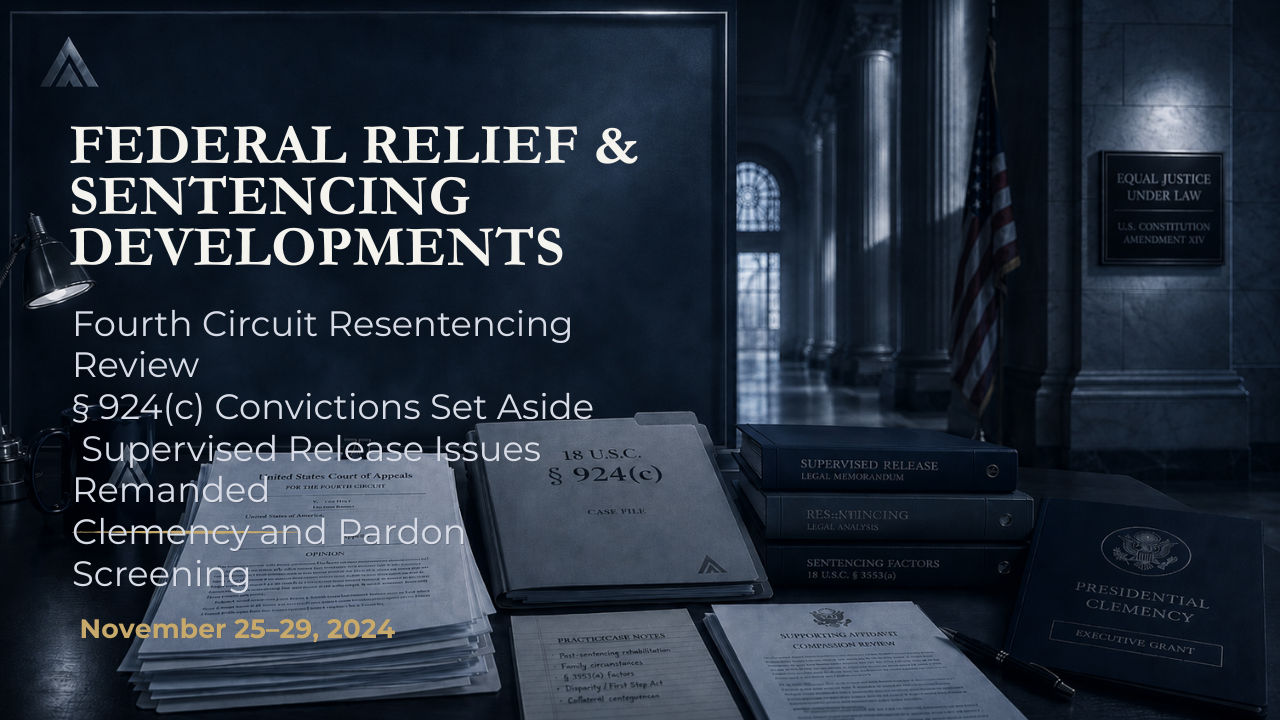
November 2024 Federal Clemency Sentencing Developments included Supreme Court recess activity, a favorable Fourth Circuit decision involving resentencing after § 924(c) convictions were set aside, and renewed discussion of presidential pardons and commutations.
This weekly update highlights developments from November 25–29, 2024, including resentencing rights, supervised-release conditions, oral pronouncement issues, § 924(c) post-conviction relief, and executive clemency considerations.
This federal relief update is provided for educational and informational purposes only. It is not legal advice and does not create legal representation.
Supreme Court Watch
Thanksgiving Recess
The Supreme Court was in recess during the week ending November 29, 2024, because of the Thanksgiving holiday.
Federal Relief Consideration: Even during weeks with limited Supreme Court activity, lower-court decisions can still create important screening issues for federal prisoners and families.
Favorable Federal Appellate Developments
Fourth Circuit: Resentencing and Supervised-Release Issues in United States v. Bullis
In United States v. Bullis, No. 23-4184, the Fourth Circuit reviewed a resentencing that followed the vacatur of two § 924(c) convictions.
Bullis had been convicted after trial of several federal offenses, including two counts of using a firearm during and in relation to other crimes under 18 U.S.C. § 924(c). After he had served more than two decades in prison, later Supreme Court authority led to his two § 924(c) convictions being set aside.
The district court then resentenced Bullis on the remaining counts. On appeal, Bullis raised several issues, including whether resentencing on counts for which he had already served the original sentences violated double jeopardy principles, whether he had a right to be present for sentencing, and whether the written supervised-release conditions differed from the oral sentence.
The Fourth Circuit agreed that there were supervised-release pronouncement problems. The court concluded that the district court imposed a special condition of supervised release that materially differed from the oral pronouncement and failed to clearly incorporate the standard conditions of supervision adopted in the district.
The Fourth Circuit vacated and remanded for resentencing.
Federal Relief Consideration: Cases involving § 924(c) vacatur, resentencing packages, completed sentences on remaining counts, oral pronouncement problems, or written supervised-release conditions may deserve careful review.
Presidential Pardons and Clemency
A Historical and Contemporary Perspective
Presidential clemency includes pardons and commutations. A pardon generally addresses the legal consequences of a federal conviction, while a commutation reduces or changes a sentence without necessarily erasing the conviction.
The pardon power has long been understood as a constitutional tool that can address mercy, fairness, rehabilitation, and systemic concerns. Historically, presidents have often used clemency more actively near the end of a term.
Modern clemency practice has drawn renewed attention because federal sentencing laws, mandatory minimums, drug penalties, firearm enhancements, and post-conviction limits can leave some individuals serving sentences that may appear unusually harsh compared to current law or current charging practices.
Contemporary Clemency Considerations
Recent clemency discussions have focused on several groups, including people serving long federal sentences, individuals affected by older drug sentencing policies, veterans, people with strong rehabilitation records, and individuals seeking relief based on changed law or changed public policy.
President Biden’s broader clemency actions included proclamation-based relief for certain federal marijuana possession offenses and pardons for certain former service members convicted under military law for consensual private conduct that is no longer criminalized.
Federal Relief Consideration: Clemency is different from court-based relief. It does not replace a direct appeal, § 2255 motion, § 2241 petition, compassionate-release motion, or sentence-reduction motion. However, it may be relevant where a person has strong rehabilitation, reentry, family hardship, medical hardship, sentencing-disparity, or public-safety factors.
Fast Screening Considerations
A case-specific review may be especially important where any of the following issues appear in the record:
- § 924(c) convictions affected by later Supreme Court or appellate decisions
- Resentencing after one or more counts were vacated
- Potential sentencing-package issues after post-conviction relief
- Double jeopardy concerns involving counts already served
- Sentencing conducted without the defendant being properly present
- Written supervised-release conditions that differ from the oral pronouncement
- Standard conditions of supervision not clearly incorporated at sentencing
- Clemency interest based on rehabilitation, hardship, unusually long sentence, or changed law
- Firearm convictions requiring case-specific review after recent Second Amendment and § 924(c) litigation
What This Means for Federal Prisoners and Families
The November 25–29, 2024 developments show that resentencing after post-conviction relief can create new legal issues. When one or more convictions are vacated, the remaining sentence, supervised-release conditions, oral pronouncement, and written judgment should all be reviewed carefully.
The clemency discussion also shows that executive relief is a separate pathway from court litigation. A person may have a legal claim, a clemency argument, both, or neither. The correct path depends on the conviction, sentence, record, procedural history, rehabilitation, and current circumstances.
Why a Written Case Evaluation May Help
A written case evaluation can help identify whether a federal case involves § 924(c) issues, resentencing errors, supervised-release condition problems, oral-pronouncement issues, clemency factors, compassionate-release arguments, or post-conviction remedies that may deserve closer review.
Because many federal relief arguments are highly fact-specific and circuit-specific, families should avoid relying on general rumor or broad legal headlines. A structured review can help determine what issues may actually be available.