
Latest Updates
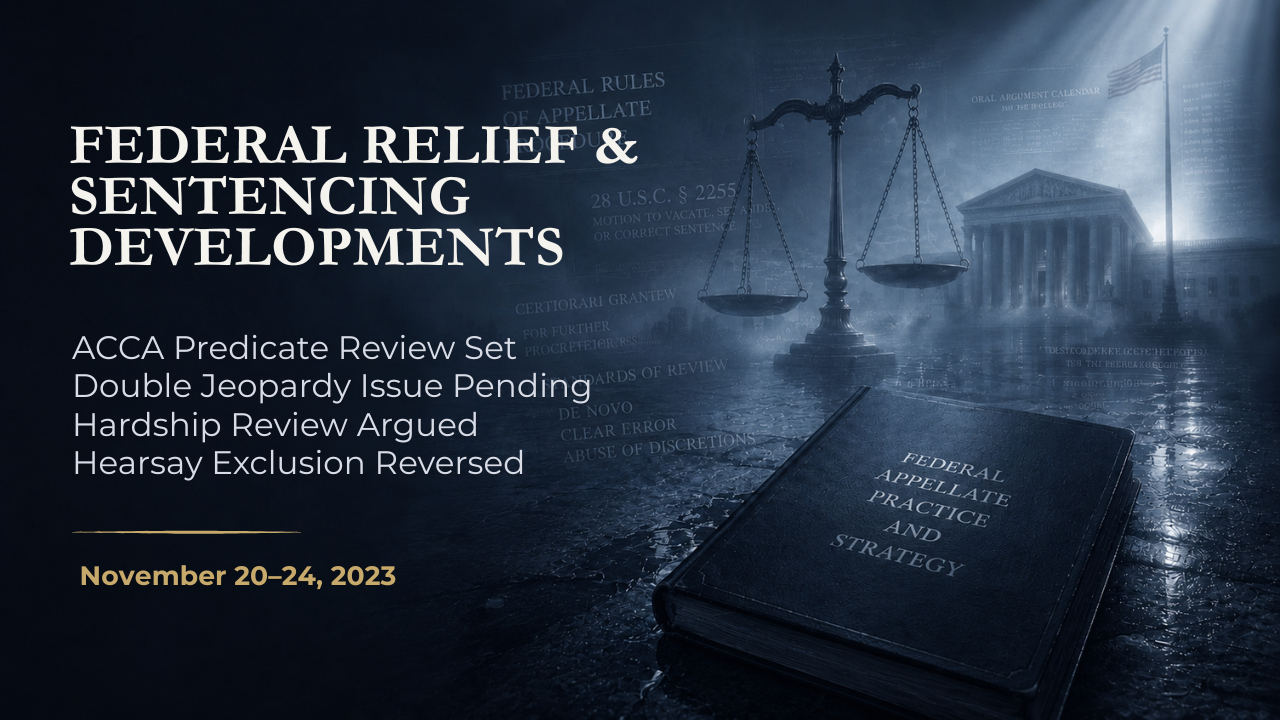
November 2023 Federal ACCA Hearsay Relief Developments
Supreme Court watch issues involving ACCA serious drug offense predicates, double jeopardy, immigration hardship review, federal hearsay evidence, Rule 804(b)(3), statements against penal interest, BOP relief statistics, and federal case-screening considerations for the week of November 20–24, 2023.
Federal Relief Developments Overview
November 2023 Federal ACCA Hearsay Relief Developments included Supreme Court watch issues involving ACCA serious drug offense predicates, double jeopardy after an insanity acquittal, immigration hardship review, and a favorable Tenth Circuit evidentiary ruling involving Rule 804(b)(3) statements against penal interest.
This weekly update highlights developments from November 20–24, 2023, including Brown v. United States, Jackson v. United States, McElrath v. Georgia, Wilkinson v. Garland, United States v. Yellowhorse, ACCA serious drug offense predicates, Rule 804(b)(3), self-inculpatory hearsay, double jeopardy, immigration hardship review, and BOP relief statistics.
This federal relief update is provided for educational and informational purposes only. It is not legal advice and does not create legal representation.
Supreme Court Watch
Brown and Jackson: ACCA Serious Drug Offense Predicate Review
The Supreme Court was scheduled to begin its December argument session with consolidated ACCA cases, Brown v. United States and Jackson v. United States.
The cases involved how courts should determine whether a prior state drug conviction qualifies as a “serious drug offense” under the Armed Career Criminal Act when federal controlled-substance schedules have changed over time.
The defendants argued for using federal drug schedules in effect at the time of the federal firearm offense or federal sentencing. The government argued for using the federal schedules in effect at the time of the prior state drug offense. The Supreme Court later adopted the government’s timing rule.
Federal Relief Consideration: ACCA cases may deserve review where a prior state drug conviction was used as a serious-drug-offense predicate and the relevant controlled substance later changed under federal law.
McElrath v. Georgia: Double Jeopardy After Insanity Acquittal
The Supreme Court was also scheduled to hear McElrath v. Georgia, a double-jeopardy case involving a not-guilty-by-reason-of-insanity verdict.
McElrath had been found not guilty by reason of insanity on one murder charge, while also being found guilty but mentally ill on other related charges. Georgia courts treated the verdicts as repugnant, vacated them, and authorized retrial.
The Supreme Court later held that the not-guilty-by-reason-of-insanity verdict was an acquittal for double-jeopardy purposes, even if it appeared inconsistent with other verdicts.
Federal Relief Consideration: Double-jeopardy issues may deserve review where a person faces retrial after an acquittal, not-guilty-by-reason-of-insanity verdict, inconsistent verdict, vacated verdict, or state procedural ruling that attempts to undo an acquittal.
Wilkinson v. Garland: Immigration Hardship Review
The Supreme Court was also scheduled to hear Wilkinson v. Garland, an immigration case involving cancellation of removal and the “exceptional and extremely unusual hardship” requirement.
The issue was whether federal courts have jurisdiction to review an agency’s hardship determination when a noncitizen seeks cancellation of removal based on hardship to a qualifying family member.
The Supreme Court later held that the hardship determination is a mixed question of law and fact reviewable under the immigration statute’s legal-question review provision.
Federal Relief Consideration: Immigration-related federal cases may deserve review where removal consequences, cancellation issues, hardship findings, agency legal standards, or jurisdictional review limits affect the person’s legal position.
Favorable Federal Appellate Developments
Tenth Circuit: Rule 804(b)(3) Hearsay Issue in United States v. Yellowhorse
In United States v. Yellowhorse, No. 23-2011, the Tenth Circuit reversed the exclusion of statements that implicated Yellowhorse after concluding that the district court applied the wrong legal test.
The case involved statements made by another person that were allegedly self-inculpatory while also implicating Yellowhorse. The district court treated references to a third party’s involvement as outside the statement-against-interest exception.
The Tenth Circuit held that this approach conflicted with precedent. A statement may still be self-inculpatory for Rule 804(b)(3) purposes even if it also incriminates another person. The court remanded for the district court to reassess whether the statements were self-inculpatory under the correct test.
Federal Relief Consideration: Trial and evidentiary cases may deserve review where a court excluded or admitted out-of-court statements against penal interest without properly analyzing whether each statement was genuinely self-inculpatory and corroborated under Rule 804(b)(3).
Why ACCA Serious Drug Offense Timing Matters
ACCA can increase a § 922(g) sentence to a 15-year mandatory minimum when the defendant has three qualifying violent-felony or serious-drug-offense predicates.
In drug-predicate cases, timing can matter because federal drug schedules may change after a prior state conviction. The question in Brown and Jackson was which version of the federal schedules should be used for ACCA analysis.
Federal Relief Consideration: ACCA screening may require examining the prior state statute, controlled substance, conviction date, federal firearm offense date, federal sentencing date, federal drug schedules, Shepard documents, and whether three qualifying predicates remain.
Why Double Jeopardy After Acquittal Matters
The Double Jeopardy Clause protects against being tried again for the same offense after an acquittal. That protection can apply even when verdicts appear inconsistent or when a state court later labels the verdicts repugnant.
The key question is whether the jury’s ruling resolved criminal liability in the defendant’s favor. If it did, retrial may be barred.
Federal Relief Consideration: Double-jeopardy review may require examining the verdict form, jury instructions, acquittal language, state-law procedure, appellate rulings, retrial order, and whether jeopardy terminated on the relevant charge.
Why Rule 804(b)(3) Hearsay Review Matters
Statements against penal interest can be important in criminal trials, especially where a declarant admits involvement while also naming another person.
Courts must carefully distinguish between genuinely self-inculpatory statements and statements that shift blame, minimize responsibility, or primarily accuse someone else.
Federal Relief Consideration: Hearsay review may require examining the actual statement, surrounding context, declarant availability, corroborating circumstances, Fifth Amendment issues, statements to relatives or law enforcement, and whether the statement was offered by the government or defense.
Why Immigration Hardship Review Matters
Immigration consequences can intersect with federal criminal cases, especially for noncitizens facing removal, cancellation issues, plea consequences, sentencing consequences, or post-conviction relief tied to immigration outcomes.
Wilkinson is important because it addressed judicial review of hardship determinations in cancellation-of-removal cases.
Federal Relief Consideration: Immigration-related review may require examining the conviction statute, plea advice, removal proceedings, cancellation application, hardship evidence, family circumstances, agency decision, and federal court jurisdiction.
BOP Relief Statistics Snapshot
The source update identified Bureau of Prisons statistics available at that time, including:
- Fair Sentencing and retroactive sentence reductions: 3,981 orders granted
- Elderly Offender Home Confinement: 1,247 approved
- First Step Act releases: 25,786 granted
- Compassionate release and sentence reductions: 4,636 granted
- Residential Reentry Center population: 8,005
- Home confinement population: 5,625
Federal Relief Consideration: BOP statistics can help show how certain relief mechanisms are being used, but they do not determine whether a specific person qualifies for relief.
Fast Screening Considerations
A case-specific review may be especially important where any of the following issues appear in the record:
- ACCA sentence based on prior state drug convictions
- Federal controlled-substance schedules changed after the prior state drug offense
- § 922(g) sentence enhanced under ACCA serious-drug-offense predicates
- Retrial authorized after an acquittal or insanity acquittal
- Verdicts vacated as inconsistent, repugnant, or legally incompatible
- Criminal case involving immigration consequences, hardship findings, or removal review
- Out-of-court statement against penal interest admitted or excluded under Rule 804(b)(3)
- Declarant statement implicated both the declarant and another person
- Hearsay ruling affected trial strategy, defense evidence, or government proof
- BOP, First Step Act, compassionate release, home confinement, or sentence-reduction questions
What This Means for Federal Prisoners and Families
The November 20–24, 2023 developments show that federal relief may arise from ACCA predicate timing issues, double-jeopardy protections after acquittal, immigration hardship-review questions, Rule 804(b)(3) hearsay errors, and BOP relief concerns.
These issues often require reviewing prior conviction records, federal sentencing transcripts, verdict forms, jury instructions, immigration records, evidentiary rulings, trial transcripts, BOP records, and appellate history.
Why a Written Case Evaluation May Help
A written case evaluation can help identify whether a federal case involves ACCA predicate issues, serious-drug-offense timing questions, double-jeopardy concerns, immigration consequences, hearsay evidentiary errors, BOP relief questions, compassionate-release factors, First Step Act issues, or other post-conviction remedies.
Because many federal relief arguments are highly fact-specific and circuit-specific, families should avoid relying on general rumor or broad headlines. A structured review can help determine what issues may actually be available.