
Latest Updates
June 2026 Federal Sentencing Post-Conviction Developments
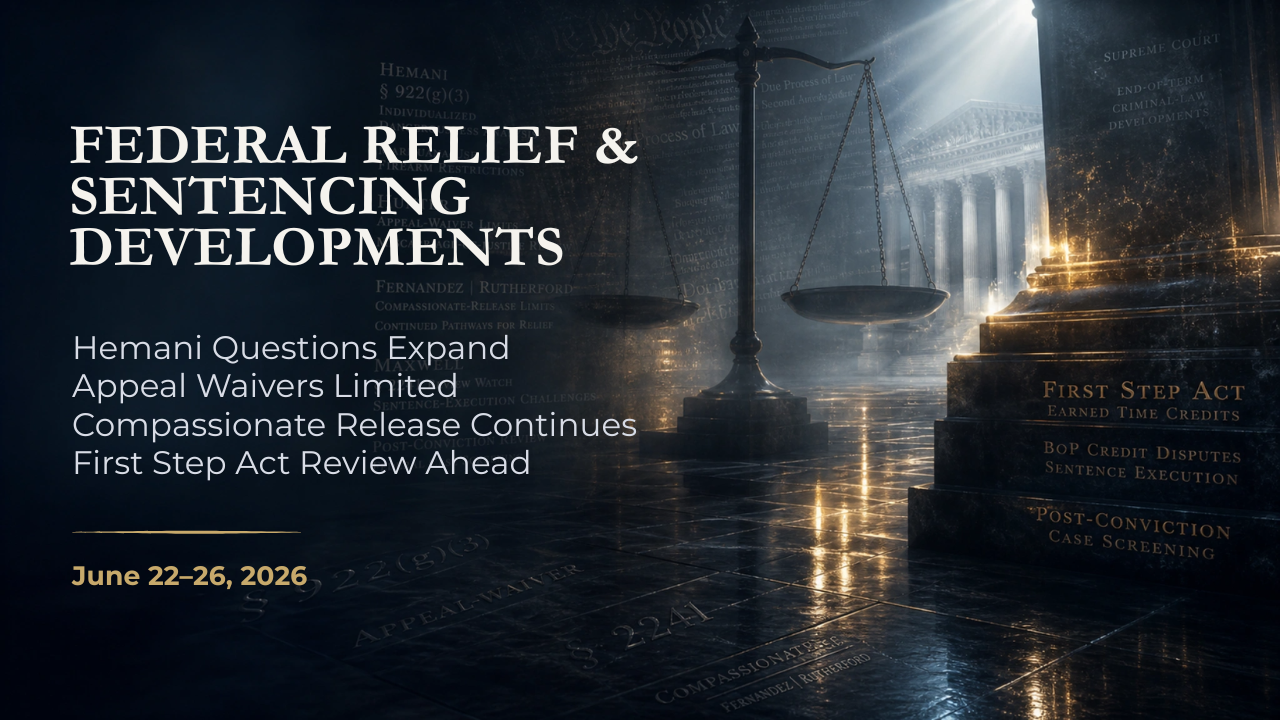
Supreme Court end-of-term decisions, Hemani firearm litigation, Hunter appeal-waiver limits, compassionate-release developments, First Step Act credit issues, and federal post-conviction review considerations for the week of June 22–26, 2026.
Federal Sentencing Developments Overview
June 2026 Federal Sentencing Post-Conviction Developments included major Supreme Court activity involving firearm prosecutions, appeal waivers, compassionate release, First Step Act credit litigation, and post-conviction review issues affecting federal prisoners and families.
This weekly update highlights developments from June 22–26, 2026, including § 922(g)(3), marijuana-related firearm prosecutions, individualized dangerousness, appeal-waiver enforcement, miscarriage-of-justice review, compassionate-release limits, § 2241 litigation, First Step Act earned time credits, and federal case-screening considerations.
This federal relief update is provided for educational and informational purposes only. It is not legal advice and does not create legal representation.
Supreme Court Watch
Hemani and the Future of § 922(g)(3) Firearm Litigation
The Supreme Court’s decision in United States v. Hemani continued to generate major discussion during the week of June 22–26, 2026. The case involved 18 U.S.C. § 922(g)(3), which prohibits firearm possession by unlawful users of controlled substances.
Most public discussion focused on the marijuana issue. Hemani was prosecuted after admitting marijuana use while also possessing firearms. The Supreme Court ruled for Hemani on the as-applied Second Amendment challenge, concluding that the government had not justified the prosecution under the historical-tradition framework required by modern Second Amendment law.
The broader question is whether Hemani will affect cases beyond marijuana. The Court’s reasoning focused heavily on individualized dangerousness rather than broad categorical assumptions. That reasoning may influence future litigation involving other controlled substances, former users, nonviolent conduct, and the meaning of “unlawful user.”
Federal Relief Consideration: § 922(g)(3) cases may deserve careful review where the person was prosecuted based on marijuana use, past drug use, occasional use, or nonviolent conduct without evidence of firearm possession while intoxicated or dangerous.
Hunter v. United States: Supreme Court Recognizes Limits on Appeal Waivers
In Hunter v. United States, the Supreme Court addressed whether an appeal waiver in a plea agreement must always be enforced. The Court held that an agreement not to appeal a sentence may be unenforceable where enforcing it would result in a miscarriage of justice.
Hunter pleaded guilty under a plea agreement containing an appeal waiver. At sentencing, the district court imposed a supervised-release condition requiring mental-health treatment and compliance with prescribed medication. Hunter attempted to challenge that condition on appeal, but the Fifth Circuit dismissed the appeal based on the waiver.
The Supreme Court reversed, explaining that appeal waivers are not absolute. Routine sentencing disagreements will not usually satisfy the miscarriage-of-justice standard, but extraordinary or egregious errors may require review despite a waiver.
Federal Relief Consideration: Plea agreements with appeal waivers or collateral-review waivers should not automatically end the inquiry. Cases involving unconstitutional conditions, involuntary pleas, ineffective assistance, sentencing errors that seriously affect judicial integrity, or extraordinary circumstances may deserve review.
Fernandez and Rutherford: Compassionate Release After Recent Supreme Court Limits
Recent Supreme Court decisions in Fernandez v. United States and Rutherford v. United States continued to shape compassionate-release litigation during the week.
The decisions narrowed certain compassionate-release arguments. Fernandez limited efforts to use compassionate release as a substitute for habeas corpus or other procedures challenging the validity of a conviction. Rutherford limited reliance on nonretroactive changes in sentencing law as a standalone basis for compassionate release.
These decisions do not eliminate compassionate release. Courts may still consider present-day circumstances such as serious medical conditions, age, family circumstances, rehabilitation, institutional conduct, reduced risk to public safety, and other individualized facts recognized under the governing statute and policy statements.
Federal Relief Consideration: Compassionate-release motions should be evaluated based on current facts, not only changes in law. Medical records, age, family hardship, rehabilitation, disciplinary history, PATTERN scores, programming, release plans, and public-safety evidence may remain important.
Maxwell v. Thomas: First Step Act Credit Litigation Remains Important
Maxwell v. Thomas remained one of the most closely watched prisoner-rights cases involving First Step Act earned time credits and the availability of judicial review under 28 U.S.C. § 2241.
The issue matters because many federal prisoners have participated in evidence-based recidivism reduction programs and productive activities in reliance on the First Step Act’s earned time credit system. Disputes continue to arise over Bureau of Prisons credit calculations, halfway-house placement, home confinement eligibility, and sentence-execution decisions.
Federal Relief Consideration: Prisoners with disputed First Step Act credits, incorrect BOP calculations, denied prerelease custody, halfway-house issues, home confinement eligibility problems, or § 2241 sentence-execution questions should continue monitoring Maxwell.
Federal Appellate Developments
Immigration Consequences After Criminal Sentences
The source update also discussed appellate activity involving post-incarceration immigration detention and removal proceedings. These cases highlight a reality that is often overlooked during criminal sentencing: completion of a prison sentence does not always end federal custody.
For noncitizens, immigration detention, removal proceedings, Convention Against Torture claims, and related appeals may become the next stage after the criminal sentence ends.
Federal Relief Consideration: Federal criminal cases involving noncitizens may deserve review for immigration consequences, plea advice, removal risks, detention issues, and whether counsel properly addressed collateral consequences before the plea.
Why Appellate Decisions Matter Even When Relief Is Denied
Appellate decisions matter even when the defendant does not win. Concurring opinions, dissenting opinions, circuit splits, and unresolved legal questions often become the foundation for future Supreme Court review.
Many major federal criminal decisions began as arguments raised in district courts and courts of appeals years before they became controlling law. This is why ongoing monitoring of appellate decisions remains important for federal prisoners and families.
Federal Relief Consideration: A denied appeal may still reveal useful issues for future litigation, especially where the opinion identifies a split, applies new Supreme Court authority, questions existing precedent, or preserves an issue for later review.
What These Developments Mean for Federal Prisoners
The developments discussed in this update share a common theme: federal courts continue to focus on the specific circumstances of individual defendants rather than broad assumptions or categorical rules.
Hemani focused on individualized dangerousness in firearm litigation. Hunter recognized that appeal waivers cannot always block review when enforcement would undermine the integrity of the judicial process. Fernandez and Rutherford clarified limits on compassionate-release litigation while leaving individualized compassionate-release review in place.
The practical lesson is that new legal decisions rarely provide automatic relief, but they also rarely eliminate every possible pathway. The significance of any development depends on the conviction, sentence, plea agreement, waiver language, sentencing record, Bureau of Prisons history, circuit law, and procedural posture.
Fast Screening Considerations
A case-specific review may be especially important where any of the following issues appear in the record:
- § 922(g)(3) conviction or charge based on marijuana or controlled-substance use
- Firearm case involving nonviolent conduct or lack of individualized dangerousness
- Challenge to the meaning of “unlawful user” under federal firearm law
- Plea agreement containing an appeal waiver or collateral-review waiver
- Supervised-release condition raising constitutional, medical, or liberty concerns
- Compassionate-release motion affected by Fernandez or Rutherford
- Compassionate-release arguments based on medical conditions, age, rehabilitation, or family circumstances
- First Step Act earned time credit dispute
- § 2241 challenge to BOP credit calculation, prerelease custody, or sentence execution
- Immigration consequences following completion of a federal criminal sentence
Start With a Free Federal Case Lookup
Every week, federal prisoners and family members read about new Supreme Court decisions, appellate rulings, sentencing amendments, compassionate-release cases, and Bureau of Prisons developments. The natural question is whether any of those developments apply to a specific case.
A Free Federal Case Lookup provides a preliminary review of publicly available information to identify whether anything immediately stands out as potentially significant. This may include review of the federal docket, procedural history, sentencing information, appellate activity, and other publicly available records.
The Free Federal Case Lookup is not a comprehensive legal analysis. It is an initial screening step to determine whether further review may be worthwhile.
When a Federal Case Assessment May Help
Some cases require more than a preliminary docket review. A Federal Case Assessment may be useful where a person received an unusually long sentence, substantial sentencing enhancements, career-offender classification, enhanced penalties under 21 U.S.C. § 851, prior compassionate-release denials, disputed First Step Act credits, possible § 2255 issues, or complex post-conviction history.
Depending on the records available, a Federal Case Assessment may review indictments, plea agreements, judgments, sentencing documents, appellate opinions, presentence reports, BOP records, prior post-conviction filings, compassionate-release issues, First Step Act considerations, sentencing-enhancement questions, supervised-release concerns, and other matters relevant to the case.
Federal Relief Consideration: The purpose of a case assessment is not to create false hope or promise a result. The purpose is to determine whether current law and recent developments may have practical relevance to a specific conviction, sentence, or custody issue.
Final Thoughts
As the Supreme Court’s 2025–2026 Term comes to a close, federal criminal law continues to evolve long after sentencing. Decisions involving firearm prosecutions, compassionate release, appeal waivers, constitutional rights, sentence administration, and post-conviction remedies will continue shaping litigation throughout the federal courts.
For federal prisoners and families, the challenge is determining whether those developments affect a particular case. That answer is rarely found in a headline. Meaningful review requires understanding the underlying record, procedural history, sentencing issues, and current state of the law.