
Latest Updates
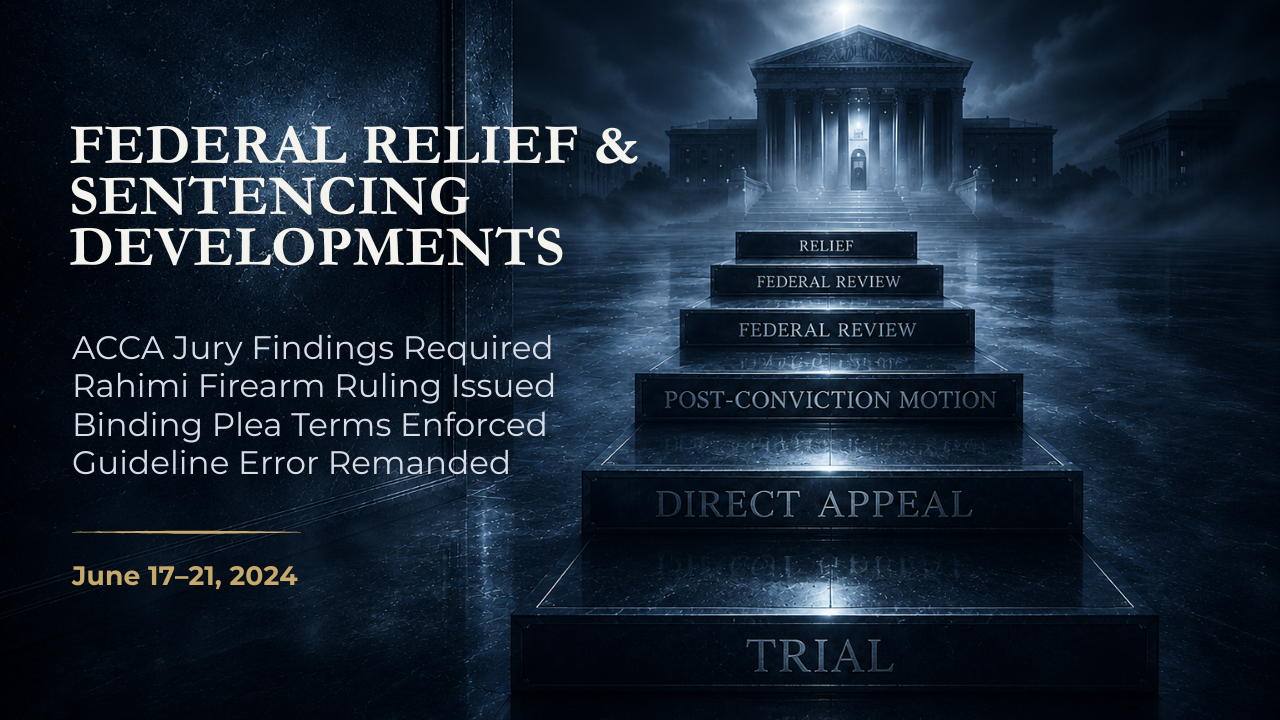
June 2024 Federal ACCA Plea Sentencing Developments
Supreme Court decisions involving ACCA jury findings, Second Amendment firearm restrictions, expert testimony, confrontation issues, Rule 11(c)(1)(C) plea agreements, aggravated-assault guideline errors, and BOP relief statistics for the week of June 17–21, 2024.
Federal Sentencing Developments Overview
June 2024 Federal ACCA Plea Sentencing Developments included major Supreme Court decisions involving ACCA different-occasions findings, § 922(g)(8) firearm restrictions, expert testimony on mental state, confrontation rights, and favorable appellate rulings involving binding plea agreements and guideline calculation errors.
This weekly update highlights developments from June 17–21, 2024, including Erlinger v. United States, United States v. Rahimi, Smith v. Arizona, Diaz v. United States, Gonzalez v. Trevino, Chiaverini v. City of Napoleon, Rule 11(c)(1)(C) plea agreements, U.S.S.G. § 2A2.2, and BOP relief statistics.
This federal relief update is provided for educational and informational purposes only. It is not legal advice and does not create legal representation.
Supreme Court Watch
Erlinger v. United States: ACCA Different-Occasions Findings Must Go to a Jury
In Erlinger v. United States, the Supreme Court held that a defendant is entitled to have a jury determine, unanimously and beyond a reasonable doubt, whether prior offenses were committed on occasions different from one another for purposes of the Armed Career Criminal Act.
This ruling is significant because ACCA can increase the sentence for a § 922(g) conviction from a lower statutory maximum to a 15-year mandatory minimum when the required predicate offenses are established.
Federal Relief Consideration: ACCA cases may deserve review where a judge, rather than a jury, decided whether prior convictions occurred on different occasions, especially if the timing, location, victims, or relationship between prior offenses was disputed.
United States v. Rahimi: Supreme Court Upholds § 922(g)(8)
In United States v. Rahimi, the Supreme Court upheld 18 U.S.C. § 922(g)(8), which prohibits firearm possession by certain individuals subject to domestic-violence restraining orders.
Although Rahimi was government-favorable on its facts, the decision did not resolve every Second Amendment question involving federal firearm statutes. Later litigation continued over other subsections of § 922(g), including felon-in-possession cases under § 922(g)(1).
Federal Relief Consideration: Federal firearm cases remain highly fact-specific and circuit-specific. Cases involving § 922(g)(1), § 922(g)(3), nonviolent prior convictions, old convictions, or individualized dangerousness arguments may still require careful review after Rahimi.
Smith v. Arizona: Confrontation Clause and Substitute Expert Testimony
In Smith v. Arizona, the Supreme Court addressed whether an expert may present statements from an absent analyst in support of the expert’s opinion.
The Court held that when an expert conveys an absent analyst’s statements and those statements support the opinion only if true, the statements are admitted for their truth. If those statements are testimonial, the Confrontation Clause may be implicated.
Federal Relief Consideration: Cases involving forensic testing, lab reports, drug analysis, DNA evidence, firearms analysis, or substitute expert testimony may deserve review where the testifying witness relied on testimonial statements from an absent analyst.
Diaz v. United States: Expert Testimony and Rule 704(b)
In Diaz v. United States, the Supreme Court addressed Federal Rule of Evidence 704(b), which limits expert testimony about whether a defendant had a mental state that constitutes an element of the charged offense.
The Court held that testimony stating that most drug couriers know they are transporting drugs did not violate Rule 704(b), because the expert did not directly state an opinion about Diaz’s own mental state.
Federal Relief Consideration: Drug-importation and courier cases may deserve review where expert testimony effectively implied knowledge, intent, or mens rea. Even after Diaz, defendants may still raise other evidentiary objections such as Rule 702, Rule 403, reliability, relevance, or unfair prejudice.
Gonzalez and Chiaverini: Fourth Amendment Civil-Rights Developments
The Supreme Court also issued decisions in Gonzalez v. Trevino and Chiaverini v. City of Napoleon, both involving Fourth Amendment-related civil-rights claims.
Gonzalez involved retaliatory arrest and the narrow exception to the probable-cause rule recognized in Nieves v. Bartlett. Chiaverini addressed malicious-prosecution claims where multiple charges were brought and at least one allegedly lacked probable cause.
Federal Relief Consideration: Although these cases arose in the civil-rights context, they may still be useful for understanding how the Supreme Court approaches probable cause, retaliatory arrest, malicious prosecution, and Fourth Amendment seizure principles.
Favorable Federal Appellate Developments
Fourth Circuit: Rule 11(c)(1)(C) Plea Agreement Enforced in United States v. Dunlap
In United States v. Dunlap, Nos. 22-4625 and 22-4646, the Fourth Circuit vacated judgments that conflicted with the stipulated sentence in Rule 11(c)(1)(C) plea agreements.
Vera and Trecika Dunlap pleaded guilty to jury tampering under written plea agreements that called for sentences of twelve months and one day. The dispute on appeal concerned whether the district court accepted or rejected the binding plea agreements before imposing higher sentences.
The Fourth Circuit held that when the record is ambiguous as to whether the district court accepted or rejected a Rule 11(c)(1)(C) plea agreement, that ambiguity must be construed in the defendant’s favor. The court remanded for reentry of judgments consistent with the stipulated sentences.
Federal Relief Consideration: Plea-agreement cases may deserve review where the court imposed a sentence higher than the Rule 11(c)(1)(C) stipulated sentence, or where the record is unclear about whether the court accepted or rejected the agreement.
Seventh Circuit: Aggravated-Assault Guideline Error in United States v. Van Sach
In United States v. Van Sach, No. 23-1367, the Seventh Circuit vacated an 87-month sentence for assaulting a correctional officer.
Van Sach challenged the district court’s calculation of the sentencing range under the aggravated-assault guideline, U.S.S.G. § 2A2.2. The government conceded that the guideline was applied in error, and the Seventh Circuit concluded that the error was not harmless.
The court vacated the sentence and remanded for resentencing.
Federal Relief Consideration: Guideline-selection errors may deserve review where the wrong guideline was applied, especially if the incorrect guideline increased the advisory range and the record does not show harmlessness.
Why Erlinger Matters for Federal Sentencing
Erlinger may become one of the most important federal sentencing decisions of 2024 for prisoners sentenced under ACCA. The decision confirms that the “different occasions” inquiry is not merely a judicial factfinding issue when it increases statutory punishment.
The decision may also influence arguments involving other sentencing enhancements where facts beyond the bare existence of a prior conviction increase mandatory minimums or statutory penalties.
Federal Relief Consideration: Cases involving ACCA, § 851 drug enhancements, recidivist enhancements, prior-release dates, incarceration-history facts, or other enhancement-related findings may require careful review after Erlinger.
Why Rahimi Still Matters for Firearm Cases
Rahimi upheld § 922(g)(8), but it did not eliminate future Second Amendment challenges to other firearm statutes. Instead, lower courts continued applying the historical-tradition framework to other categories of firearm restrictions.
The source update noted concern that Rahimi did not resolve broader felon-in-possession issues, including cases involving nonviolent prior convictions such as Range.
Federal Relief Consideration: § 922(g) firearm cases should be reviewed based on the specific subsection, the prior conviction history, the circuit, whether the issue was preserved, and whether the defendant’s conduct falls within a historically recognized category of firearm disqualification.
BOP Relief Statistics Snapshot
The source update identified Bureau of Prisons statistics available at that time, including:
- Fair Sentencing and retroactive sentence reductions: 4,143 orders granted
- Elderly Offender Home Confinement: 1,246 approved
- First Step Act releases: 34,378 granted
- Compassionate release and sentence reductions: 4,726 granted
- Residential Reentry Center population: 8,334
- Home confinement population: 4,956
Federal Relief Consideration: BOP statistics can help show how certain relief mechanisms are being used, but they do not determine whether a specific person qualifies for relief.
Fast Screening Considerations
A case-specific review may be especially important where any of the following issues appear in the record:
- ACCA sentence based on prior offenses found by a judge to be committed on different occasions
- Disputed timing, location, victims, or relationship between ACCA predicates
- § 922(g)(1), § 922(g)(3), or other firearm conviction affected by post-Rahimi litigation
- Substitute expert testimony relying on absent analyst statements
- Drug courier or importation case involving expert testimony about knowledge or intent
- Rule 11(c)(1)(C) plea agreement with unclear acceptance or rejection by the court
- Sentence imposed above a stipulated binding plea sentence
- Guideline-selection error involving U.S.S.G. § 2A2.2 or another offense guideline
- Retaliatory arrest, malicious prosecution, or probable-cause issue affecting related litigation
- BOP, First Step Act, compassionate release, or home confinement questions
What This Means for Federal Prisoners and Families
The June 17–21, 2024 developments show that federal relief may arise from Supreme Court sentencing decisions, firearm litigation, confrontation issues, expert-testimony rulings, plea-agreement enforcement, and guideline calculation errors.
These issues often require reviewing the indictment, plea agreement, sentencing transcript, presentence report, judgment, expert testimony, lab reports, prior conviction records, and whether later Supreme Court decisions affect the theory used in the case.
Why a Written Case Evaluation May Help
A written case evaluation can help identify whether a federal case involves ACCA issues after Erlinger, firearm litigation after Rahimi, confrontation issues after Smith, expert-testimony concerns after Diaz, Rule 11(c)(1)(C) plea problems, guideline-selection errors, BOP relief issues, compassionate-release factors, or other post-conviction remedies.
Because many federal relief arguments are highly fact-specific and circuit-specific, families should avoid relying on general rumor or broad headlines. A structured review can help determine what issues may actually be available.