
Latest Updates
January 2023 Federal Compassionate Release Ruan Developments
Federal appellate and Supreme Court watch developments involving compassionate release, advanced age, serious medical decline, ineffective assistance involving plea offers, warrantless parolee residence searches, Ruan medical-prescribing mens rea, attorney-client privilege, acquitted conduct sentencing, BOP relief statistics, and federal case-screening considerations for the week of January 2–6, 2023.
Federal Relief Developments Overview
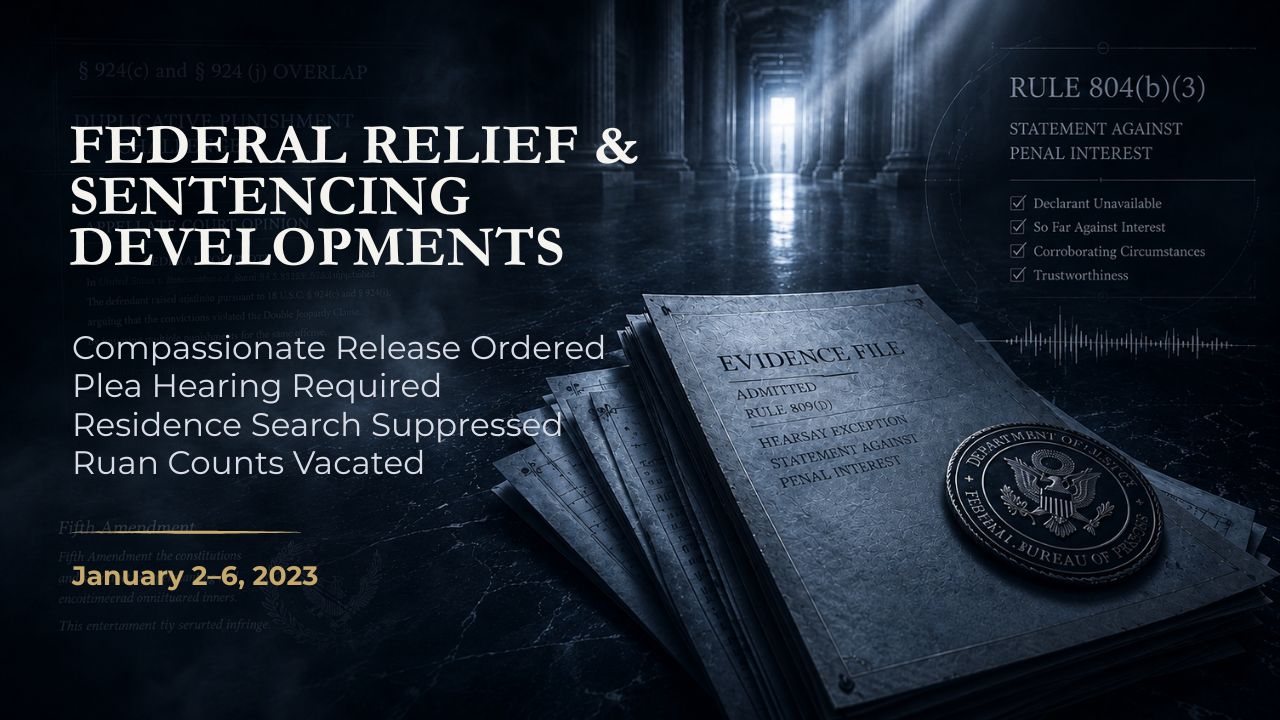
January 2023 Federal Compassionate Release Ruan Developments included Supreme Court watch activity involving acquitted conduct and attorney-client privilege, along with favorable federal appellate decisions involving compassionate release, ineffective assistance related to plea offers, warrantless searches of alleged parolee residences, and medical-prescribing jury instructions after Ruan.
This weekly update highlights developments from January 2–6, 2023, including McClinton v. United States, In re Grand Jury, United States v. Malone, Villa v. United States, United States v. Thabit, United States v. Ruan, compassionate release, 18 U.S.C. § 3582(c)(1)(A), § 3553(a), ineffective assistance, plea offers, Fourth Amendment suppression, parolee residence searches, 21 U.S.C. § 841, medical-prescribing mens rea, and BOP relief statistics.
This federal relief update is provided for educational and informational purposes only. It is not legal advice and does not create legal representation.
Supreme Court Watch
McClinton and Acquitted Conduct Sentencing
During the week ending January 6, 2023, the source update noted continuing Supreme Court attention to McClinton v. United States, a case involving acquitted conduct sentencing.
Acquitted conduct refers to conduct for which a jury returned a not-guilty verdict but which a sentencing court later considers when calculating the guideline range or selecting the final sentence.
Federal Relief Consideration: Acquitted-conduct cases may deserve review where the PSR, guideline calculation, sentencing transcript, statement of reasons, or court explanation shows that conduct rejected by a jury increased the sentence, offense level, relevant conduct, restitution, or variance analysis.
In re Grand Jury: Dual-Purpose Attorney-Client Privilege
The source update also discussed In re Grand Jury, a Supreme Court case involving dual-purpose attorney-client communications.
The question was how privilege applies when a lawyer’s communication contains both legal advice and nonlegal advice that cannot easily be separated.
The case was later dismissed by the Supreme Court as improvidently granted, but the issue remained important in cases involving privilege, subpoenas, grand jury investigations, and attorney-client communications.
Federal Relief Consideration: Privilege issues may deserve review where the government sought communications involving legal advice, tax advice, business advice, compliance advice, or mixed-purpose communications between a client and counsel.
Favorable Federal Appellate Developments
Fourth Circuit: Compassionate Release Ordered in United States v. Malone
In United States v. Malone, No. 21-6242, the Fourth Circuit reversed the denial of compassionate release and remanded with instructions to grant the motion.
Malone had served approximately 11 years of a 330-month federal sentence and sought compassionate release based on advanced age and serious health decline. The district court denied relief, and after the Bureau of Prisons placed Malone on CARES Act home confinement because of severe COVID-19 risk, he filed another compassionate-release motion.
The Fourth Circuit concluded that the district court abused its discretion by failing to properly assess Malone’s ailing health, advanced age, and the relevant § 3553(a) factors. The court held that proper consideration of those factors would likely have produced a different outcome.
Federal Relief Consideration: Compassionate-release cases may deserve review where the person is elderly, seriously ill, medically vulnerable, on home confinement, or unable to access benefits or care, and the district court did not meaningfully address the individualized circumstances and § 3553(a) factors.
Sixth Circuit: Plea-Offer Ineffective Assistance Hearing in Villa v. United States
In Villa v. United States, No. 22-5437, the Sixth Circuit vacated the denial of a § 2255-related amendment request and remanded for an evidentiary hearing.
The issue was whether counsel failed to communicate a government plea or cooperation offer. Villa argued that he did not learn about the offer until years later, after obtaining counsel’s case file. The government relied on counsel’s affidavit stating otherwise.
The Sixth Circuit concluded that the district court could not simply adopt one side’s factual account without an evidentiary hearing where competing affidavits created a factual dispute.
Federal Relief Consideration: Ineffective-assistance cases may deserve review where a plea offer, cooperation offer, or sentencing benefit was not communicated, not explained, or rejected without adequate advice, especially where affidavits or records create a factual dispute.
Eighth Circuit: Warrantless Residence Search Suppressed in United States v. Thabit
In United States v. Thabit, No. 21-4028, the Eighth Circuit affirmed suppression of evidence seized during a warrantless search.
Officers arrested Thabit on an absconder warrant near a residence and then searched the residence without a warrant. The Eighth Circuit held that officers must have probable cause to believe a dwelling is the parolee’s residence before initiating a warrantless search of a residence not known to be the parolee’s home.
Because law enforcement lacked probable cause to believe Thabit lived at the searched residence, suppression was proper.
Federal Relief Consideration: Suppression cases may deserve review where officers searched a third-party residence based on parole, probation, supervised-release, or absconder status without probable cause that the person actually lived there.
Eleventh Circuit: Ruan Mens Rea Error in United States v. Ruan
In United States v. Ruan, No. 17-12653, the Eleventh Circuit vacated substantive controlled-substance convictions after remand from the Supreme Court.
The Supreme Court had held in Ruan v. United States that, once a medical provider produces evidence that prescribing was authorized, the government must prove beyond a reasonable doubt that the defendant knowingly or intentionally acted in an unauthorized manner.
On remand, the Eleventh Circuit concluded that the jury instruction used for the substantive § 841 drug counts did not convey the required mens rea and that the error was not harmless beyond a reasonable doubt for several counts involving Dr. Ruan and Dr. Couch.
Federal Relief Consideration: Medical-prescribing prosecutions may deserve review where jury instructions allowed conviction based on an objective standard, negligence-like standard, or lack of “usual course” compliance without requiring proof that the defendant knowingly or intentionally acted without authorization.
Why Compassionate Release Review Matters
Compassionate release under 18 U.S.C. § 3582(c)(1)(A) allows a court to reduce a sentence when extraordinary and compelling reasons exist, statutory exhaustion has been satisfied, and the § 3553(a) factors support relief.
Advanced age, serious medical decline, COVID vulnerability, home confinement, sentence length, rehabilitation, and care needs may all matter depending on the record and current law.
Federal Relief Consideration: Compassionate-release review may require medical records, BOP records, CARES Act home-confinement records, administrative remedy documents, age-related records, release plan, disciplinary history, rehabilitation evidence, and sentencing records.
Why Plea-Offer Ineffective Assistance Matters
Defense counsel generally must communicate formal plea offers and provide competent advice about the risks and benefits of accepting or rejecting them.
If a defendant lost the opportunity for a more favorable plea, cooperation agreement, or sentencing benefit because counsel failed to communicate or explain an offer, the issue may support post-conviction review.
Federal Relief Consideration: Plea-offer review may require prosecutor emails, defense counsel files, plea drafts, cooperation letters, affidavits, correspondence, sentencing exposure comparisons, and testimony from counsel and the defendant.
Why Parolee Residence Search Review Matters
People on parole, probation, or supervised release may have reduced privacy expectations, but officers still must satisfy the legal requirements that apply before searching a residence.
A residence search may be unlawful where officers search a third party’s home without probable cause that the supervised person actually resides there.
Federal Relief Consideration: Residence-search review may require arrest records, surveillance logs, informant tips, address records, utility records, mail records, clothing or property evidence, warrant information, bodycam footage, and suppression hearing transcripts.
Why Ruan Review Matters for Medical Providers
Ruan changed how courts must instruct juries in certain controlled-substance prescribing cases. The government must prove the defendant’s subjective mens rea once authorization is at issue.
This may affect doctors, nurse practitioners, physician assistants, clinic owners, pharmacists, and others charged under controlled-substance distribution theories involving medical treatment.
Federal Relief Consideration: Medical-provider review may require the indictment, prescription records, expert testimony, good-faith evidence, jury instructions, objections, verdict form, harmless-error analysis, and whether all counts were affected by the instruction.
Why Acquitted Conduct and Privilege Issues Matter
Supreme Court watch issues can affect future federal relief screening even before the Court issues a final decision. Acquitted conduct and attorney-client privilege both involve core fairness concerns in criminal proceedings.
Federal Relief Consideration: Acquitted-conduct review may require sentencing records, verdict forms, and relevant-conduct findings. Privilege review may require subpoenas, privilege logs, attorney communications, grand jury records, and rulings on legal versus nonlegal advice.
BOP Relief Statistics Snapshot
The source update identified Bureau of Prisons statistics available at that time, including:
- Fair Sentencing and retroactive sentence reductions: 3,979 orders granted
- Elderly Offender Home Confinement: 1,217 approved
- First Step Act releases: 11,564 granted
- Compassionate release and sentence reductions: 4,390 granted
The source update also noted that five new compassionate-release motions were granted during the week.
Federal Relief Consideration: BOP and compassionate-release statistics can provide context, but they do not determine whether a specific person qualifies for relief.
Fast Screening Considerations
A case-specific review may be especially important where any of the following issues appear in the record:
- Compassionate-release denial failed to address advanced age or serious medical decline
- Defendant was placed on CARES Act home confinement due to medical risk
- District court relied on outdated compassionate-release policy statement
- Counsel may have failed to communicate a plea or cooperation offer
- § 2255 record contains competing affidavits requiring an evidentiary hearing
- Officers searched a residence based on parolee status without probable cause the person lived there
- Residence searched belonged to or was controlled by a third party
- Medical-prescribing conviction involved pre-Ruan jury instructions
- Controlled-substance provider case involved good-faith or authorization evidence
- Sentence was increased based on acquitted conduct or disputed relevant conduct
What This Means for Federal Prisoners and Families
The January 2–6, 2023 developments show that federal relief may arise from compassionate-release errors, plea-offer ineffective assistance, unlawful residence searches, Ruan jury-instruction problems, acquitted-conduct sentencing concerns, and privilege issues in criminal investigations.
These issues often require reviewing the judgment, PSR, sentencing transcript, compassionate-release motion, BOP medical records, administrative remedy records, plea-offer communications, counsel files, suppression records, search evidence, jury instructions, verdict forms, and appellate history.
Why a Written Case Evaluation May Help
A written case evaluation can help identify whether a federal case involves compassionate-release factors, advanced age or medical-risk issues, plea-offer ineffective assistance, Fourth Amendment suppression problems, Ruan jury-instruction errors, medical-provider defense issues, acquitted-conduct sentencing concerns, attorney-client privilege issues, First Step Act credits, § 2255 issues, § 2241 issues, or other post-conviction remedies.
Because many federal relief arguments are highly fact-specific, circuit-specific, and procedure-specific, families should avoid relying on general rumor or broad headlines. A structured review can help determine what issues may actually be available.