
Latest Updates
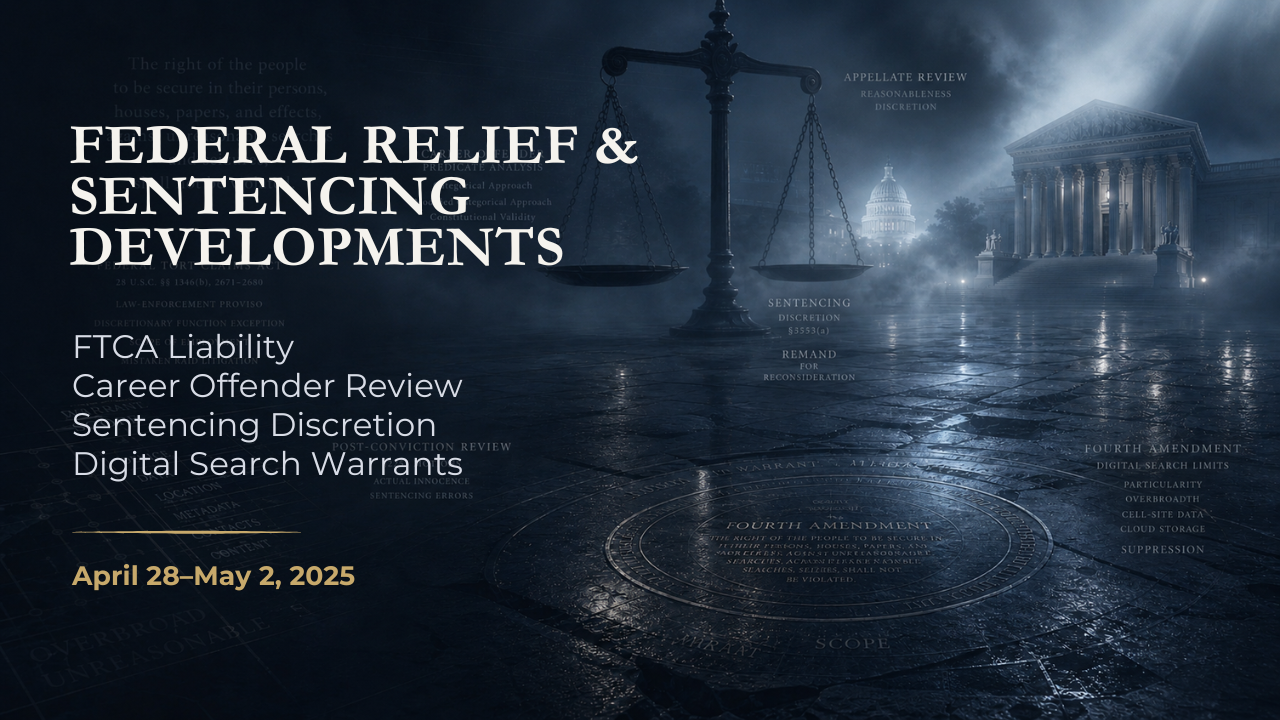
Federal Relief & Sentencing Developments — April 28–May 2, 2025
Supreme Court FTCA litigation, law-enforcement liability, career offender predicate challenges, federal sentencing review, appellate sentencing discretion, and Fourth Amendment digital search suppression.
This federal sentencing developments bulletin reviews recent Supreme Court and appellate activity affecting federal relief strategy, sentencing enhancements, search warrants, suppression litigation, and post-conviction review.
Federal Sentencing Developments Executive Summary
Recent federal sentencing developments include Supreme Court argument involving a mistaken FBI SWAT raid and whether federal agents may be shielded from liability under the Federal Tort Claims Act.
This update also reviews federal decisions involving career offender enhancements, appellate sentencing review, and suppression of evidence obtained through an overbroad cellphone search warrant.
Supreme Court Watch
FTCA Liability & Mistaken Law-Enforcement Raids
The Supreme Court heard argument in a case involving a mistaken FBI SWAT raid and whether claims against the federal government may proceed under the Federal Tort Claims Act.
The case involved questions about how the FTCA’s discretionary function exception interacts with the law-enforcement proviso, which allows certain claims involving federal law-enforcement misconduct.
Federal Relief Consideration: Although this issue does not directly involve criminal sentencing, law-enforcement liability cases may affect civil claims involving federal raids, wrongful searches, excessive force, false arrest, trespass, and emotional distress.
Pattern-or-Practice Discrimination & Limitations Issues
The Court was also monitoring a relisted case involving when the statute of limitations begins for claims alleging a pattern or practice of racial discrimination.
Federal Relief Consideration: Limitations issues can be important in federal civil-rights litigation, especially where a claim involves repeated conduct, continuing violations, or delayed discovery of harm.
Favorable Federal Appellate Decisions
Career Offender Predicate Challenges — Third Circuit
In United States v. Payo, the Third Circuit vacated a career offender sentence after reviewing whether prior robbery convictions qualified as crimes of violence.
The district court had relied on a docket sheet not produced by the government and on an argument the government had not advanced. The appellate court disagreed with both approaches and remanded for further proceedings.
Federal Relief Consideration: Career offender enhancements may require careful review of prior convictions, Shepard documents, categorical-approach arguments, government burden, and whether the sentencing court relied on proper materials.
Related resource: Understanding Federal Sentencing
Federal Sentencing Review & Appellate Guidelines Concerns
In United States v. Shields, a federal resentencing opinion addressed broader concerns about federal sentencing review in the post-Booker era.
The opinion discussed the relationship between district court discretion and appellate review, including concerns that appellate courts may sometimes create practical sentencing rules through procedural-review doctrines.
Federal Relief Consideration: Sentencing review often depends on whether the district court properly explained its reasoning, addressed relevant mitigation, applied the Guidelines correctly, and followed appellate mandates on remand.
Fourth Amendment Cellphone Search Suppression — Tenth Circuit
In United States v. Santiago, the Tenth Circuit reversed the denial of a suppression motion involving evidence obtained from an iPhone.
The phone was first searched under an impermissibly broad state warrant. A later federal warrant relied on information obtained from that initial search, causing the Fourth Amendment issue to affect the later search as well.
The appellate court vacated the conviction and sentence and remanded for further proceedings.
Federal Relief Consideration: Digital search cases may require careful review of warrant scope, particularity, overbreadth, affidavit content, tainted evidence, and whether later warrants relied on unlawfully obtained information.
Why These Federal Sentencing Developments Matter
These developments show how federal relief issues may arise from law-enforcement search conduct, career offender predicate analysis, sentencing explanation, appellate mandates, and Fourth Amendment digital privacy violations.
Federal relief analysis is highly case-specific. Search warrants, warrant affidavits, cellphone extraction records, sentencing transcripts, prior conviction documents, PSRs, plea agreements, and appellate records may all affect whether a development applies to a particular case.