
Latest Updates
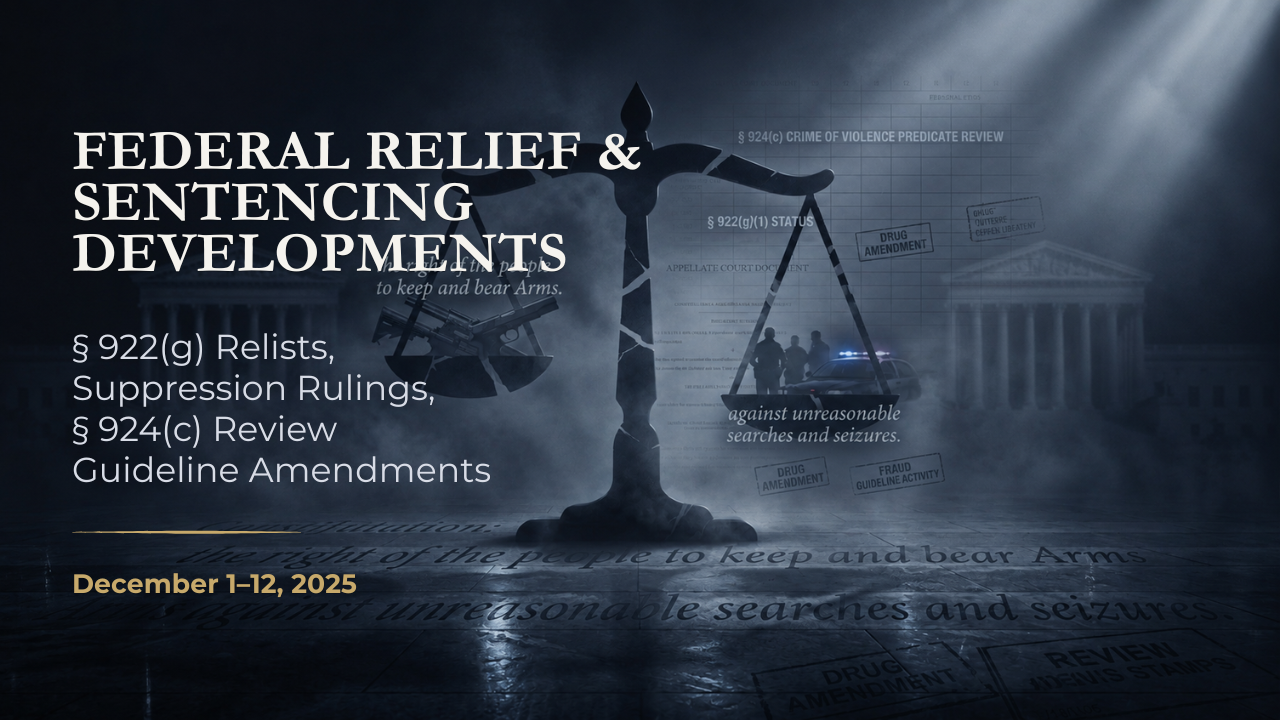
Federal Relief & Sentencing Developments — December 1–12, 2025
Supreme Court relists, Second Amendment firearm litigation, Fourth Amendment suppression issues, supervised release conditions, § 924(c) crime-of-violence challenges, jury-instruction error, and 2026 Sentencing Guidelines amendment activity.
This federal sentencing developments bulletin reviews recent appellate decisions and federal relief considerations involving constitutional litigation, post-conviction review, federal sentencing procedure, and guideline reform.
Federal Sentencing Developments Executive Summary
Recent federal sentencing developments include significant Supreme Court activity involving relisted criminal cases, including a large number of challenges to 18 U.S.C. § 922(g)(1), the federal felon-in-possession statute.
This update also reviews favorable appellate decisions involving prolonged traffic stops, supervised release conditions, § 924(c) predicates, jury-instruction error, and upcoming Sentencing Commission activity involving drug and fraud guideline amendments.
Supreme Court Watch
§ 922(g)(1) Relists & Second Amendment Litigation
The Supreme Court added numerous relisted cases involving challenges to 18 U.S.C. § 922(g)(1), the federal felon-in-possession statute.
Relists occur when the Court holds a petition over for additional conference consideration, which may suggest that the justices are taking a closer look at whether a case is an appropriate vehicle for review.
Federal Relief Consideration: Second Amendment litigation involving § 922(g)(1) remains an important area to monitor, especially for federal defendants and inmates with firearm convictions tied to prior convictions.
Other Supreme Court Activity
The Court also continued filling its argument calendar with cases involving venue for criminal trials, federal court authority over arbitration-related issues, the Rooker-Feldman doctrine, and other federal jurisdiction questions.
Federal Relief Consideration: Supreme Court rulings involving venue, jurisdiction, and constitutional rights may affect federal criminal litigation, direct appeals, and post-conviction arguments depending on the procedural history of a case.
Favorable Federal Appellate Decisions
Fourth Amendment Traffic Stop Suppression — Fourth Circuit
In United States v. Hawkins, the Fourth Circuit reversed the denial of suppression after concluding that officers unlawfully prolonged a traffic stop to investigate suspected drug activity.
The court determined that the facts relied on by the government did not establish reasonable suspicion to extend the stop beyond the traffic-related mission.
Federal Relief Consideration: Suppression issues may be important where a traffic stop was extended for a K-9 sniff, drug investigation, search, or pat-down after the original traffic purpose should have ended.
Supervised Release Conditions — Fifth Circuit
In United States v. Currier, the Fifth Circuit addressed discretionary supervised release conditions that appeared in the written judgment but were not orally pronounced at sentencing.
The court emphasized that discretionary conditions in the written judgment must match the oral sentence, and conflicting written conditions may require correction on remand.
Federal Relief Consideration: Written judgments should be reviewed carefully where supervised release conditions appear stricter, broader, or different from what the sentencing judge actually stated in court.
§ 924(c) Crime-of-Violence Predicate — Fifth Circuit
In United States v. Elkins, the Fifth Circuit vacated a § 924(c) conviction and related life sentence after reviewing whether cyberstalking qualified as a crime of violence.
The court concluded that the relevant cyberstalking statute was divisible and that one version was not categorically a crime of violence. Because the verdict could have rested on that version, the § 924(c) conviction could not stand.
Federal Relief Consideration: § 924(c) convictions may require review where the predicate offense is a non-force statute, a divisible statute, or an offense that may not categorically qualify as a crime of violence.
Jury Instruction Error & Involuntary Intoxication Defense — Tenth Circuit
In United States v. Rainford, the Tenth Circuit reversed and ordered a new trial after finding legal error in jury instructions involving an involuntary intoxication defense.
The defendant’s defense involved medication-related intoxication. The appellate court concluded that the jury instructions improperly treated certain facts as automatic bars to the defense rather than evidence for the jury to weigh.
Federal Relief Consideration: Jury-instruction issues may be significant where the trial court misstated a defense, limited a mental-state theory, or gave instructions that prevented the jury from properly considering the defense.
Sentencing Commission & 2026 Guideline Amendments
The U.S. Sentencing Commission scheduled public activity involving proposed 2026 guideline amendments, including possible changes to drug and fraud guideline provisions.
Drug Guidelines — U.S.S.G. § 2D1.1
Potential drug guideline changes may involve penalty structure issues, including methamphetamine purity considerations and how drug quantities affect federal sentencing calculations.
Federal Relief Consideration: Drug guideline amendments may eventually affect sentencing arguments, compassionate release considerations, or future guideline analysis depending on final amendment language and retroactivity decisions.
Fraud & Theft Guidelines — U.S.S.G. § 2B1.1
Potential fraud guideline changes may involve loss calculations, intended loss, actual loss, gain, victim impact, role considerations, and possible simplification or adjustment of the loss table.
Federal Relief Consideration: Fraud sentencing issues often depend heavily on loss amount, victim impact, role adjustments, and whether the guideline calculation accurately reflects culpability.
Learn more: Understanding Federal Sentencing
Why These Federal Sentencing Developments Matter
These developments show how federal relief issues may arise from constitutional questions, traffic-stop procedure, firearm predicates, written judgment errors, jury instructions, and sentencing guideline calculations.
Federal relief analysis is highly case-specific. Suppression motions, plea agreements, appeal waivers, sentencing transcripts, jury instructions, written judgments, guideline worksheets, and prior convictions may all affect whether a development is relevant to a particular case.