
Latest Updates
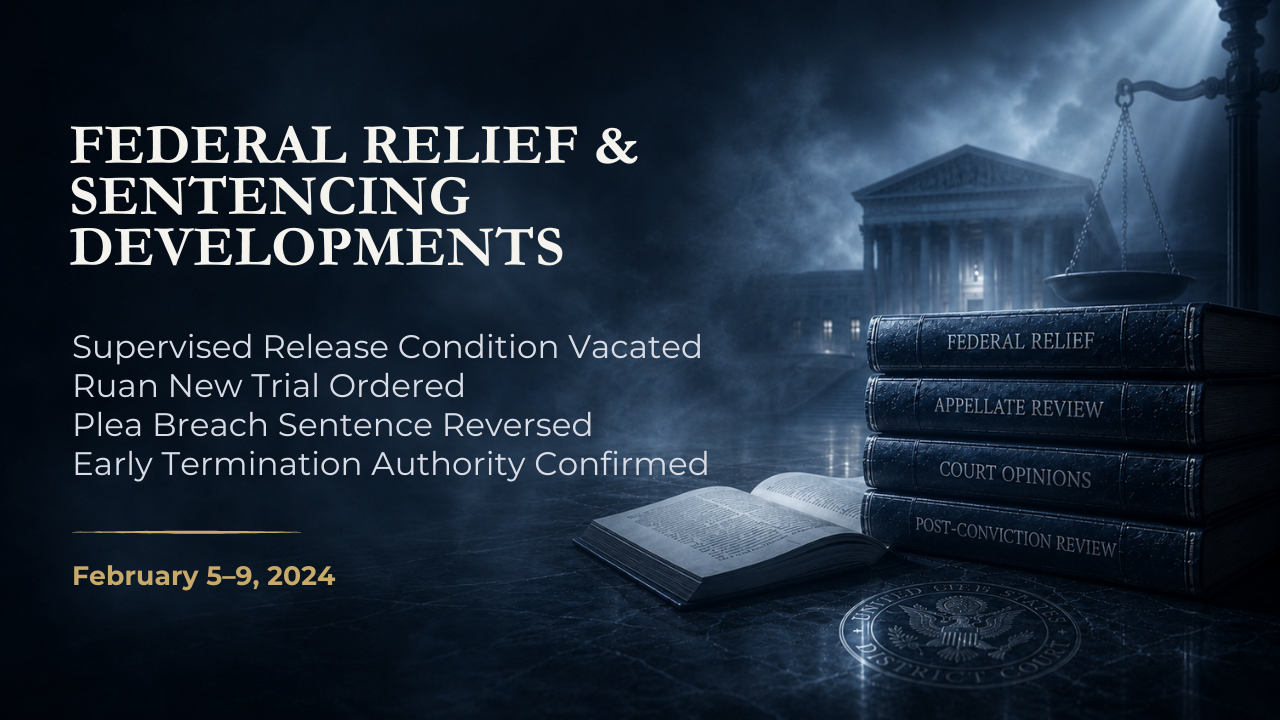
February 2024 Federal Plea Supervised Release Developments
Federal appellate decisions involving supervised-release condition limits, Ruan jury-instruction errors, plea-agreement breaches, early termination of supervised release, crime-of-violence predicate review, Sentencing Commission guideline-amendment monitoring, and BOP relief statistics for the week of February 5–9, 2024.
Federal Sentencing Developments Overview
February 2024 Federal Plea Supervised Release Developments included favorable appellate rulings involving overbroad supervised-release gang-association conditions, opioid-prescribing convictions after Ruan, government plea-agreement breaches, early termination authority under § 3583(e)(1), and crime-of-violence predicate errors after Borden.
This weekly update highlights developments from February 5–9, 2024, including United States v. Sims, United States v. Smithers, United States v. Malmquist, United States v. Lester, United States v. Devereaux, supervised-release conditions, unauthorized controlled-substance prescribing, acceptance-of-responsibility plea promises, early termination of supervised release, 18 U.S.C. § 113(a)(6), and BOP relief statistics.
This federal relief update is provided for educational and informational purposes only. It is not legal advice and does not create legal representation.
Supreme Court Watch
February Supreme Court Conference Schedule
During the week of February 5–9, 2024, the source update noted that the Supreme Court’s next conference was scheduled for February 16, 2024, with orders expected after that conference.
No new Supreme Court criminal-law opinion was identified in the source update for this week, but several major criminal and sentencing cases remained pending during the 2023 Term.
Federal Relief Consideration: Even when no new Supreme Court criminal opinion is issued during a particular week, pending Supreme Court matters may still affect federal relief screening involving firearms, statutory interpretation, sentencing procedure, supervised release, and post-conviction review.
Favorable Federal Appellate Developments
Second Circuit: Gang-Association Supervised-Release Condition Vacated in United States v. Sims
In United States v. Sims, No. 21-3015, the Second Circuit vacated a special supervised-release condition that prohibited Sims from associating with members, associates, or prospects of a named gang or any other criminal gang, club, or organization.
Sims had pleaded guilty to possessing a firearm after a prior felony conviction under 18 U.S.C. § 922(g). On appeal, he challenged the association condition as unsupported, overbroad, and vague.
The Second Circuit agreed that the district court’s sentencing explanation and the record did not show the findings needed to impose the condition. The court vacated the condition and remanded for the limited purpose of allowing the district court to explain its reasoning or develop the record as needed.
Federal Relief Consideration: Supervised-release cases may deserve review where association bans, gang restrictions, internet limits, search conditions, travel restrictions, or other special conditions were imposed without individualized findings or were written too broadly.
Fourth Circuit: New Trial Ordered After Ruan Error in United States v. Smithers
In United States v. Smithers, No. 19-4761, the Fourth Circuit vacated convictions and remanded for a new trial in an opioid-prescribing prosecution.
Smithers, formerly a doctor of osteopathy, had been convicted on hundreds of counts related to opioid-prescription practices and sentenced to 480 months in prison.
After his conviction, the Supreme Court decided Ruan v. United States, clarifying the mens rea required for unauthorized controlled-substance prescribing prosecutions. The Fourth Circuit concluded that the jury instructions in Smithers’s case misstated the law and that the errors were not harmless.
Federal Relief Consideration: Controlled-substance prescribing cases may deserve review where the jury instructions failed to require proof that the provider knowingly or intentionally acted in an unauthorized manner, especially in cases tried before Ruan.
Fifth Circuit: Plea-Agreement Breach in United States v. Malmquist
In United States v. Malmquist, No. 22-50872, the Fifth Circuit vacated a sentence after finding that the government breached the plea agreement.
Malmquist pleaded guilty to conspiracy to possess with intent to distribute 50 grams or more of methamphetamine. The plea agreement included the government’s promise to recommend a three-level reduction for acceptance of responsibility.
At sentencing, the government opposed the reduction. The Fifth Circuit concluded that this breach constituted plain error because it affected Malmquist’s substantial rights and called into question the fairness, integrity, and public reputation of the proceedings.
The sentence was vacated and the case was remanded for resentencing.
Federal Relief Consideration: Plea-agreement cases may deserve review where the government promised to recommend acceptance of responsibility, a specific offense level, a sentencing range, dismissal of counts, or another sentencing position but later argued against that promise.
Eighth Circuit: Early Termination Authority Recognized in United States v. Lester
In United States v. Lester, No. 23-2176, the Eighth Circuit reversed and remanded after the district court concluded it lacked authority to consider early termination of supervised release.
The issue involved whether 21 U.S.C. § 841(b)(1)(A), which requires imposition of a supervised-release term, prevents a district court from later terminating supervised release early under 18 U.S.C. § 3583(e)(1).
The Eighth Circuit held that § 841(b)(1)(A) requires the court to impose the statutory supervised-release term at sentencing, but it does not prevent the court from later considering early termination after the defendant has served at least one year of supervised release.
Federal Relief Consideration: People serving supervised release may deserve review for early termination where they have completed at least one year, maintained compliance, completed programming, shown low risk, and can present a strong record supporting termination under § 3583(e)(1).
Tenth Circuit: Assault Resulting in Serious Bodily Injury Not a Crime of Violence in United States v. Devereaux
In United States v. Devereaux, No. 22-1203, the Tenth Circuit vacated a sentence after concluding that the district court improperly treated a prior conviction under 18 U.S.C. § 113(a)(6) as a crime of violence.
Devereaux was sentenced for being a felon in possession of a firearm. The district court increased his base offense level after treating his prior federal conviction for assault resulting in serious bodily injury as a qualifying crime of violence.
The Tenth Circuit held that § 113(a)(6) is indivisible and can be committed recklessly. Because reckless conduct does not satisfy the elements-clause force requirement after Borden v. United States, the prior conviction did not categorically qualify as a crime of violence.
Federal Relief Consideration: Firearm and guideline cases may deserve review where a prior assault, aggravated assault, robbery, or violent-offense conviction was treated as a crime of violence even though the statute can be violated recklessly or through conduct broader than the federal elements clause.
Sentencing Commission Watch
Guideline Amendment Monitoring: Compassionate Release, Acquitted Conduct, and Related Issues
The source update referenced Sentencing Commission activity involving proposed guideline amendments, including topics such as compassionate release, sexual abuse of a ward, and acquitted conduct.
However, the source language appears to reference the 2023 amendment cycle and February 2023 public hearing schedule. For this February 2024 update, the more accurate takeaway is that guideline amendment activity remained important to federal sentencing monitoring, including later 2024 attention to acquitted conduct and other guideline issues.
Federal Relief Consideration: Cases may deserve review where a sentence was affected by compassionate-release policy changes, acquitted conduct, guideline amendments, criminal-history amendments, status points, zero-point offender rules, or other guideline changes that may apply prospectively or retroactively.
Why Supervised-Release Condition Review Matters
Supervised-release conditions can significantly affect daily life, housing, family relationships, employment, travel, internet access, and reentry stability.
Special conditions usually require an individualized explanation showing how the condition relates to the offense, the defendant’s history, deterrence, public protection, and rehabilitation, while imposing no greater deprivation of liberty than reasonably necessary.
Federal Relief Consideration: A supervised-release review may require comparing the oral sentence, written judgment, PSR recommendation, sentencing objections, court explanation, and whether the condition is vague, overbroad, or unsupported by the record.
Why Ruan Matters for Medical Provider Cases
Ruan changed the way courts analyze certain controlled-substance prescribing prosecutions. The government must prove that the provider knowingly or intentionally acted in an unauthorized manner, not merely that the prescribing fell below an objective medical standard.
Federal Relief Consideration: Provider cases may require review of the indictment, jury instructions, good-faith instruction, expert testimony, trial objections, closing arguments, verdict form, and whether the jury was properly instructed on the required mental state.
Why Plea Promises Matter at Sentencing
Defendants often give up trial rights, appellate rights, and other protections in exchange for the government’s promises. When the government breaches those promises, resentencing may be required even if the defendant did not object at the time.
Federal Relief Consideration: Plea-breach review may require comparing the plea agreement, change-of-plea transcript, PSR, government objections, sentencing memorandum, oral argument, and the final guideline calculation.
Why Early Termination of Supervised Release Matters
Early termination under § 3583(e)(1) may be available after a person has served at least one year of supervised release, depending on the person’s conduct and the interests of justice.
Lester is important because it confirms that a mandatory supervised-release term imposed at sentencing does not necessarily eliminate the court’s later authority to consider early termination.
Federal Relief Consideration: Early termination screening may require reviewing the judgment, offense history, supervision performance, drug testing history, restitution status, employment, programming, probation position, risk level, and post-release conduct.
Why Crime-of-Violence Predicate Review Matters
Predicate classifications can significantly increase guideline ranges and statutory penalties. After Borden, offenses that can be committed with a reckless mental state may not qualify under elements clauses requiring the use of force against another person.
Federal Relief Consideration: Predicate review may require examining the statute of conviction, divisibility, Shepard documents, plea records, charging documents, judgments, and later circuit authority interpreting the offense.
BOP Relief Statistics Snapshot
The source update identified Bureau of Prisons statistics available at that time, including:
- Fair Sentencing and retroactive sentence reductions: 4,133 orders granted
- Elderly Offender Home Confinement: 1,247 approved
- First Step Act releases: 29,021 granted
- Compassionate release and sentence reductions: 4,682 granted
- Residential Reentry Center population: 7,950
- Home confinement population: 5,115
Federal Relief Consideration: BOP statistics can help show how certain relief mechanisms are being used, but they do not determine whether a specific person qualifies for relief.
Fast Screening Considerations
A case-specific review may be especially important where any of the following issues appear in the record:
- Special supervised-release condition imposed without individualized explanation
- Gang-association, club-association, internet, search, travel, or contact ban that may be vague or overbroad
- Controlled-substance prescribing conviction tried before Ruan
- Jury instruction failed to require knowing or intentional unauthorized conduct
- Government promised acceptance-of-responsibility credit but opposed it at sentencing
- Plea agreement promised a specific guideline recommendation later undermined by the government
- Motion for early termination of supervised release denied because the court believed it lacked authority
- Mandatory drug supervised-release term treated as barring early termination
- Prior assault conviction used as a crime-of-violence predicate despite reckless mens rea
- BOP, First Step Act, compassionate release, home confinement, or guideline amendment questions
What This Means for Federal Prisoners and Families
The February 5–9, 2024 developments show that federal relief may arise from unsupported supervised-release conditions, Ruan jury-instruction errors, plea-agreement breaches, early termination authority errors, and crime-of-violence predicate mistakes.
These issues often require reviewing the sentencing transcript, written judgment, plea agreement, PSR, jury instructions, trial record, supervised-release record, prior conviction documents, BOP records, and appellate history.
Why a Written Case Evaluation May Help
A written case evaluation can help identify whether a federal case involves supervised-release condition errors, Ruan-based trial issues, plea-agreement breach claims, early termination questions, crime-of-violence predicate problems, guideline amendment issues, BOP relief questions, compassionate-release factors, or other post-conviction remedies.
Because many federal relief arguments are highly fact-specific and circuit-specific, families should avoid relying on general rumor or broad headlines. A structured review can help determine what issues may actually be available.