
Latest Updates
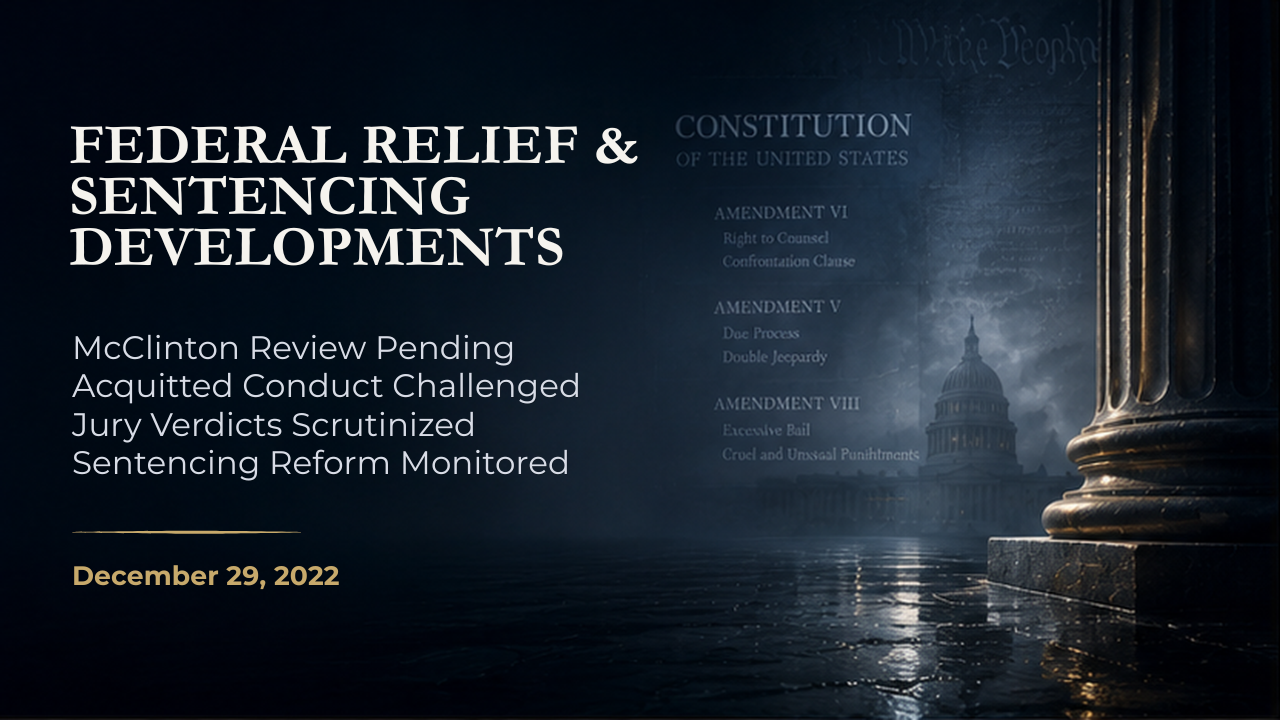
December 2022 Federal Acquitted Conduct Sentencing Update
Special federal sentencing update covering McClinton v. United States, acquitted conduct sentencing, United States v. Watts, jury acquittals, guideline enhancements, Supreme Court review, compassionate release statistics, Fair Sentencing Act relief, and federal case-screening considerations.
Federal Sentencing Update Overview
December 2022 Federal Acquitted Conduct Sentencing Update focused on McClinton v. United States, a Supreme Court petition challenging the long-standing federal sentencing practice of allowing judges to consider acquitted conduct when calculating or selecting a sentence.
The update also addressed broader federal relief screening issues involving acquitted conduct, guideline enhancements, jury acquittals, compassionate release, Fair Sentencing Act reductions, First Step Act credits, and post-conviction review.
This federal relief update is provided for educational and informational purposes only. It is not legal advice and does not create legal representation.
Supreme Court Watch
McClinton v. United States and Acquitted Conduct Sentencing
McClinton v. United States, No. 21-1557, was scheduled for consideration at the Supreme Court’s January 2023 conference.
The case raised an important question about acquitted conduct sentencing. Acquitted conduct refers to conduct for which a jury returned a not-guilty verdict, but which the sentencing judge later considers when calculating the guideline range or deciding the final sentence.
In McClinton, the defendant was convicted of robbery-related charges but acquitted of murder-related conduct. At sentencing, the court nevertheless considered the alleged killing and imposed a much longer sentence than the guideline range that would have applied without that conduct.
Federal Relief Consideration: Acquitted-conduct cases may deserve review where the PSR, sentencing transcript, guideline calculation, statement of reasons, or court explanation shows that conduct rejected by a jury increased the sentence, offense level, relevant conduct, restitution, or variance analysis.
Background: United States v. Watts
The federal practice of considering acquitted conduct at sentencing has long been tied to United States v. Watts, a 1997 Supreme Court decision allowing sentencing courts to consider acquitted conduct under a preponderance-of-the-evidence standard, at least within certain statutory limits.
Critics of acquitted-conduct sentencing argue that the practice undermines the jury’s not-guilty verdict, the reasonable-doubt standard, and the Sixth Amendment right to trial by jury.
Supporters have argued that sentencing courts historically consider a broad range of conduct and that an acquittal does not necessarily mean the conduct did not occur, only that the government failed to prove it beyond a reasonable doubt.
Federal Relief Consideration: Because acquitted-conduct law has changed through guideline amendments and continues to involve constitutional debate, any case involving acquitted conduct should be reviewed under the law in effect at the relevant sentencing, appeal, or post-conviction stage.
Why McClinton Was Important
McClinton was important because it presented the Supreme Court with a direct opportunity to reconsider whether acquitted conduct may be used to increase a federal sentence.
Several Justices had previously expressed concern about the practice. In earlier years, some Justices questioned whether it is fair or constitutional for a judge to increase punishment based on conduct a jury rejected.
Although the Supreme Court ultimately denied certiorari in McClinton in 2023, the issue remained active in federal sentencing reform discussions and later became part of the U.S. Sentencing Commission’s amendment process.
Federal Relief Consideration: Even when the Supreme Court does not grant review, a case may still involve preserved sentencing issues, guideline objections, direct appeal arguments, compassionate-release considerations, or later guideline-amendment screening.
Sentencing Commission Activity After McClinton
After this December 2022 update, the U.S. Sentencing Commission later adopted Amendment 826, which amended the guidelines to limit the use of acquitted conduct in determining the guideline range.
Amendment 826 generally provides that relevant conduct does not include conduct for which the defendant was criminally charged and acquitted in federal court, unless that conduct also establishes, in whole or in part, the instant offense of conviction.
Federal Relief Consideration: Amendment 826 may be important for future sentencings and guideline calculations, but amendment-based relief depends on effective dates, retroactivity rules, procedural posture, and whether the original sentence was actually affected by acquitted conduct.
Why Acquitted Conduct Review Matters
Acquitted conduct can significantly affect a sentence. In some cases, the conduct may increase the offense level, trigger a cross-reference, increase drug quantity, increase loss amount, affect firearm findings, support an upward variance, or influence restitution and supervised-release conditions.
The concern is especially serious where the conduct substantially increases the guideline range or final sentence despite the jury’s not-guilty verdict.
Federal Relief Consideration: A proper review should determine whether the sentencing court actually relied on acquitted conduct, whether objections were preserved, whether the issue was raised on appeal, and whether the case may be affected by later guideline changes.
Common Records Needed for Acquitted-Conduct Screening
Acquitted-conduct review often requires more than the judgment alone. The key issue is whether the sentencing court used conduct connected to counts or allegations rejected by the jury.
- Indictment and superseding indictments
- Jury instructions
- Verdict form
- Presentence Investigation Report
- Sentencing objections
- Sentencing memorandum
- Statement of reasons
- Sentencing transcript
- Judgment
- Direct appeal and post-conviction history
Federal Relief Consideration: The strongest screening usually compares the acquitted counts, the PSR’s relevant-conduct findings, and the sentencing judge’s explanation for the sentence imposed.
Compassionate Release and Sentence-Reduction Context
The source update also noted that six new compassionate-release motions and four Fair Sentencing Act or retroactive sentence-reduction requests were granted during the week.
These statistics provide context for federal relief activity, but they do not determine whether any particular person qualifies for relief.
Federal Relief Consideration: Compassionate release, Fair Sentencing Act review, retroactive guideline reductions, First Step Act credits, § 2255 motions, § 2241 petitions, and clemency are separate pathways with different rules and standards.
Why Acquitted Conduct Is Different From Other Relevant Conduct
Federal sentencing courts often consider relevant conduct beyond the offense of conviction. But acquitted conduct is different because the jury specifically returned a not-guilty verdict on the conduct or count.
That distinction is why acquitted conduct has drawn repeated scrutiny from judges, defense groups, sentencing scholars, Congress, and the Sentencing Commission.
Federal Relief Consideration: Relevant-conduct review should separate uncharged conduct, dismissed conduct, stipulated conduct, admitted conduct, and acquitted conduct. Each category may raise different legal and procedural issues.
Fast Screening Considerations
A case-specific review may be especially important where any of the following issues appear in the record:
- Jury acquitted the defendant of one or more counts
- PSR still relied on the acquitted conduct as relevant conduct
- Acquitted conduct increased the offense level or guideline range
- Sentencing court applied a cross-reference based on acquitted conduct
- Acquitted conduct increased drug quantity, loss amount, or firearm findings
- Judge imposed an upward variance based on acquitted conduct
- Sentencing transcript references conduct rejected by the jury
- Direct appeal preserved acquitted-conduct or Sixth Amendment arguments
- Case may be affected by later guideline amendments on acquitted conduct
- Other relief may exist through compassionate release, First Step Act review, § 2255, § 2241, or clemency
What This Means for Federal Prisoners and Families
The December 29, 2022 McClinton update shows why acquitted conduct remains an important federal sentencing issue. A person may have been acquitted by a jury but still received a longer sentence because the sentencing judge considered the same conduct under a lower evidentiary standard.
These issues often require detailed review of the trial record, verdict form, PSR, objections, sentencing transcript, guideline calculations, appellate history, and later guideline amendments.
Why a Written Case Evaluation May Help
A written case evaluation can help identify whether a federal case involves acquitted-conduct sentencing, relevant-conduct disputes, guideline cross-references, drug-quantity or loss-amount issues, firearm findings, upward variances, compassionate-release factors, Fair Sentencing Act relief, First Step Act credits, § 2255 issues, § 2241 issues, clemency considerations, or other post-conviction remedies.
Because acquitted-conduct issues are highly record-specific and procedure-specific, families should avoid relying on general headlines alone. A structured review can help determine whether acquitted conduct actually affected the sentence and whether any relief pathway may apply.