
Latest Updates
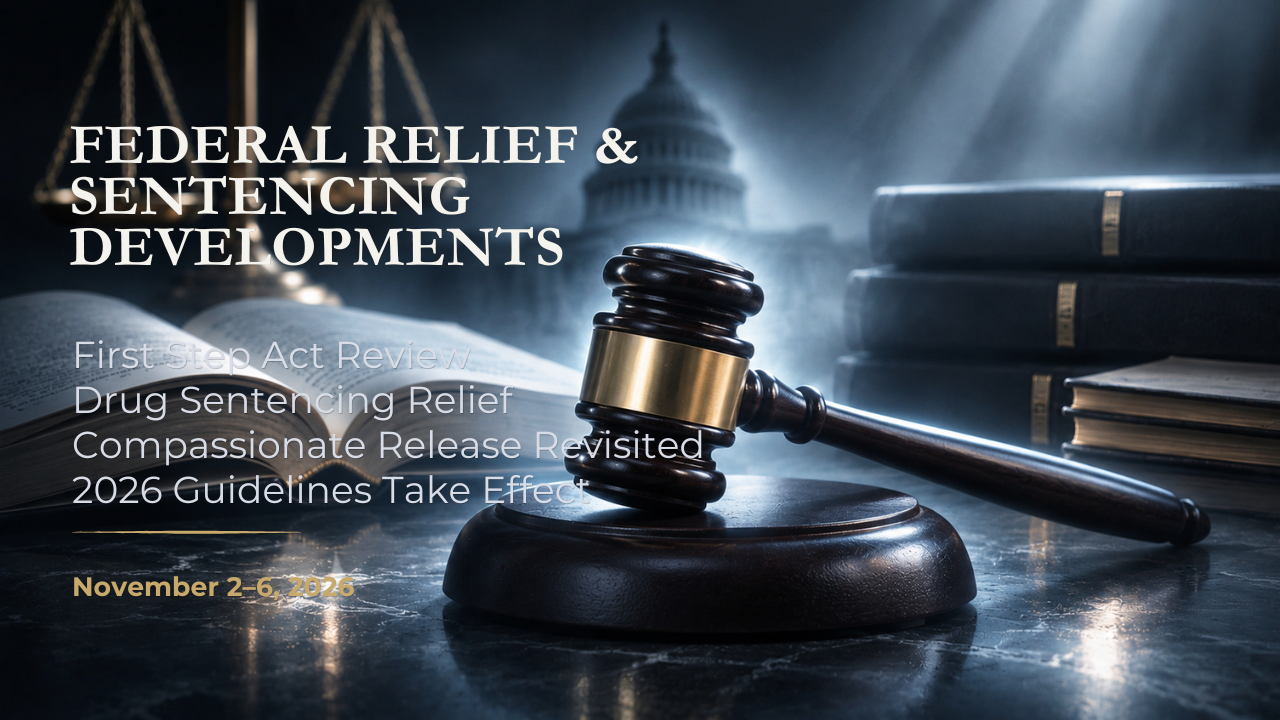
November 2026 Federal First Step Act Sentencing Developments
Federal criminal law developments from November 2–6, 2026, involving Supreme Court review of First Step Act earned-time credits, § 2241 habeas petitions, prison medical-care rights, federal sentencing enhancements, compassionate release, newly effective Sentencing Guidelines, BOP administration, and post-conviction review.
Federal Relief Developments Overview
November 2026 Federal First Step Act Sentencing Developments highlight the importance of access to judicial review, accurate sentencing calculations, and the application of current legal standards in federal post-conviction proceedings.
During November 2–6, 2026, the Supreme Court heard argument in Maxwell v. Dinis, a case addressing whether certain First Step Act earned-time-credit disputes may proceed through habeas corpus under 28 U.S.C. § 2241. The Court also prepared to hear Nielsen v. Watanabe, involving damages claims arising from allegedly inadequate medical treatment in federal custody.
In the federal courts of appeals, the Seventh Circuit ordered resentencing in Cherry v. United States after an improper drug enhancement affected statutory penalties and the advisory Guidelines calculation. The Eleventh Circuit also vacated the denial of a compassionate-release motion in United States v. Spikes because the district court applied an outdated policy statement and failed to provide sufficient reasoning.
This federal relief update is provided for educational and informational purposes only. It is not legal advice and does not create legal representation.
Supreme Court Watch
Maxwell: Supreme Court Hears First Step Act § 2241 Argument
On November 2, 2026, the Supreme Court heard oral argument in Maxwell v. Dinis, No. 25-5930.
The central issue is whether a federal prisoner may use a habeas corpus petition under 28 U.S.C. § 2241 to challenge the Bureau of Prisons’ application of First Step Act earned-time credits when seeking earlier transfer to a Residential Reentry Center or home confinement.
The Fifth Circuit determined that the requested transfer did not fall within the scope of habeas review because halfway-house placement and home confinement remain forms of federal custody.
Maxwell argues that the requested transfer represents a sufficiently significant change in custody to permit habeas review. The federal government also supports vacating the lower-court judgment, although the parties differ over the breadth of the appropriate rule.
Because both principal parties oppose the judgment below, the Supreme Court appointed an outside attorney to present arguments supporting that judgment.
During oral argument, the Justices considered whether the case could be resolved narrowly without announcing a broader rule governing challenges to prison conditions. The argument also addressed possible statutory restrictions on judicial review of particular BOP placement decisions.
Federal Relief Consideration: Access to judicial review and entitlement to earlier placement are different questions. A favorable decision could clarify whether § 2241 is an available procedural remedy without deciding whether Maxwell or any other prisoner has earned sufficient credits or satisfied the requirements for transfer.
What Maxwell Means for First Step Act Credit Disputes
Federal prisoners disputing First Step Act earned-time-credit determinations should continue maintaining clear records of their program participation, credit assessments, projected placement dates, administrative remedies, and BOP responses.
A pending Supreme Court case does not suspend applicable administrative procedures or automatically establish that an individual is entitled to earlier release.
Federal Relief Consideration: When a credit calculation or placement decision is disputed, identifying the precise BOP action, the applicable eligibility requirements, and the available administrative record may be essential to determining whether federal judicial review is possible.
Nielsen: Supreme Court to Consider Federal Prison Medical-Care Damages Claims
The Supreme Court scheduled oral argument in Nielsen v. Watanabe, No. 25-417, for November 9, 2026.
The case concerns whether a constitutional damages claim against federal prison officials involving allegedly inadequate medical treatment may proceed under the limited judicial remedy recognized in Bivens and Carlson v. Green.
The underlying allegations involve a prisoner who suffered a serious injury and contends that officials failed to provide adequate medical attention.
The Supreme Court has substantially restricted the circumstances in which courts may recognize damages remedies against federal officials without express congressional authorization.
Federal Relief Consideration: Nielsen concerns whether a damages remedy is legally available, not whether the underlying allegations establish liability. Claims involving medical treatment, prison conditions, or constitutional violations require careful identification of the correct legal remedy and applicable procedural requirements.
Seventh Circuit: Cherry and Federal Drug Sentencing Enhancements
Improper Drug Enhancement Leads to Resentencing
In Cherry v. United States, No. 21-2231, decided November 5, 2026, the Seventh Circuit granted relief under 28 U.S.C. § 2255 after determining that an improper statutory drug enhancement caused prejudice.
Cherry received a 240-month prison sentence and eight years of supervised release. The sentence reflected an enhanced statutory penalty based on a prior Illinois cocaine conviction.
Under applicable Seventh Circuit precedent, the Illinois statute covered a broader range of substances than the federal definition relevant to the enhancement. The prior conviction therefore did not qualify under the version of the federal drug statute governing Cherry’s sentencing.
The error increased the statutory minimum prison sentence, raised the statutory maximum, doubled the minimum supervised-release term, and increased the advisory career-offender Guidelines range.
The Government argued that Cherry suffered no prejudice because his actual sentence was below even the properly calculated advisory range.
The Seventh Circuit rejected that argument, explaining that an erroneous sentencing range can influence the ultimate sentence even when the sentencing judge imposes a substantial downward variance.
Federal Relief Consideration: A below-Guidelines sentence does not automatically eliminate prejudice from an erroneous enhancement. Review may need to account for the statutory minimum, statutory maximum, advisory range, supervised-release term, and whether the original judge would have imposed the same sentence under the correct framework.
Why Different Enhancements Require Separate Analysis
The Seventh Circuit did not invalidate every sentencing enhancement associated with Cherry’s prior conviction. It separately rejected his challenge to the career-offender designation under the applicable Guidelines.
A state conviction may fail to qualify under one federal statutory definition while remaining a qualifying offense under a different Guidelines provision.
The court also cautioned that an attorney’s failure to predict a later appellate decision does not automatically constitute ineffective assistance.
Federal Relief Consideration: Federal sentencing review should examine each predicate offense and enhancement separately, including the version of the applicable statute, the precise state conviction, controlling circuit law, sentencing calculations, and procedural history.
Eleventh Circuit: Spikes and Compassionate-Release Review
Compassionate-Release Denial Vacated After Use of Outdated Policy Statement
In United States v. Spikes, No. 26-10132, decided November 3, 2026, the Eleventh Circuit vacated the denial of a compassionate-release motion and remanded for further proceedings.
The district court had relied on an outdated understanding of U.S.S.G. § 1B1.13, despite the Sentencing Commission’s November 1, 2023 revisions to the compassionate-release policy statement.
The Eleventh Circuit also found that the district court’s explanation was insufficient to permit meaningful appellate review of the decision.
The appellate court did not determine that Spikes was entitled to compassionate release. Instead, it directed reconsideration using the proper legal framework and an adequate explanation.
Federal Relief Consideration: A compassionate-release denial may warrant review when the court relied on an outdated policy statement, failed to address a material change in governing law, or did not adequately explain the reasons supporting its decision.
Preparing a Renewed Compassionate-Release Motion
A renewed motion should address the actual grounds for a previous denial rather than merely repeat earlier arguments.
Important considerations include whether the court previously rejected the claimed extraordinary and compelling reasons, relied on the § 3553(a) factors, raised dangerousness concerns, or identified a procedural obstacle.
Depending on the individual circumstances, updated medical records, evidence of family needs, rehabilitation, institutional conduct, and a realistic release plan may be relevant.
Federal Relief Consideration: Spikes is an unpublished decision and does not establish binding circuit precedent. Nevertheless, it illustrates the importance of applying the correct legal standard and explaining how the current record addresses the reasons for any earlier denial.
Sentencing Commission Watch
2026 Federal Sentencing Guidelines Are Now Effective
The 2026 amendments to the United States Sentencing Guidelines became effective November 1, 2026.
The amendments address various sentencing provisions, including drug offenses, monetary thresholds, multiple-count calculations, sentencing options, and simplification of existing rules.
However, none of the amendments in the 2026 package was designated for retroactive application under U.S.S.G. § 1B1.10(d).
Accordingly, a prisoner generally cannot obtain a reduction under 18 U.S.C. § 3582(c)(2) based solely on the new amendments.
Federal Relief Consideration: The effective date of a Guideline amendment does not establish that previously imposed sentences may be reopened. A proper assessment must identify the particular amendment, whether it lowers the relevant sentencing range, and whether an available legal procedure permits its application.
Other Sentence-Reduction Pathways Remain Separate
The lack of retroactivity for the 2026 amendment package does not eliminate relief that may be available through an earlier retroactive amendment or another legally authorized procedure.
Federal Relief Consideration: Before preparing a sentence-reduction filing, review the applicable Guidelines manual, Presentence Investigation Report, Statement of Reasons, sentencing transcript, judgment, and prior post-conviction history.
BOP and First Step Act Watch
FCC Proposal Concerning Contraband Cellphones in Correctional Facilities
During the reporting period, federal communications policy discussions included a proposed approach to allowing qualifying state and local correctional facilities to use cellphone-jamming technology under specified authorization and safeguards.
Such technology raises questions about institutional security, interference with legitimate communications, equipment authorization, and the geographic reach of any permitted signal blocking.
The newsletter described an anticipated November 19, 2026 FCC consideration of the proposal.
Federal Relief Consideration: A proposed rule or announced vote is not an adopted regulation. The proposal should not be interpreted as a current nationwide requirement for federal prisons or as authorization for every institution to begin jamming cellular signals.
Documenting First Step Act Earned-Time-Credit Disputes
As the Supreme Court considers the procedural questions raised in Maxwell, accurate documentation remains essential for prisoners disputing BOP earned-time-credit calculations.
Relevant materials may include time-credit assessments, program-participation records, projected release dates, anticipated community-placement dates, administrative-remedy submissions, and written BOP decisions.
Federal Relief Consideration: A clear written record should identify the disputed calculation or eligibility determination, the correction requested, and the BOP’s response. An ongoing Supreme Court case does not replace an individual prisoner’s responsibility to preserve records and comply with applicable procedures.
Fast Screening Considerations
A case-specific review may be particularly important when the record presents any of the following issues:
- First Step Act credits appear to have been earned but not properly applied toward prerelease custody
- BOP placement or time-credit decisions may raise § 2241 procedural questions
- Administrative-remedy submissions and BOP responses reveal unresolved calculation disputes
- A federal prisoner has raised a serious constitutional medical-care damages claim
- A statutory drug enhancement was based on a prior state conviction that may not qualify
- An incorrect statutory maximum affected the career-offender Guidelines calculation
- An enhanced mandatory minimum or supervised-release term affected the sentence
- A § 2255 claim alleges ineffective assistance concerning a sentencing enhancement
- A compassionate-release denial relied on an outdated version of U.S.S.G. § 1B1.13
- A district court failed to explain the reasoning supporting denial of compassionate release
- New medical, family, or institutional evidence addresses the reasons for an earlier denial
- A federal sentence may be affected by a retroactive amendment from an earlier Guidelines cycle
- Proposed BOP or communications-policy changes are being confused with currently effective rules
What This Means for Federal Prisoners and Families
The November 2–6, 2026 developments reinforce an important distinction between identifying a legal issue and establishing eligibility for relief.
In Maxwell, the Supreme Court is considering the availability of a procedural remedy. In Cherry, a specific sentencing enhancement error was sufficiently consequential to require resentencing. In Spikes, applying an outdated legal standard required reconsideration of a compassionate-release motion.
These issues demonstrate why effective federal case review requires attention to the original conviction, sentencing calculations, governing law, procedural history, BOP records, administrative remedies, and the actual relief requested.
Why a Free Federal Case Lookup May Help
A free federal case lookup can provide an initial review of publicly available docket history, sentencing details, appellate proceedings, and related case information to help identify whether an issue may warrant closer examination.
A lookup is not a complete legal assessment and does not establish that a prisoner is entitled to relief.
When to Consider a Federal Case Assessment
Where preliminary review identifies a potentially significant issue, a more detailed federal case assessment may be appropriate.
Relevant materials may include the indictment, plea agreement, Presentence Investigation Report, Statement of Reasons, sentencing transcript, judgment, appellate decisions, prior § 2255 filings, compassionate-release orders, BOP credit calculations, administrative remedies, and other case-specific records.
The objective is to determine whether current law and the available record identify a legitimate issue for further review, while accounting for procedural requirements, applicable deadlines, and limitations on relief.
Related APEX Federal Relief Resources
- Understanding § 2241 Petitions
- First Step Act Credits
- Federal Time Credits
- BOP Administrative Remedies
- Halfway House and Home Confinement
- Understanding § 2255 Motions
- Ineffective Assistance of Counsel Claims
- § 2255 Evidentiary Hearings
- Compassionate Release
- Retroactive Guideline Amendments
- Understanding Federal Sentencing
- Federal Sentence Reduction Basics