
Latest Updates
September 2024 Federal Sentencing Appeals Developments
Supreme Court new-term timing, favorable appellate decisions involving federal-program bribery, wire fraud, loss calculation, fair-market value, and evidentiary issues for the week of September 23–27, 2024.
Federal Sentencing Developments Overview
September 2024 Federal Sentencing Appeals Developments included Supreme Court new-term preparation and several significant federal appellate decisions involving bribery, wire fraud, loss calculation, and co-conspirator evidentiary rules.
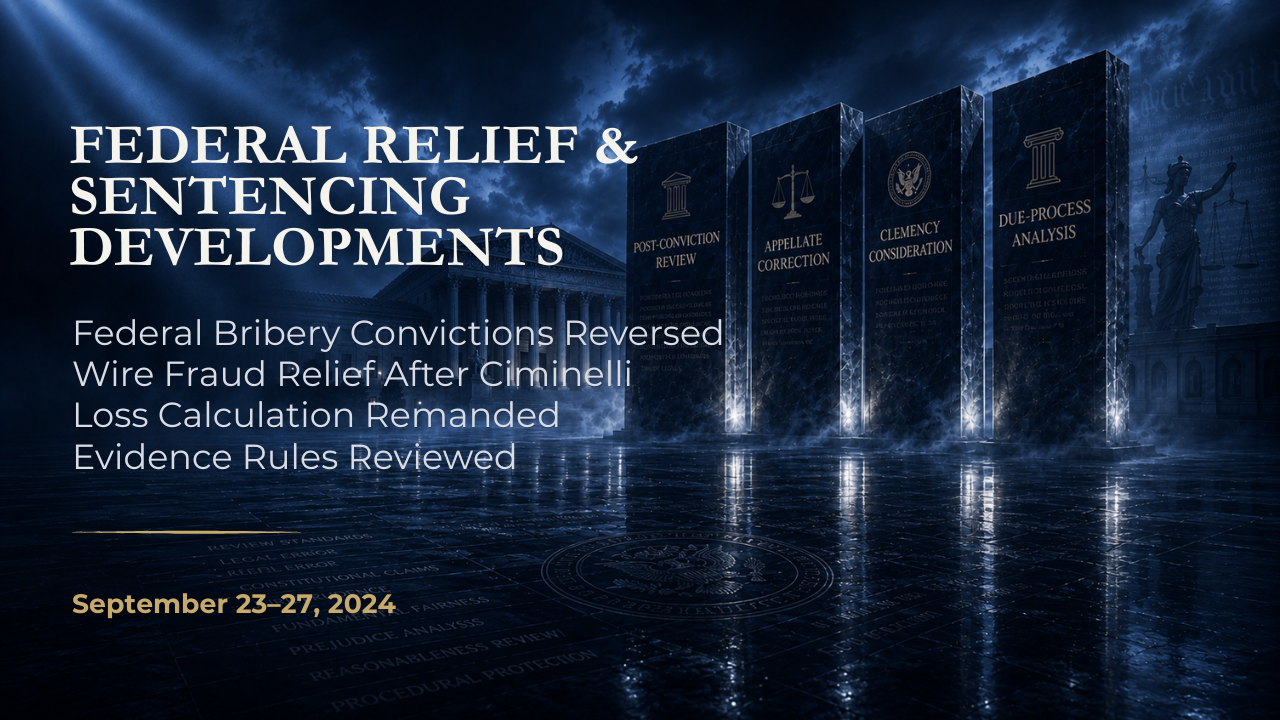
This weekly update highlights developments from September 23–27, 2024, including federal-program bribery, Hobbs Act extortion, wire fraud after Ciminelli and Percoco, fair-market-value loss calculations, and hearsay issues involving co-conspirator statements.
This federal relief update is provided for educational and informational purposes only. It is not legal advice and does not create legal representation.
Supreme Court Watch
New Term Conference Approaching
The Supreme Court remained in summer recess during the week ending September 27, 2024. The first conference of the new term was scheduled for September 30, 2024, with the new term beginning in early October.
Federal Relief Consideration: The start of a new Supreme Court term can create important issues to watch, but most case-specific relief depends on actual decisions, not merely upcoming conferences or pending petitions.
Favorable Federal Appellate Developments
First Circuit: § 666 Convictions Reversed in United States v. DeQuattro and Cromwell
In United States v. DeQuattro, No. 23-1115, the First Circuit reviewed convictions arising from an alleged bribery and extortion scheme involving casino-development work connected to the Mashpee Wampanoag Tribe.
David DeQuattro, an architect, and Cedric Cromwell, Chairman of the Mashpee Wampanoag Tribal Council and President of the Mashpee Wampanoag Gaming Authority, were charged with federal offenses involving alleged payments and benefits connected to a casino construction contract.
DeQuattro was convicted of federal-program bribery under 18 U.S.C. § 666(a)(2), and Cromwell was convicted of federal-program bribery under § 666(a)(1)(B), as well as Hobbs Act extortion counts and conspiracy. On appeal, the defendants challenged their § 666 convictions, and the government challenged the judgment of acquittal on other counts.
The First Circuit reversed the § 666 convictions and remanded for further proceedings.
Federal Relief Consideration: Federal-program bribery cases may deserve review where the proof of corrupt exchange, official action, agency relationship, or statutory elements is disputed.
Second Circuit: Wire Fraud Convictions Vacated After Ciminelli and Percoco
In United States v. Aiello, No. 18-3710, the Second Circuit revisited convictions after the Supreme Court issued decisions in Ciminelli v. United States and Percoco v. United States.
The defendants had been convicted of wire fraud, wire fraud conspiracy, and related charges connected to alleged bid-rigging and public-corruption theories. After the Supreme Court rejected the “right-to-control” theory in Ciminelli and narrowed honest-services fraud principles in Percoco, the matter returned to the Second Circuit.
In light of those Supreme Court decisions, the Second Circuit vacated the wire fraud and wire fraud conspiracy convictions and vacated Aiello’s honest-services wire fraud conspiracy conviction.
Federal Relief Consideration: Wire fraud and honest-services cases may deserve review where the government relied on right-to-control, intangible-interest, access, influence, or public-corruption theories affected by Ciminelli or Percoco.
Fifth Circuit: Loss Calculation and Fair-Market Value Error in United States v. Ritchey
In United States v. Ritchey, No. 23-60468, the Fifth Circuit vacated a sentence involving a scheme to overcharge the Department of Veterans Affairs for medical supplies during the COVID-19 pandemic.
Ritchey pleaded guilty to conspiracy to defraud the United States. His 60-month sentence depended in part on the loss amount, which was calculated using the estimated fair-market value of masks and other items sold at inflated prices.
On appeal, Ritchey argued that the district court used unrealistic benchmarks, including pre-pandemic pricing, to determine fair-market value. Because the loss calculation could significantly affect the Guidelines range, the Fifth Circuit vacated the sentence and remanded for resentencing.
Federal Relief Consideration: Economic-crime sentences may deserve review where the loss amount depends on fair-market value, unusual market conditions, pandemic pricing, government procurement, offsets, credits, or disputed valuation methods.
Important Federal Appellate Development
Eleventh Circuit: Co-Conspirator Statements and Joint Venture Evidence in United States v. Holland
In United States v. Holland, No. 22-14219, the Eleventh Circuit addressed the hearsay exclusion for statements made by co-conspirators or joint venturers.
The government alleged an illegal healthcare kickback scheme and sought to introduce out-of-court statements made by alleged co-conspirators. The district court excluded the statements after concluding that the government failed to prove the relevant criminal mental state.
The Eleventh Circuit reversed, explaining that the proponent of co-conspirator statements need not prove that the joint venture was itself unlawful. The statements may be admissible if made during and in furtherance of a joint venture that included the opposing party.
Federal Relief Consideration: Although this ruling was not defendant-favorable in the ordinary sense, it is important for trial and appeal review. Cases involving co-conspirator statements may require careful attention to hearsay objections, joint venture proof, limiting instructions, and Confrontation Clause issues.
Fast Screening Considerations
A case-specific review may be especially important where any of the following issues appear in the record:
- Federal-program bribery conviction under 18 U.S.C. § 666
- Hobbs Act extortion or official-right extortion theory
- Wire fraud conviction based on right-to-control theory
- Honest-services fraud conviction affected by Percoco
- Public-corruption or bid-rigging case affected by Ciminelli
- Economic-crime sentence driven by disputed loss amount
- Fair-market-value dispute involving unusual market conditions
- Government procurement or pandemic-pricing loss calculation
- Co-conspirator statements admitted or excluded under Rule 801(d)(2)(E)
- Healthcare kickback or joint-venture evidence issues
What This Means for Federal Prisoners and Families
The September 23–27, 2024 developments show that federal relief may turn on statutory interpretation, proof of intent, trial instructions, loss calculations, and evidentiary rulings.
In fraud and public-corruption cases, older convictions may deserve review if the government used theories later limited by the Supreme Court. In economic-crime cases, sentencing may deserve review if the loss amount was calculated using disputed or unrealistic valuation methods.
Why a Written Case Evaluation May Help
A written case evaluation can help identify whether a federal case involves § 666 issues, Hobbs Act extortion theories, wire fraud problems, Ciminelli or Percoco arguments, loss-calculation errors, fair-market-value disputes, hearsay issues, or other post-conviction remedies.
Because many federal relief arguments are highly fact-specific and circuit-specific, families should avoid relying on general rumor or broad headlines. A structured review can help determine what issues may actually be available.