
Latest Updates
October 2024 Federal Appeals Sentencing Developments
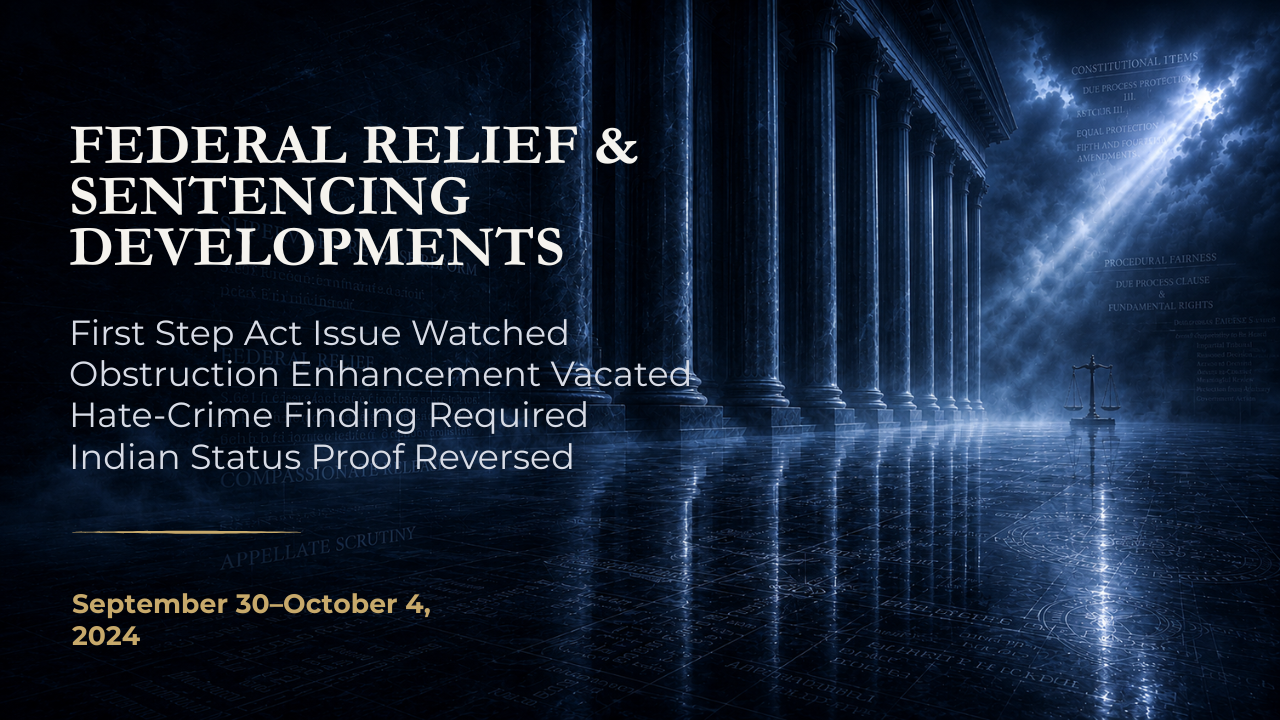
Supreme Court First Step Act resentencing watch, favorable appellate decisions involving obstruction enhancements, hate-crime motivation, Indian country jurisdiction, and federal criminal appeals screening issues for the week of September 30–October 4, 2024.
Federal Appeals Developments Overview
October 2024 Federal Appeals Sentencing Developments included Supreme Court activity involving First Step Act resentencing, new certiorari grants of criminal-law interest, and favorable appellate decisions involving sentencing enhancements and jurisdictional proof.
This weekly update highlights developments from September 30–October 4, 2024, including First Step Act § 403, § 924(c) stacking, obstruction-of-justice enhancements, hate-crime motivation enhancements, Indian country jurisdiction, and federal post-conviction screening considerations.
This federal relief update is provided for educational and informational purposes only. It is not legal advice and does not create legal representation.
Supreme Court Watch
New Term Begins and Hewitt First Step Act Issue Draws Attention
The Supreme Court held its first conference of the new term on September 30, 2024, and returned to the bench on October 7, 2024.
One criminal-law issue drawing attention was Hewitt v. United States, involving whether First Step Act § 403’s changes to § 924(c) mandatory minimums apply to people whose offenses occurred before the Act, but whose cases were later remanded for resentencing after the Act became law.
The issue mattered because federal courts had divided on whether defendants facing resentencing after vacatur could benefit from the First Step Act’s reduced § 924(c) stacking penalties.
Federal Relief Consideration: Cases involving pre-First Step Act § 924(c) stacking and resentencing after vacatur may deserve careful review, especially where the person was not yet under a final operative sentence after the First Step Act became law.
Supreme Court Grants of Criminal-Law Interest
The Court’s new-term order list included several grants with possible criminal-law or criminal-procedure significance.
Matters noted in the source update included Thompson v. United States, involving what counts as a false statement in a federal bank-fraud context; Barnes v. Felix, involving Fourth Amendment excessive-force analysis in a civil rights case; Perttu v. Richards, involving Prison Litigation Reform Act exhaustion and jury-trial procedure; and Gutierrez v. Sanz, involving post-conviction DNA testing and standing in a capital case.
Federal Relief Consideration: A Supreme Court grant identifies an issue to watch, but it does not automatically create relief. Relief usually depends on the Court’s later decision and how that decision applies to the specific record.
Favorable Federal Appellate Developments
Second Circuit: Obstruction Enhancement Vacated in United States v. Orelien
In United States v. Orelien, No. 23-6175-cr, the Second Circuit vacated a two-level obstruction-of-justice enhancement under U.S.S.G. § 3C1.1.
Orelien was convicted of Hobbs Act robbery and conspiracy to commit Hobbs Act robbery. The district court sentenced him to two concurrent 96-month terms of imprisonment followed by supervised release.
On appeal, Orelien challenged the obstruction enhancement. The Second Circuit agreed that the district court did not support the enhancement with a sufficient finding that the obstruction was intentional. The court vacated the enhancement and remanded for further proceedings.
Federal Relief Consideration: Obstruction enhancements require clear findings. If the sentencing court did not make sufficient findings of intentional obstruction, the enhancement may deserve review.
Ninth Circuit: Hate-Crime Motivation Enhancement Vacated in United States v. Patterson
In United States v. Patterson, No. 22-50287, the Ninth Circuit vacated a sentence involving the hate-crime motivation enhancement under U.S.S.G. § 3A1.1.
Patterson pleaded guilty to Hobbs Act robbery and identity theft. He met the victim through Grindr and later took the victim’s phone and used it to withdraw money from the victim’s bank accounts.
The Ninth Circuit concluded that application of the enhancement required a finding beyond a reasonable doubt that the defendant was motivated by hate or animus. Because the district court did not make that finding, the panel vacated and remanded for resentencing.
Federal Relief Consideration: Hate-crime motivation enhancements require careful record review. A protected characteristic may be relevant to victim selection, but the enhancement may require proof of hate or animus depending on the circuit and guideline interpretation.
Tenth Circuit: Indian Status Evidence Reversed in United States v. Harper
In United States v. Harper, No. 23-5091, the Tenth Circuit reversed convictions and remanded after finding error in the admission of a verification letter used to prove Harper’s Indian status.
Harper was convicted of kidnapping and assault in Indian country. Federal jurisdiction depended on proof that Harper qualified as Indian under federal law. Harper argued that the district court improperly admitted a Choctaw Nation verification letter as hearsay and that the letter did not qualify as a business record.
The Tenth Circuit found merit in the evidentiary issue, reversed the convictions and sentence, and remanded for further proceedings.
Federal Relief Consideration: Indian country cases may deserve review where jurisdiction depended on tribal-status proof, hearsay documents, business-record foundations, or verification letters prepared for litigation.
Fast Screening Considerations
A case-specific review may be especially important where any of the following issues appear in the record:
- Pre-First Step Act § 924(c) stacking sentence followed by resentencing after vacatur
- First Step Act § 403 issue involving whether reduced penalties apply at resentencing
- Obstruction enhancement under U.S.S.G. § 3C1.1 without specific intent findings
- Hate-crime motivation enhancement under U.S.S.G. § 3A1.1
- Sentence increased based on alleged protected-characteristic targeting
- Indian country conviction requiring proof of Indian status
- Jurisdictional evidence based on tribal verification letters or hearsay documents
- Post-conviction DNA testing or standing issues
- False-statement issues in federal bank-fraud cases
- Fourth Amendment excessive-force or procedural issues being watched at the Supreme Court
What This Means for Federal Prisoners and Families
The September 30–October 4, 2024 developments show why Supreme Court grants and appellate decisions both matter. A pending Supreme Court case may signal a future issue, while circuit decisions may already create immediate screening questions for certain cases.
These developments also show that sentencing relief may depend on detailed records. Enhancements, jurisdictional proof, and § 924(c) stacking issues often require review of the indictment, plea agreement, presentence report, sentencing transcript, jury instructions, and appellate history.
Why a Written Case Evaluation May Help
A written case evaluation can help identify whether a federal case involves First Step Act § 403 issues, § 924(c) stacking, obstruction-enhancement errors, hate-crime enhancement problems, Indian country jurisdiction, evidentiary issues, or other post-conviction remedies.
Because many federal relief arguments are highly fact-specific and circuit-specific, families should avoid relying on general rumor or broad headlines. A structured review can help determine what issues may actually be available.