
Latest Updates
November 2024 Federal Clemency Relief Developments
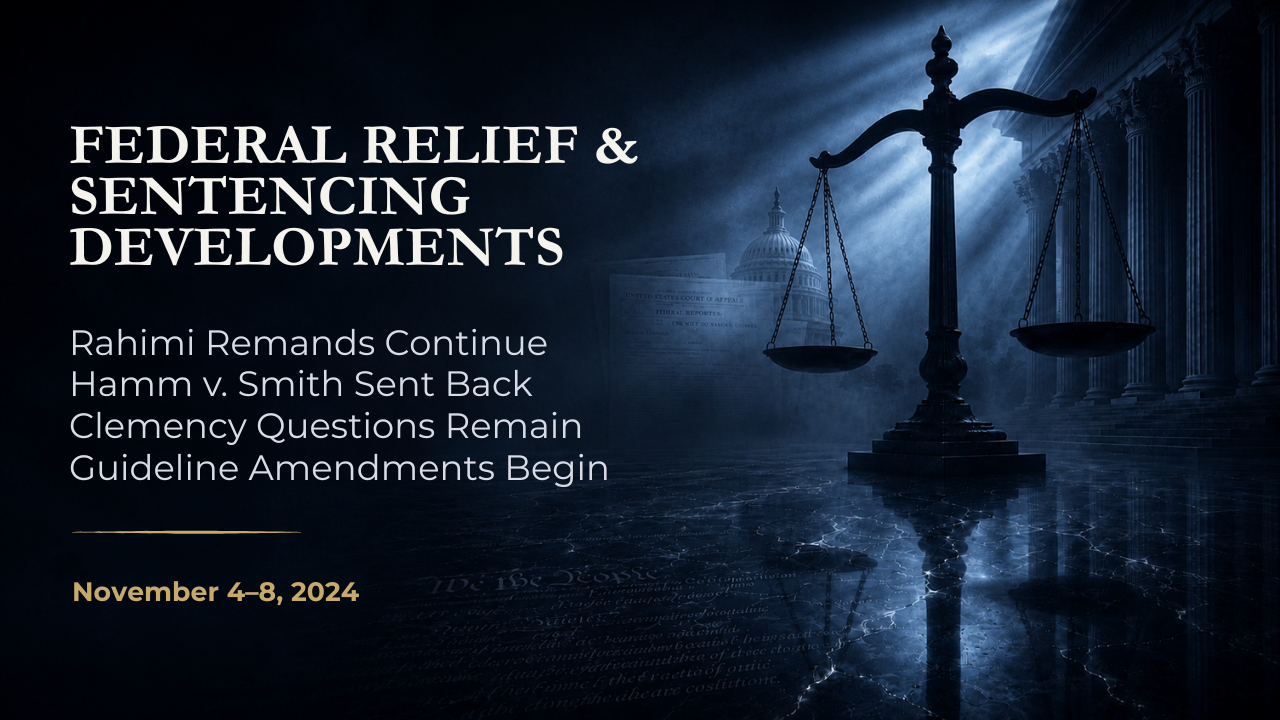
Supreme Court Rahimi remands, Hamm v. Smith death-penalty review, federal clemency discussion, BOP relief statistics, and sentencing guideline amendment considerations for the week of November 4–8, 2024.
Federal Relief Developments Overview
November 2024 Federal Clemency Relief Developments included Supreme Court activity involving Second Amendment firearm cases, death-penalty intellectual-disability review, federal clemency questions, BOP relief statistics, and sentencing guideline amendments that became effective November 1, 2024.
This weekly update highlights developments from November 4–8, 2024, including Rahimi-related remands, Hamm v. Smith, presidential clemency, compassionate release, First Step Act releases, home confinement, and federal sentencing guideline screening considerations.
This federal relief update is provided for educational and informational purposes only. It is not legal advice and does not create legal representation.
Supreme Court Watch
November 8 Conference and Rahimi-Related Criminal Remands
The Supreme Court held its November 8, 2024 conference, with orders expected the following week because of the federal holiday.
The Court also released an order list that included multiple criminal cases granted, vacated, and remanded for further consideration in light of United States v. Rahimi. These GVR orders showed that Second Amendment issues after Rahimi remained active in the lower courts.
Federal Relief Consideration: Firearm cases involving § 922(g), Second Amendment challenges, domestic-violence restraining orders, nonviolent prior convictions, or as-applied constitutional arguments may require careful circuit-specific review after Rahimi.
Hamm v. Smith: Intellectual Disability and Death-Penalty Review
In Hamm v. Smith, the Supreme Court issued a per curiam order involving the death sentence of Joseph Clifton Smith. The district court had vacated Smith’s death sentence after concluding that he was intellectually disabled under Atkins v. Virginia.
Smith had received multiple full-scale IQ scores ranging from 72 to 78. His intellectual-disability claim depended in part on whether his IQ could be treated as 70 or below after accounting for the standard error of measurement.
The Supreme Court vacated the Eleventh Circuit’s judgment and remanded for further consideration because the basis of the Eleventh Circuit’s analysis was unclear.
Federal Relief Consideration: Death-penalty cases involving intellectual-disability claims, IQ scores, standard error of measurement, adaptive functioning, or Atkins issues require detailed record review and highly specialized legal analysis.
Favorable Federal Appellate Developments
No New Favorable Federal Circuit Opinions Identified This Week
No new favorable federal circuit opinions were identified for the week of November 4–8, 2024.
Federal Relief Consideration: Weeks without favorable circuit opinions can still include important federal relief developments through Supreme Court orders, guideline amendments, BOP statistics, clemency activity, and pending cases.
Federal Clemency Watch
President Biden’s Clemency Legacy and Future Clemency Questions
Federal clemency remained an important topic during the final months of President Biden’s term. Clemency includes pardons and commutations and is separate from court-based relief such as direct appeals, § 2255 motions, § 2241 petitions, compassionate release, or sentence-reduction motions.
President Biden had already taken several notable clemency actions before this period, including proclamation-based relief involving certain federal marijuana possession offenses and certain former service members convicted under military law for consensual private conduct that is no longer criminalized.
The future of federal clemency also became a major public issue after the 2024 presidential election, particularly because President-elect Donald Trump had discussed possible pardons for some individuals convicted in connection with January 6, 2021.
Federal Relief Consideration: Clemency is discretionary and politically sensitive, but it may be relevant where a person has strong rehabilitation, reentry, medical hardship, family hardship, sentencing disparity, unusually long sentence, or public-safety factors.
BOP Relief Statistics Snapshot
The source update also identified Bureau of Prisons statistics available at that time, including:
- Fair Sentencing and retroactive sentence reductions: 4,149 orders granted
- Elderly Offender Home Confinement: 1,246 approved
- First Step Act releases: 39,672 granted
- Compassionate release and sentence reductions: 4,764 granted
- Residential Reentry Center population: 8,355
- Home confinement population: 4,985
Federal Relief Consideration: BOP and sentence-reduction statistics can show how often certain forms of relief are being used, but they do not determine whether relief is available in any specific case.
Sentencing Guideline Amendment Watch
The 2024 U.S. Sentencing Guideline amendments became effective on November 1, 2024. Topics included acquitted conduct, loss calculation, circuit conflicts, youthful individuals, and miscellaneous guideline changes.
Federal Relief Consideration: Guideline amendments do not automatically create relief for every federal prisoner. A case-specific review is needed to determine whether an amendment affects the guideline calculation, whether retroactivity applies, and whether a procedural vehicle exists.
Fast Screening Considerations
A case-specific review may be especially important where any of the following issues appear in the record:
- § 922(g) conviction affected by Second Amendment arguments after Rahimi
- Firearm conviction involving nonviolent prior convictions or as-applied constitutional challenges
- § 924(c) conviction affected by predicate-offense litigation
- Death-penalty case involving intellectual disability or Atkins claims
- Sentence affected by acquitted conduct
- Loss calculation affecting the advisory Guidelines range
- Youthful-offender facts affecting criminal-history or sentencing analysis
- Compassionate-release interest based on medical, family, age, rehabilitation, or disparity factors
- First Step Act, home confinement, or BOP custody-related issues
- Clemency interest based on rehabilitation, hardship, public safety, or unusually harsh sentence
What This Means for Federal Prisoners and Families
The November 4–8, 2024 developments show that federal relief can arise from several different sources: Supreme Court orders, guideline amendments, BOP statistics, clemency policy, and post-conviction litigation.
These developments also show why careful screening matters. A headline about Rahimi, clemency, guideline amendments, or BOP releases does not automatically mean relief applies. The answer depends on the conviction, sentence, circuit, record, procedural posture, and available legal remedy.
Why a Written Case Evaluation May Help
A written case evaluation can help identify whether a federal case involves Second Amendment firearm issues, § 924(c) predicate concerns, guideline-amendment questions, compassionate-release factors, BOP custody issues, clemency considerations, or post-conviction remedies.
Because many federal relief arguments are highly fact-specific and circuit-specific, families should avoid relying on general rumor or broad headlines. A structured review can help determine what issues may actually be available.