
Latest Updates
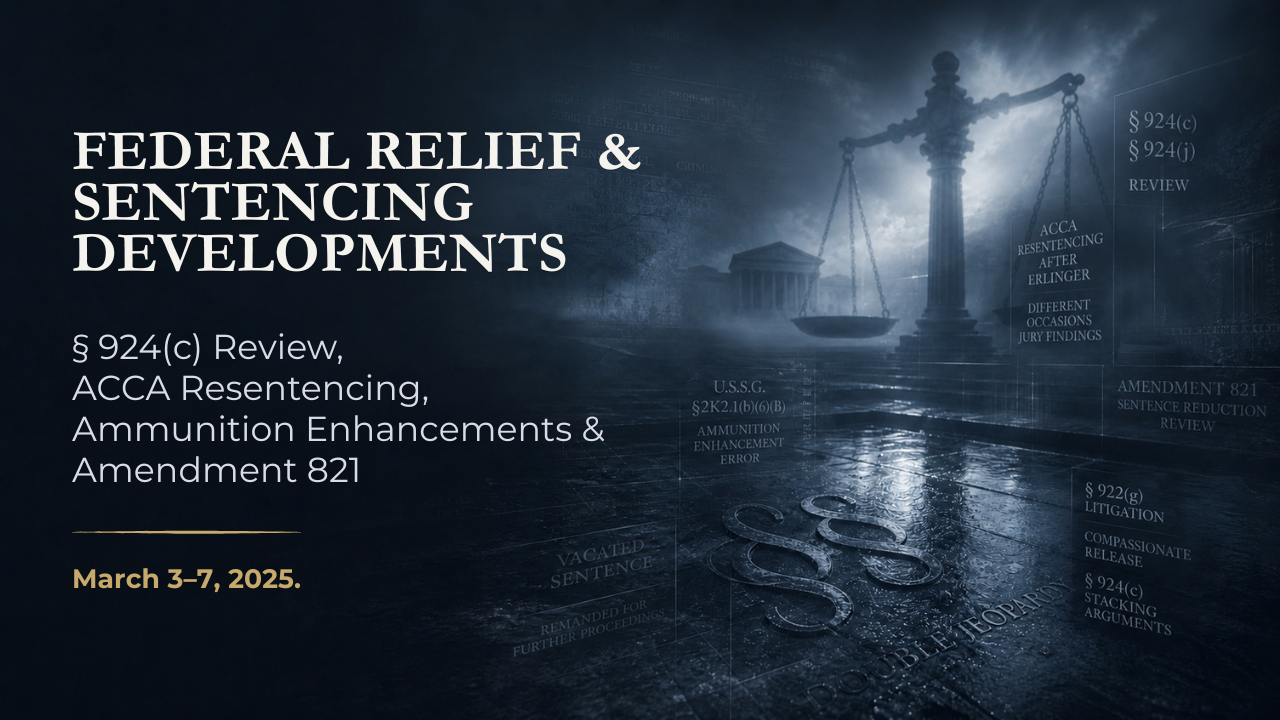
Federal Relief & Sentencing Developments — March 3–7, 2025
Supreme Court review of § 924(c) and § 924(j), ammunition enhancement errors, ACCA resentencing after Erlinger, Amendment 821 review, § 922(g) firearm litigation, and compassionate release developments.
This federal sentencing developments bulletin reviews recent Supreme Court activity and federal appellate decisions affecting sentencing enhancements, Armed Career Criminal Act findings, Amendment 821 reductions, firearm convictions, and federal relief strategy.
Federal Sentencing Developments Executive Summary
Recent federal sentencing developments include Supreme Court review in Barrett v. United States, involving whether the Double Jeopardy Clause permits two sentences for one act that violates both 18 U.S.C. § 924(c) and § 924(j).
This update also reviews favorable appellate decisions involving ammunition-related guideline enhancements, ACCA different-occasions findings after Erlinger, Amendment 821 sentence-reduction review, § 922(g) firearm litigation, and compassionate release arguments involving older stacked § 924(c) sentences.
Supreme Court Watch
Double Jeopardy, § 924(c) & § 924(j) — Barrett v. United States
In Barrett v. United States, the Supreme Court granted review of whether the Double Jeopardy Clause permits two separate sentences for a single act that violates both 18 U.S.C. § 924(c) and § 924(j).
The issue had divided multiple federal circuits and may affect firearm-related sentencing where overlapping statutory provisions were used to impose multiple punishments.
Federal Relief Consideration: Cases involving both § 924(c) and § 924(j) may require review for potential double-jeopardy, multiple-punishment, and sentencing-stacking issues depending on the indictment, plea agreement, verdict, and sentencing record.
Favorable Federal Appellate Decisions
Ammunition Enhancement Error — Fifth Circuit
In United States v. Cisneros, the Fifth Circuit vacated a sentence after finding plain error in the application of U.S.S.G. § 2K2.1(b)(6)(B).
The sentencing enhancement was based on possession of ammunition in connection with another felony offense. The appellate court concluded that the record did not show the ammunition facilitated, or had the potential to facilitate, another felony offense.
Federal Relief Consideration: Firearm and ammunition enhancements may require review where the government relied on proximity alone, especially where ammunition was present without a firearm and the record does not show facilitation of another felony.
ACCA Different-Occasions Finding After Erlinger — Sixth Circuit
In United States v. Cogdill, the Sixth Circuit vacated an Armed Career Criminal Act sentence after reconsideration in light of Erlinger v. United States.
The sentencing judge had determined that prior drug offenses occurred on different occasions. After Erlinger, that finding must be made by a jury, not the judge, when it increases the statutory penalty.
Federal Relief Consideration: ACCA sentences may require review where a judge made the different-occasions finding instead of a jury, especially where harmless-error arguments are disputed.
Amendment 821 Sentence Reduction Review — Sixth Circuit
In United States v. Erker, the Sixth Circuit remanded so the district court could consider the defendant’s eligibility for a sentence reduction under Amendment 821.
Federal Relief Consideration: Amendment 821 may affect certain defendants depending on criminal history score, zero-point offender status, status points, prior record, guideline calculations, and whether the amendment changes the applicable sentencing range.
Related resource: Understanding Federal Sentencing
§ 922(g) Firearm Litigation & Compassionate Release
Federal courts continued addressing Second Amendment challenges involving § 922(g) firearm convictions, especially where prior convictions were nonviolent or non-drug-related.
Several circuits also continued allowing courts to consider nonretroactive § 403(a) changes to old stacked § 924(c) sentences as part of compassionate release analysis when combined with other individualized factors.
Federal Relief Consideration: Firearm and compassionate release arguments depend on the specific record. Prior convictions, offense conduct, sentencing history, rehabilitation, medical issues, family circumstances, and current circuit law may all matter.
Related resource: Compassionate Release
Why These Federal Sentencing Developments Matter
These developments show how federal relief issues may arise from § 924(c) and § 924(j) sentencing overlap, ammunition-related enhancements, ACCA different-occasions findings, Amendment 821 eligibility, § 922(g) firearm litigation, and compassionate release law.
Federal relief analysis is highly case-specific. Indictments, plea agreements, verdict forms, sentencing transcripts, guideline worksheets, prior conviction records, and appellate history may all affect whether a development applies.