
Latest Updates
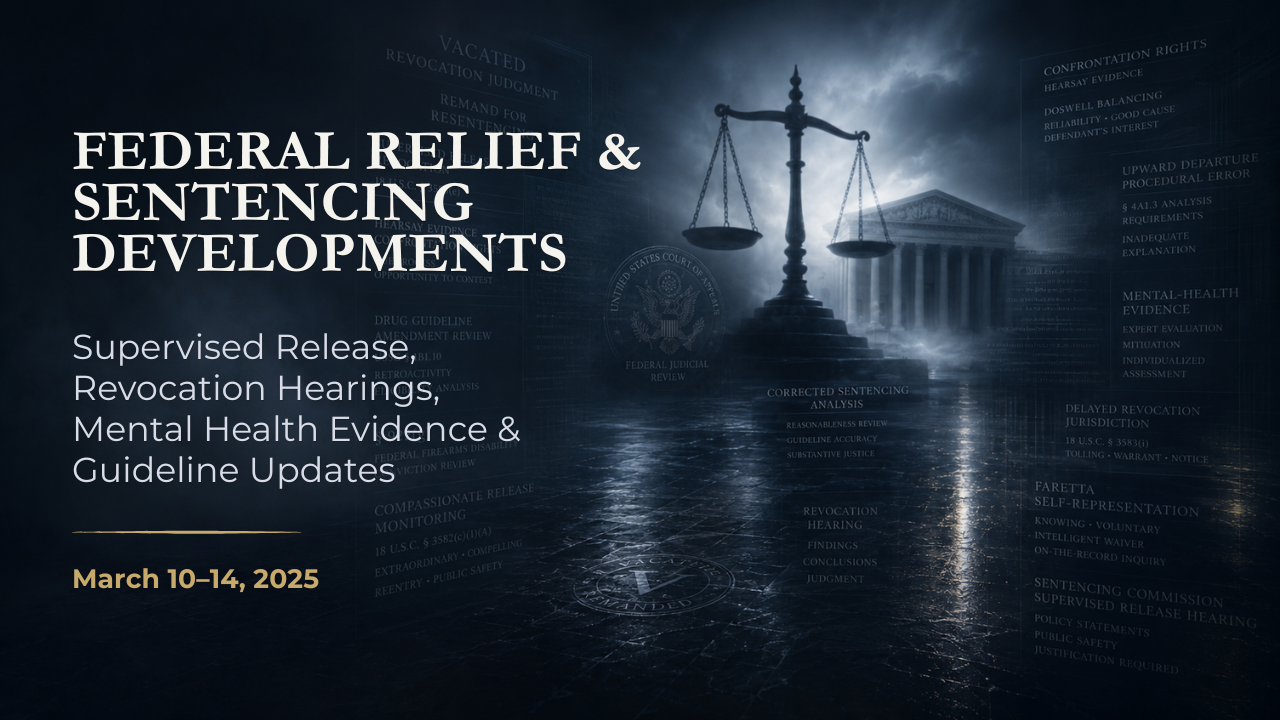
Federal Relief & Sentencing Developments — March 10–14, 2025
Supervised release revocation challenges, hearsay confrontation rights, upward departure sentencing errors, revocation jurisdiction limits, Faretta inquiry issues, Sentencing Commission hearings, and federal relief considerations.
This federal sentencing developments bulletin reviews recent appellate decisions and federal sentencing updates affecting supervised release, sentencing procedure, firearm cases, compassionate release, and post-conviction review.
Federal Sentencing Developments Executive Summary
Recent federal sentencing developments include appellate decisions involving supervised release revocation, confrontation rights at revocation hearings, upward departure procedure, mental-health evidence at sentencing, delayed revocation jurisdiction, and self-representation rights.
This update also reviews Sentencing Commission activity involving proposed amendments to the federal sentencing guidelines related to supervised release and drug offenses.
Supreme Court Watch
The Supreme Court released an order list from its March 7, 2025 conference, with no major criminal-law developments reported during this period. The next conference was scheduled for March 21, 2025.
Federal Relief Consideration: Even when Supreme Court activity is limited, circuit-level decisions may create important arguments involving sentencing procedure, supervised release, revocation hearings, and federal post-conviction review.
Favorable Federal Appellate Decisions
Supervised Release Revocation & Hearsay Evidence — Fourth Circuit
In United States v. Wheeler, the Fourth Circuit vacated a supervised release revocation judgment after concluding that the district court improperly admitted hearsay evidence without properly applying the required confrontation balancing test.
The court emphasized that before hearsay evidence is admitted at a revocation hearing, the court must balance the releasee’s confrontation interest against the government’s good cause for not producing the witness.
Federal Relief Consideration: Revocation proceedings may require review where the government relied on hearsay evidence, unavailable witnesses, police summaries, probation reports, or alleged victim statements without adequate confrontation analysis.
Upward Departure, Mental Health Evidence & Sentencing Procedure — Fourth Circuit
In United States v. Nixon, the Fourth Circuit vacated a sentence that more than doubled the advisory guideline range after finding multiple procedural errors.
The sentencing court relied heavily on violent conduct that occurred while the defendant was awaiting sentencing, failed to properly apply criminal history departure rules, skipped required intermediate criminal history categories, and disregarded unrebutted expert mental-health evidence without adequate explanation.
Federal Relief Consideration: Sentencing records may require review where the court imposed a major upward departure or variance, relied on dissimilar conduct, skipped required guideline steps, or rejected expert mental-health evidence without explanation.
Related resource: Understanding Federal Sentencing
Delayed Revocation Hearing & Jurisdiction — Tenth Circuit
In United States v. Gulley, the Tenth Circuit vacated a revocation judgment after concluding that the district court lacked authority to revoke an expired term of supervised release.
The issue involved 18 U.S.C. § 3583(i), which allows revocation after expiration only if a warrant or summons issued before expiration and the delay was reasonably necessary.
The appellate court concluded that the delay was not reasonably necessary and remanded with instructions to release the defendant from custody.
Federal Relief Consideration: Supervised release cases may require review where the revocation hearing occurred after supervision expired, especially if the delay was lengthy or not clearly justified.
Faretta Inquiry & Self-Representation at Sentencing — Eleventh Circuit
In United States v. Davis, the Eleventh Circuit vacated a sentence and remanded for the district court to conduct an appropriate Faretta inquiry regarding the defendant’s right to self-representation at sentencing.
Federal Relief Consideration: Self-representation issues may support relief where a defendant clearly invoked the right to represent himself and the court failed to conduct a proper inquiry into whether the waiver of counsel was knowing, voluntary, and intelligent.
Sentencing Commission Hearing Developments
The U.S. Sentencing Commission held a public hearing to receive testimony on proposed amendments to the federal sentencing guidelines involving supervised release and drug offenses.
Federal Relief Consideration: Sentencing Commission activity may affect future guideline amendments, supervised release practices, drug offense calculations, and potential later sentence-reduction arguments depending on final amendment language and retroactivity decisions.
§ 922(g) Firearm Litigation & Compassionate Release
Federal litigation continued involving § 922(g) firearm convictions, especially where prior convictions were nonviolent or non-drug-related.
Several circuits also continued allowing courts to consider nonretroactive § 403(a) changes to old stacked § 924(c) sentences as part of compassionate release analysis when combined with other individualized factors.
Federal Relief Consideration: Firearm and compassionate release arguments depend on the specific record, including prior convictions, offense conduct, sentencing history, rehabilitation, medical issues, family circumstances, and current circuit law.
Related resource: Compassionate Release
Why These Federal Sentencing Developments Matter
These developments show how federal relief issues may arise from revocation hearing procedures, hearsay confrontation rights, upward departure errors, mental-health evidence, delayed revocation jurisdiction, self-representation issues, and Sentencing Commission guideline activity.
Federal relief analysis is highly case-specific. Revocation petitions, hearing transcripts, sentencing records, expert reports, guideline worksheets, supervision dates, warrants, summonses, and appellate history may all affect whether a development applies.