
Latest Updates
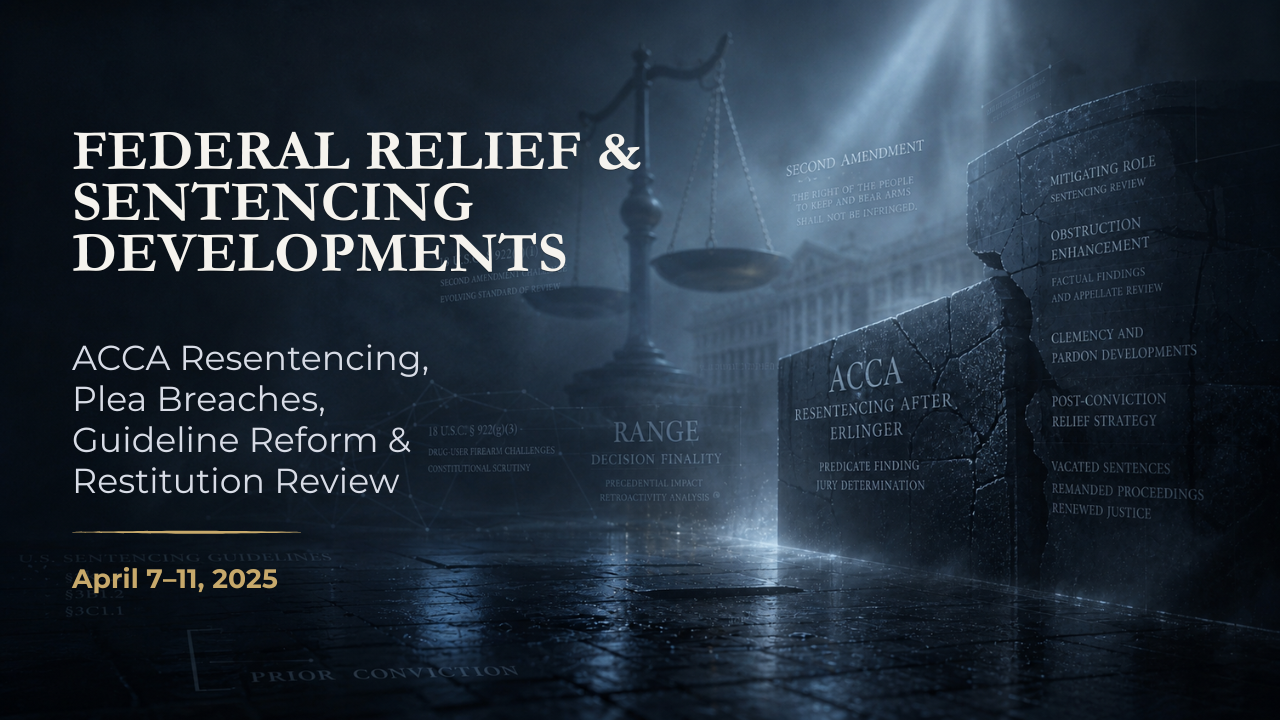
Federal Relief & Sentencing Developments — April 7–11, 2025
Supreme Court grants involving restitution and Sixth Amendment counsel rights, ACCA resentencing, plea agreement breach, Sentencing Commission amendments, supervised release reform, and federal sentencing guideline updates.
This federal sentencing developments bulletin reviews recent Supreme Court activity, appellate sentencing decisions, federal guideline amendments, and federal relief considerations affecting post-conviction review.
Federal Sentencing Developments Executive Summary
Recent federal sentencing developments include Supreme Court grants involving restitution under the Mandatory Victim Restitution Act and Sixth Amendment attorney-client communication during trial recesses.
This update also reviews First Circuit decisions involving ACCA resentencing and government breach of a plea agreement, along with major Sentencing Commission amendments involving guideline simplification, supervised release reform, drug offenses, firearms offenses, and possible future retroactivity review.
Supreme Court Watch
Restitution & Ex Post Facto Review — Ellingburg v. United States
In Ellingburg v. United States, the Supreme Court agreed to review whether restitution imposed under the Mandatory Victim Restitution Act may violate the Ex Post Facto Clause when it increases punishment.
Federal Relief Consideration: Restitution issues may require review where a restitution order depends on post-offense legal changes, disputed loss calculations, or whether restitution operates as punishment in a particular case.
Attorney-Client Communication During Trial — Villarreal v. Texas
In Villarreal v. Texas, the Supreme Court agreed to review whether a court violates the Sixth Amendment by preventing a defendant and lawyer from discussing the defendant’s testimony during an overnight recess.
Federal Relief Consideration: Restrictions on attorney-client communication during trial may affect direct appeal or post-conviction claims involving counsel access, trial fairness, and Sixth Amendment rights.
Immigration Enforcement & Judicial Review — Noem v. Garcia
In Noem v. Garcia, the Supreme Court addressed judicial authority involving a person mistakenly removed from the United States despite a prior protection order.
Federal Relief Consideration: Immigration-related proceedings may affect federal case analysis where removal, immigration status, collateral consequences, or agency error intersects with criminal history or custody concerns.
Favorable Federal Appellate Decisions
ACCA Resentencing & Prior Conviction Review — First Circuit
In Rodriguez-Mendez v. United States, the First Circuit ruled that a robbery conviction under Article 173B did not qualify as a violent felony under the Armed Career Criminal Act.
The defendant’s ACCA-enhanced sentence was reversed and the case was remanded for resentencing.
Federal Relief Consideration: ACCA sentences may require review where prior convictions were treated as violent felonies under outdated or incorrect categorical-approach analysis.
Plea Agreement Breach & Resentencing — First Circuit
In United States v. Maldonado-Maldonado, the First Circuit vacated a sentence after the government conceded that it breached the plea agreement.
The breach involved advocating for a greater injury enhancement than the plea agreement contemplated, implicitly supporting a harsher guideline, failing to request the agreed sentence, and failing to object to the presentence report’s recommendation.
The case was remanded for expedited resentencing before a different district judge.
Federal Relief Consideration: Plea agreement breach issues may support relief where the government advocates for enhancements, guideline theories, or sentencing outcomes inconsistent with its promises.
Related resource: Understanding § 2255 Motions
Sentencing Commission Amendment Developments
The U.S. Sentencing Commission unanimously approved significant amendments to the federal sentencing guidelines, with an expected effective date of November 1, 2025, unless Congress disapproves them.
Guideline Simplification
The amendment package included broad guideline simplification, including removal of numerous departure provisions that became less central after Booker made the Guidelines advisory.
Federal Relief Consideration: Simplification amendments may affect future sentencing arguments, guideline presentation, and how courts structure guideline analysis.
Supervised Release Reform
The amendments included provisions encouraging a more individualized and evidence-based approach to supervised release.
Federal Relief Consideration: Supervised release conditions and revocation responses may require review where they were imposed automatically or without individualized analysis.
Drug & Firearm Offense Reforms
The Commission addressed drug and firearm guideline issues, including fentanyl-laced counterfeit pills, role-based drug sentencing considerations, and machinegun conversion devices.
Federal Relief Consideration: Drug and firearm guideline changes may affect future sentencing strategy, especially where offense level calculations were driven heavily by drug type, quantity, role, or firearm-specific conduct.
Possible Retroactivity Review
The Commission also voted to conduct a retroactivity impact analysis for selected drug and circuit-conflict reforms.
Federal Relief Consideration: Retroactivity decisions may determine whether already-sentenced individuals can seek sentence reductions under 18 U.S.C. § 3582(c)(2).
Related resource: Understanding Federal Sentencing
Why These Federal Sentencing Developments Matter
These developments show how federal relief issues may arise from restitution questions, attorney-client communication restrictions, ACCA predicate analysis, plea agreement breaches, sentencing guideline amendments, supervised release reform, and possible retroactivity.
Federal relief analysis is highly case-specific. Plea agreements, sentencing transcripts, PSRs, prior conviction records, restitution orders, guideline worksheets, and appellate history may all affect whether a development applies to a particular case.