
Latest Updates
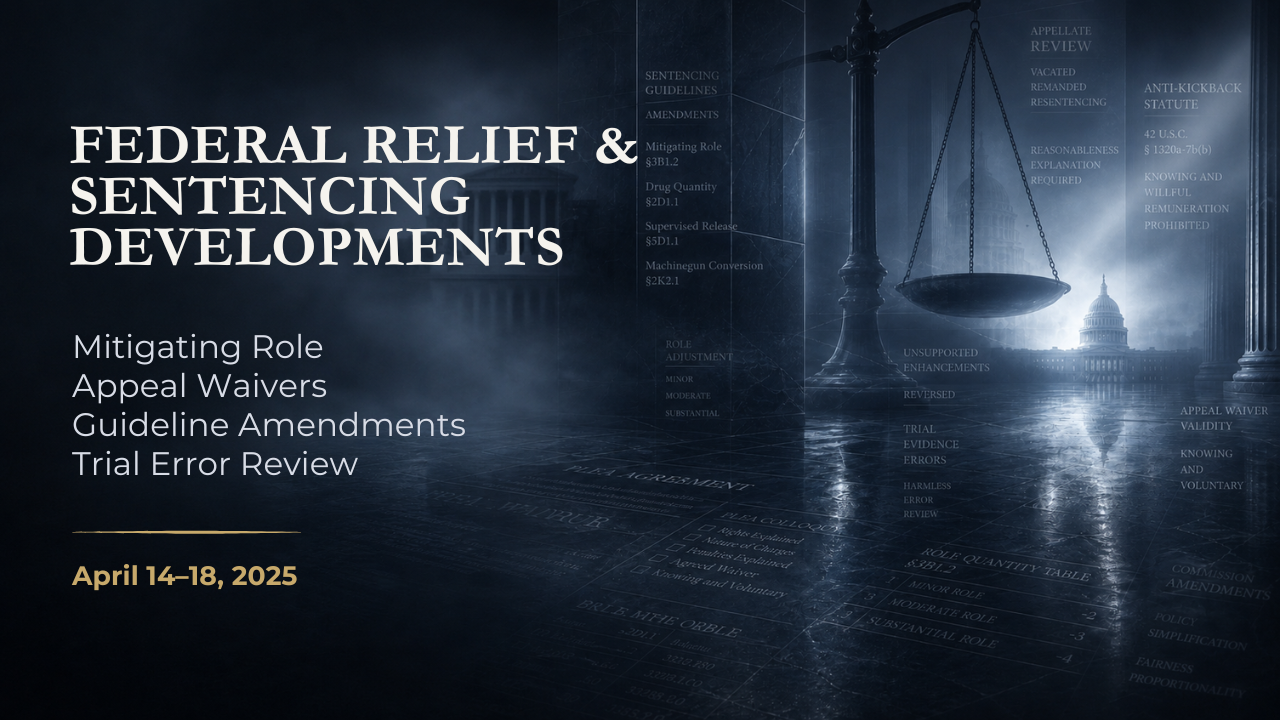
Federal Relief & Sentencing Developments — April 14–18, 2025
Supreme Court birthright citizenship activity, mitigating role sentencing, invalid appeal waivers, sentencing enhancement challenges, trial evidence errors, Anti-Kickback Act limits, and Sentencing Commission amendment updates.
This federal sentencing developments bulletin reviews recent appellate decisions and federal relief considerations involving sentencing guidelines, post-conviction review, trial errors, federal healthcare fraud statutes, and proposed guideline amendments.
Federal Sentencing Developments Executive Summary
Recent federal sentencing developments include appellate decisions involving mitigating role reductions, invalid appeal waivers, inadequate sentencing explanations, improper sentencing enhancements, evidentiary trial errors, and limits on federal Anti-Kickback Act prosecutions.
This update also reviews proposed Sentencing Commission amendments involving supervised release reforms, drug offense guideline changes, firearms offenses, sentencing simplification, and circuit-conflict resolution.
Supreme Court Watch
Birthright Citizenship Emergency Applications
At its April 17 conference, the Supreme Court agreed to hear emergency applications involving the federal government’s attempt to change birthright citizenship policy.
Federal Relief Consideration: Although the birthright citizenship issue is not a sentencing case, Supreme Court emergency-docket activity may affect immigration-related consequences, citizenship litigation, federal jurisdiction questions, and collateral consequences in some federal cases.
Favorable Federal Appellate Decisions
Mitigating Role Sentencing Review — First Circuit
In United States v. Guia-Sendeme, the First Circuit remanded for resentencing after concluding that the district court needed to reconsider whether the defendant qualified for a mitigating role adjustment under U.S.S.G. § 3B1.2.
Federal Relief Consideration: Mitigating role arguments may be important for couriers, transporters, lookouts, low-level participants, or defendants whose role was limited compared to the broader offense conduct.
Appeal Waiver & Sentencing Explanation — Fourth Circuit
In United States v. Smith, the Fourth Circuit vacated a sentence after finding that the appeal waiver was invalid and the sentence was procedurally unreasonable.
The court found that the sentencing proceeding was rushed, the district court failed to address mitigation, and resentencing before a different judge was required.
Federal Relief Consideration: Appeal waivers do not always bar review. Sentencing transcripts should be reviewed where the court failed to explain the sentence, ignored mitigation arguments, or did not ensure the waiver was knowing and voluntary.
Sentencing Enhancement Challenge — Fourth Circuit
In United States v. Avila, the Fourth Circuit vacated a sentence after concluding that the government failed to prove facts necessary to support a sentencing enhancement under U.S.S.G. § 2G2.2(c)(1).
Federal Relief Consideration: Sentencing enhancements require factual support. Guideline enhancements may be challengeable where the government did not prove the conduct necessary for the enhancement.
Trial Evidence Error & New Trial — Sixth Circuit
In United States v. Sadrinia, the Sixth Circuit reversed a conviction involving unlawful opioid prescribing after concluding that the trial court improperly admitted unrelated bad-act evidence.
Federal Relief Consideration: Trial errors involving unrelated bad-act evidence, unfair prejudice, intent evidence, or improper propensity evidence may support appellate or post-conviction review depending on the record.
Anti-Kickback Statute Limits — Seventh Circuit
In United States v. Sorenson, the Seventh Circuit reversed a conviction after concluding that the government stretched the Anti-Kickback Statute beyond the evidence presented.
The court found that payments to advertisers and manufacturers, rather than healthcare providers, did not support the charged theory.
Federal Relief Consideration: Healthcare fraud and Anti-Kickback cases may require careful review of statutory elements, payment structure, recipient identity, referral theory, and whether the government proved the specific prohibited conduct.
Sentencing Commission Amendment Developments
Supervised Release Reforms
The Sentencing Commission considered reforms encouraging courts to take a more individualized approach to supervised release rather than applying it automatically.
Federal Relief Consideration: Supervised release issues may require review where conditions, revocation responses, or supervision terms were imposed without individualized analysis.
Drug Offense Guideline Revisions
Proposed drug guideline changes included greater focus on a defendant’s function within the trafficking operation, including low-level roles such as couriers, lookouts, errands, communications, or limited distribution.
The amendments also included a mitigating role cap for certain drug offense calculations.
Federal Relief Consideration: Drug guideline amendments may affect future sentencing arguments for defendants whose role was limited and whose guideline range was driven heavily by drug quantity rather than actual culpability.
Firearms Offenses & Sentencing Simplification
The proposed amendments also addressed machinegun conversion devices and simplification of sentencing procedures, along with efforts to resolve circuit conflicts.
Federal Relief Consideration: Firearms guideline changes and sentencing simplification may affect future guideline calculations, enhancement disputes, and sentencing consistency across districts.
Why These Federal Sentencing Developments Matter
These developments show how federal relief issues may arise from mitigating role errors, invalid appeal waivers, inadequate sentencing explanations, unsupported enhancements, improper trial evidence, healthcare fraud theories, and evolving guideline amendments.
Federal relief analysis is highly case-specific. Sentencing transcripts, plea agreements, guideline worksheets, trial records, enhancement findings, role evidence, and appellate history may all affect whether a development applies to a particular case.