
Latest Updates
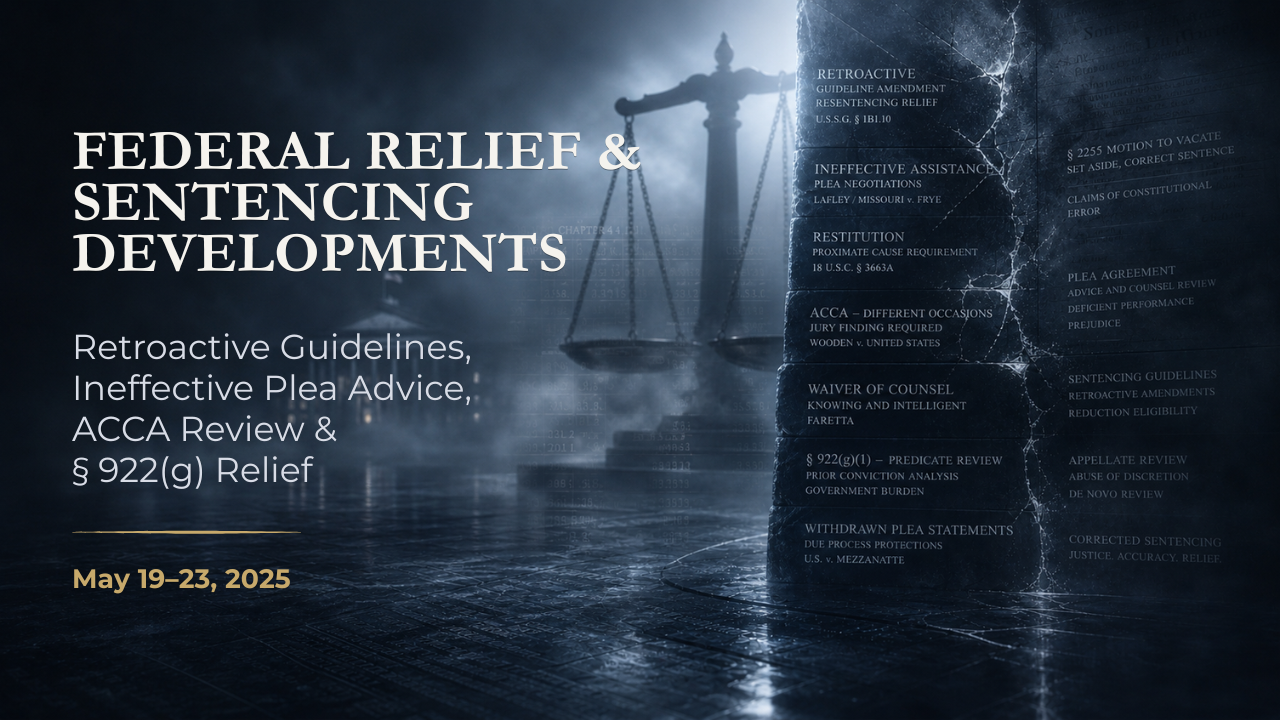
Federal Relief & Sentencing Developments — May 19–23, 2025
Federal appellate decisions involving retroactive guideline amendments, ineffective plea advice, restitution errors, ACCA jury-finding requirements, waiver of counsel, § 922(g) prior-conviction issues, and withdrawn plea statements.
This federal sentencing developments bulletin reviews recent appellate decisions affecting post-conviction relief, sentencing reductions, plea negotiations, restitution, Armed Career Criminal Act enhancements, and federal firearm convictions.
Federal Sentencing Developments Executive Summary
Recent federal sentencing developments include multiple appellate wins involving resentencing under retroactive guideline amendments, ineffective assistance during plea negotiations, restitution errors, ACCA sentencing issues after Erlinger, and Sixth Amendment self-representation concerns.
This update also reviews important decisions involving § 922(g)(1) prior-conviction requirements and the improper use of withdrawn plea statements at trial.
Supreme Court Watch
The Supreme Court held its May 22, 2025 conference, with orders expected the following week. During this reporting period, federal circuit courts continued issuing decisions affecting sentencing, post-conviction relief, firearm convictions, and plea-related litigation.
Federal Relief Consideration: Circuit decisions may create important review opportunities involving sentencing errors, ineffective assistance, plea agreements, restitution, ACCA enhancements, and federal firearm convictions.
Favorable Federal Appellate Decisions
Retroactive Guideline Amendment & Resentencing — Third Circuit
In United States v. Martinez, the Third Circuit vacated a sentence and remanded for resentencing in light of a retroactive Sentencing Guidelines amendment affecting certain first-time offenders.
The court concluded that when a defendant may seek relief under 18 U.S.C. § 3582(c)(2), the appellate court may use its authority under 28 U.S.C. § 2106 to vacate and remand where doing so promotes fairness and judicial economy.
Federal Relief Consideration: Retroactive guideline amendments may affect sentence reduction eligibility, especially where a person qualifies for a reduced guideline range under a later amendment.
Tax Conspiracy Enhancement Error — Third Circuit
In United States v. Lucidonio, the Third Circuit vacated a sentence involving a tax conspiracy enhancement under U.S.S.G. § 2T1.9(b)(2).
The court rejected a narrow interpretation of “encourage” but found that the government failed to prove the enhancement applied to conduct involving individuals beyond co-conspirators.
Federal Relief Consideration: Sentencing enhancements must be supported by evidence meeting the applicable guideline requirements. Tax and fraud enhancements may require close review of the conduct, participants, and scope of the scheme.
Ineffective Assistance During Plea Negotiations — Fourth Circuit
In United States v. Brown, the Fourth Circuit reversed the denial of relief after finding prejudice from ineffective assistance during plea negotiations.
The defendant rejected a plea deal after receiving erroneous advice about sentencing exposure. The appellate court concluded there was a reasonable probability that he would have accepted the plea if properly advised.
The court remanded and required the government to re-offer the same plea agreements.
Federal Relief Consideration: Ineffective assistance claims may be important where counsel gave incorrect sentencing advice, failed to explain plea exposure, or caused a defendant to reject a favorable plea offer.
Related resource: Understanding § 2255 Motions
Restitution & Proximate Cause — Fifth Circuit
In United States v. West, the Fifth Circuit vacated a restitution order after finding that the presentence report relied on inapplicable statutes and the district court failed to conduct the required proximate-cause analysis.
Federal Relief Consideration: Restitution orders may be challengeable where the court relied on the wrong statute, failed to connect losses to the offense, or did not conduct the required causation analysis.
ACCA Different-Occasions Finding After Erlinger — Sixth Circuit
In United States v. Kimbrough, the Sixth Circuit vacated ACCA-enhanced sentences after finding that the judge, rather than a jury, made the “different occasions” finding required for Armed Career Criminal Act sentencing.
The court concluded that the Erlinger error was not harmless and remanded for further proceedings.
Federal Relief Consideration: ACCA sentences may require review where a judge made the different-occasions finding that increased the mandatory minimum instead of submitting that issue to a jury.
Waiver of Counsel & Self-Representation — Eighth Circuit
In United States v. Pitts, the Eighth Circuit vacated convictions after finding that the district court failed to give the constitutionally required warnings before allowing the defendant to represent himself at trial.
The appellate court concluded that the record did not show a knowing and intelligent waiver of counsel.
Federal Relief Consideration: Self-representation issues may support relief where the court failed to explain the risks of proceeding without counsel or failed to confirm that waiver of counsel was knowing and intelligent.
§ 922(g)(1) Prior-Conviction Requirement — Tenth Circuit
In United States v. Davis, the Tenth Circuit reversed a § 922(g)(1) conviction after concluding that the defendant’s prior Colorado conviction did not qualify as a crime punishable by more than one year in prison.
Because the record of conviction did not allow for a sentence above Colorado’s one-year presumptive maximum, the prior offense did not satisfy the federal firearm statute’s prior-conviction requirement.
Federal Relief Consideration: § 922(g)(1) cases may require careful review of whether the prior conviction legally qualifies as punishable by more than one year under the applicable state sentencing framework.
Withdrawn Plea Statements & Due Process — Tenth Circuit
In United States v. Wilson, the Tenth Circuit reversed a conviction after the government used statements from a withdrawn plea agreement at trial without a judicial finding that the defendant breached the plea agreement.
The court concluded that using the plea admissions without a hearing and breach finding violated due process and was not shown to be harmless.
Federal Relief Consideration: Plea-statement protections may be important where the government used withdrawn plea statements, admissions, or cooperation-related statements at trial without satisfying required procedural safeguards.
Why These Federal Sentencing Developments Matter
These developments show how federal relief issues may arise from retroactive guideline amendments, plea advice errors, restitution analysis, ACCA findings, self-representation warnings, § 922(g) predicate issues, and improper use of plea statements.
Federal relief analysis is highly case-specific. Plea offers, sentencing transcripts, PSRs, prior conviction records, restitution records, trial transcripts, waiver-of-counsel colloquies, and appellate history may all affect whether a development applies to a particular case.