
Latest Updates
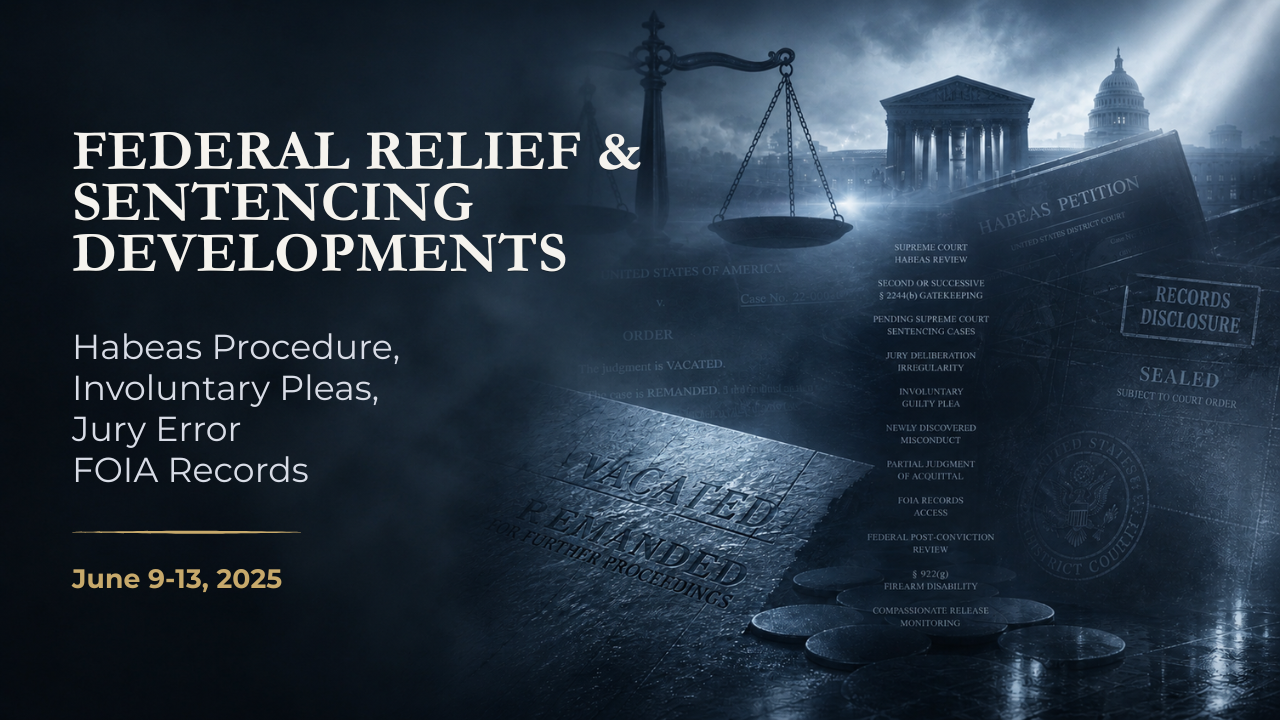
Federal Relief & Sentencing Developments — June 9–13, 2025
Supreme Court habeas procedure, pending federal sentencing decisions, jury-deliberation error, involuntary plea relief, industrial-safety conviction review, FOIA records access, and federal appellate decisions affecting post-conviction strategy.
This federal sentencing developments bulletin reviews recent Supreme Court and appellate activity involving habeas filings, suppression-related plea issues, trial fairness, military records access, and federal relief considerations.
Federal Sentencing Developments Executive Summary
Recent federal sentencing developments include a Supreme Court ruling addressing when a second-in-time habeas filing qualifies as “second or successive” under AEDPA after a district court has entered judgment on the first habeas petition.
This update also reviews federal appellate decisions involving jury-deliberation irregularities, newly discovered misconduct affecting plea voluntariness, partial conviction relief, FOIA records access, and continued monitoring of pending Supreme Court sentencing cases.
Supreme Court Watch
Habeas Procedure & Second-or-Successive Filings — Rivers v. Guerrero
In Rivers v. Guerrero, the Supreme Court addressed how to classify a second-in-time habeas filing when the first habeas petition has already been denied by the district court but remains under appellate review.
The Court held that, in general, once the district court has entered judgment on the first habeas petition, a later habeas application qualifies as second or successive and is subject to AEDPA’s gatekeeping requirements.
Federal Relief Consideration: Habeas timing and successive-petition rules are highly technical. People pursuing habeas relief should carefully review filing posture, appellate status, authorization requirements, and whether a later filing may be treated as second or successive.
Related resource: Understanding § 2255 Motions
Pending Supreme Court Sentencing Cases
The Supreme Court continued to hold several closely watched federal sentencing cases, including Hewitt v. United States and Esteras v. United States.
Hewitt involved First Step Act sentencing questions tied to pre-Act § 924(c) sentences, while Esteras involved supervised release revocation and which sentencing factors courts may consider.
Federal Relief Consideration: These pending decisions may affect resentencing, supervised release revocation, compassionate release, and post-conviction arguments involving older § 924(c) sentencing structures.
Favorable Federal Appellate Decisions
Jury Deliberation Error & Trial Fairness — First Circuit
In United States v. Matta-Quiñones, the First Circuit vacated convictions and remanded for a new trial after concluding that the government’s case agent improperly participated as a presence during jury deliberations.
Because the supervised release revocation sentence was based on those convictions, that sentence was also vacated and remanded for resentencing.
Federal Relief Consideration: Trial fairness issues may arise where government agents, witnesses, or unauthorized individuals have improper access to jury deliberations or otherwise affect the jury process.
Newly Discovered Misconduct & Involuntary Plea — Fourth Circuit
In United States v. Garrett, the Fourth Circuit vacated a guilty plea after newly discovered information revealed alleged police misconduct and disclosure-related issues that affected the defendant’s ability to understand the case before pleading guilty.
The court concluded that a reasonable defendant in the same position would not have pleaded guilty had all relevant information been known.
Federal Relief Consideration: Guilty pleas may be challengeable where later-discovered police misconduct, prosecution disclosure problems, or integrity issues would have materially affected the decision to plead guilty.
Industrial-Safety Prosecution & Partial Judgment of Acquittal — Seventh Circuit
In United States v. Clark and Mesner, the Seventh Circuit reviewed convictions arising from a fatal industrial explosion and related federal workplace-safety prosecution.
The appellate court vacated one conviction as to one defendant and remanded for entry of a judgment of acquittal and further proceedings.
Federal Relief Consideration: Complex regulatory and workplace-safety prosecutions may require careful review of jury instructions, evidentiary rulings, indictment theory, sufficiency of the evidence, and constitutional arguments.
FOIA Records Access & Military Proceeding Records — D.C. Circuit
In Rudometkin v. United States, the D.C. Circuit reversed in part in a FOIA case involving records related to military judicial disciplinary and appointment issues.
The court concluded that the government had not shown it released all reasonably segregable, non-exempt material under FOIA Exemption 5 and remanded for further proceedings.
Federal Relief Consideration: FOIA and records-access litigation may matter where disciplinary records, appointment records, investigative files, or government-held documents could affect review of a conviction, sentence, or proceeding.
§ 922(g) Firearm Litigation & Compassionate Release Considerations
Recent federal litigation continued highlighting potential relief pathways involving certain § 922(g) firearm convictions and compassionate release arguments based on non-retroactive sentencing reforms.
Federal Relief Consideration: Firearm-related post-conviction arguments and compassionate release motions remain highly individualized. Prior convictions, offense facts, procedural history, rehabilitation, sentencing records, and circuit law all matter.
Related resource: Compassionate Release
Why These Federal Sentencing Developments Matter
These developments show how federal relief issues may arise from habeas procedure, second-or-successive filing rules, jury-deliberation problems, involuntary pleas, newly discovered misconduct, partial acquittals, FOIA access, and pending Supreme Court sentencing decisions.
Federal relief analysis is highly case-specific. Plea records, suppression history, discovery disclosures, jury-deliberation issues, FOIA records, military records, sentencing transcripts, and habeas filing history may all affect whether a development is relevant to a particular case.