
Latest Updates
Federal Relief & Sentencing Developments — July 28–August 8, 2025
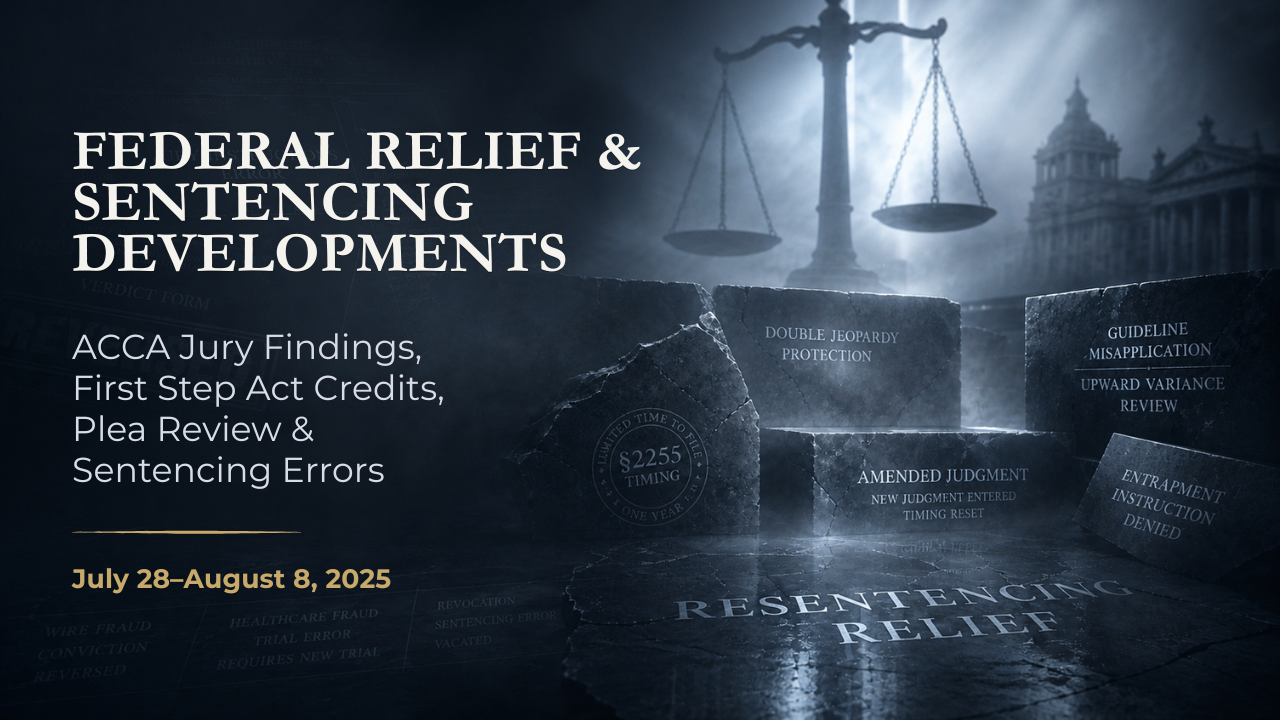
Federal appellate victories involving wire fraud, healthcare fraud, revocation sentencing, double jeopardy, § 2255 timing, sentencing guideline errors, upward variances, entrapment instructions, and resentencing relief.
This federal sentencing developments bulletin reviews recent appellate decisions affecting federal relief strategy, post-conviction review, jury-instruction challenges, habeas litigation, sentencing procedure, and conviction reversals.
Federal Sentencing Developments Executive Summary
Recent federal sentencing developments include multiple appellate decisions vacating convictions, reversing sentences, ordering new trials, restarting § 2255 timing, and remanding cases for resentencing based on legal and procedural errors.
These developments may affect federal case review involving jury instructions, wire fraud property theories, healthcare fraud intent, double jeopardy, revocation sentencing, restitution-related amended judgments, guideline selection, upward variances, and entrapment defenses.
Supreme Court Watch
The Supreme Court remained in summer recess during this reporting period, but federal circuit courts continued issuing decisions that may affect federal inmates, families, and post-conviction litigation.
Federal Relief Consideration: Circuit-level appellate decisions can create important arguments involving sentencing error, ineffective assistance, habeas review, § 2255 timing, trial errors, and post-conviction relief.
Favorable Federal Appellate Decisions
Wire Fraud, Property Rights & Jury Instructions — Second Circuit
In United States v. Chastain, the Second Circuit vacated wire fraud and money laundering convictions after concluding that the district court misinstructed the jury.
The jury instruction allowed conviction based on misappropriation of an intangible interest that was not tied to property rights, which affected the verdict.
Federal Relief Consideration: Wire fraud convictions may require careful review where the government relied on unclear property theories, intangible interests, or jury instructions that did not properly define the required property interest.
Healthcare Fraud, Intent & Exculpatory Evidence — Sixth Circuit
In United States v. Singh, the Sixth Circuit vacated healthcare fraud convictions after finding multiple reversible errors involving jury instructions, excluded state-of-mind evidence, and lay testimony about medical necessity.
The court concluded that the combined errors were not harmless and remanded the case for further proceedings.
Federal Relief Consideration: Fraud cases may present appellate issues where the court misdefined intent, excluded exculpatory evidence, or permitted improper opinion testimony on technical or medical issues.
Revocation Sentencing & § 3553(a) Factors — Sixth Circuit
In United States v. Hoyle, the Sixth Circuit reversed a supervised release revocation sentence after concluding that the district court relied on sentencing factors that did not apply to the revocation proceeding.
Federal Relief Consideration: Revocation sentences may require review where the court relied on improper § 3553(a) factors, imposed unsupported punishment, or failed to apply the correct statutory framework.
Double Jeopardy & Improper Mistrial — Seventh Circuit
In Green v. Milwaukee County Circuit Court, the Seventh Circuit found a double jeopardy violation after a defendant was retried following a mistrial that lacked manifest necessity.
The court reversed and remanded with instructions to issue an unconditional writ.
Federal Relief Consideration: Double jeopardy issues may arise where a mistrial was declared without proper legal basis and the government later retried the defendant.
§ 2255 Timing & Amended Judgments — Seventh Circuit
In Lee v. United States, the Seventh Circuit held that an amended judgment adding restitution restarted the one-year limitations period for filing a § 2255 motion.
The court reversed the dismissal of the § 2255 motion as untimely and remanded for further proceedings.
Federal Relief Consideration: § 2255 timing may require careful review where an amended judgment changed restitution, sentence terms, supervised release, or other judgment components.
Related resource: Understanding § 2255 Motions
Civil Rights Litigation & Appointment of Counsel — Eighth Circuit
In Smith v. Walker, the Eighth Circuit vacated summary judgment after finding that the district court abused its discretion by denying counsel to a pro se plaintiff with a credibility-based civil rights claim and limited access to evidence or legal resources.
Federal Relief Consideration: Appointment-of-counsel issues may be important where a pro se litigant faces complex credibility disputes, limited access to evidence, or meaningful barriers to presenting claims.
Sentencing Guideline Misapplication — Eighth Circuit
In United States v. Womack, the Eighth Circuit vacated a sentence after concluding that the district court applied the wrong sentencing guideline provision.
The court held that the higher guideline provision required additional jury findings that had not been made.
Federal Relief Consideration: Sentencing guideline errors may support resentencing where the court applied an incorrect base offense level or relied on facts not properly found by the jury.
Upward Variance & Sentencing Explanation — Tenth Circuit
In United States v. Guevara-Lopez, the Tenth Circuit vacated an above-guideline sentence after finding that the district court imposed the statutory maximum without adequate justification under § 3553(a).
Federal Relief Consideration: Upward variances may be challengeable where the court fails to provide sufficient explanation, relies on unsupported reasoning, or imposes a sentence greater than necessary.
Entrapment Instruction & Right to Present a Defense — Tenth Circuit
In United States v. Spradley, the Tenth Circuit reversed a conviction after concluding that the defendant was entitled to an entrapment jury instruction.
The court remanded for a new trial where the jury could consider the entrapment defense.
Federal Relief Consideration: Trial error may exist where the court refused a legally supported defense instruction, including entrapment, good faith, involuntary intoxication, or other state-of-mind defenses.
Offshore Disclosure, Tax Issues & Sentencing Findings — Eleventh Circuit
In United States v. Gyetvay, the Eleventh Circuit vacated and remanded for resentencing after concluding that the district court failed to make necessary factual findings involving whether property served as the object of the offense.
Federal Relief Consideration: Sentencing findings must be supported by the record. Missing or inadequate factual findings may support resentencing where guideline calculations, offense-object determinations, or financial-loss issues are disputed.
Related resource: Understanding Federal Sentencing
Why These Federal Sentencing Developments Matter
These developments show how federal relief issues may arise from jury instructions, fraud theories, double jeopardy, amended judgments, § 2255 timing, revocation sentencing, guideline selection, upward variances, and defense instructions.
Federal relief analysis is highly case-specific. Trial transcripts, jury instructions, sentencing transcripts, judgments, amended judgments, plea agreements, guideline worksheets, appeal records, and prior filings may all affect whether a development is relevant to a particular case.